
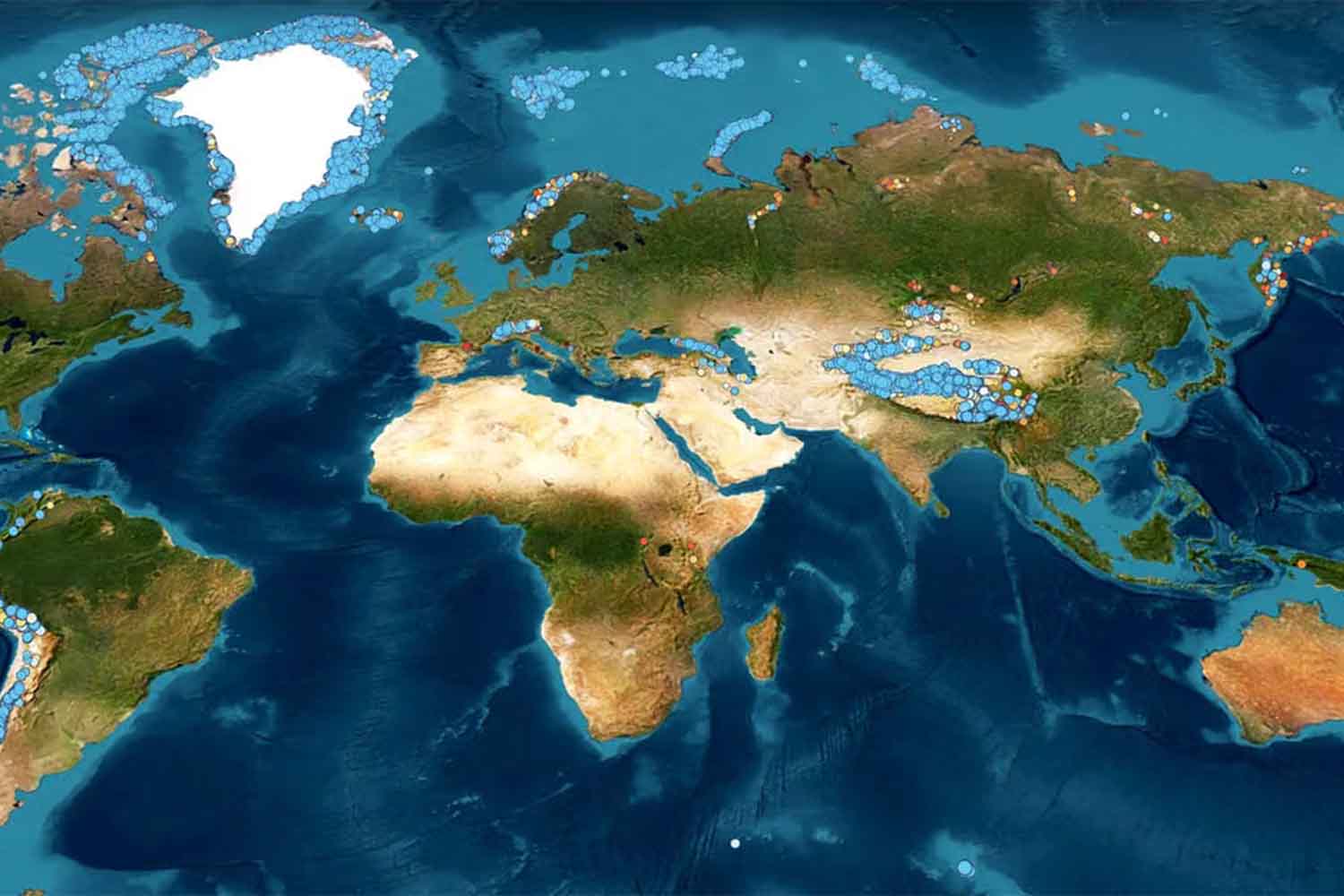
In August the Bella Tola glacier, near Saint-Luc, Switzerland, was declared extinct after almost completely disappearing. The models had assigned him a rather precise window: between 2026 and 2029. That’s how it went. Now the same calculation, fortunately still on paper, can be done with over 200 thousand glaciers on the planet. Just look for one on the map and change the level of global warming.
It is called Global Glacier Extinction Explorer and is the new platform developed starting from the work of researchers from ETH Zurich and Vrije Universiteit Brussel. For each glacier it shows area, altitude and above all an estimate of the year in which it could disappear under four scenarios: +1.5 °C, +2 °C, +2.7 °C and +4 °C compared to the pre-industrial era. It’s not a giant diary with the date of the ice funeral. It’s a model projection, with uncertainty ranges, and it changes quite a bit as you move the thermometer.
How the glacier map works
Behind the playable part of the site is a study published on Nature Climate Changewhich followed the possible fate of the glaciers contained in the Randolph Glacier Inventory 6.0. There are more than 200 thousand and they are simulated through three global models, GloGEM, OGGM and PyGEM, combined with different climate models.
To establish when a glacier can be considered “disappeared,” the researchers set two concrete thresholds: a surface area of less than 0.01 square kilometers or less than 1% of the initial volume. For each, a median year of disappearance is then calculated together with the dispersion between the different simulations. And here it is necessary to keep the calendar with a certain lightness: dimensions, altitude, geometry and local climatic conditions make it impossible to know today the exact year in which a single glacier will cease to exist.
There is also another interesting limitation. The models follow the glaciers as they were cataloged in the reference inventory, around 2000, and do not simulate their fragmentation. A large glacier that breaks into multiple ice bodies therefore continues to be treated as a single entity. Even the overall count depends on the ability of the inventories to identify the smallest bodies: for this reason the authors themselves invite us to consider the number of glaciers with greater caution than measures such as mass and surface area.
By mid-century we could lose thousands of glaciers every year
The data that comes out of the monitor is less easy to ignore. With warming limited to 1.5°C, the number of glaciers set to disappear each year would peak around 2041, with around 2,000 annual extinctions. In the +4 °C scenario the peak slips towards the mid-1950s and doubles: around 4,000 glaciers lost in a single year.
After the peak the pace would slow, but only because a huge portion of the most vulnerable glaciers would already have disappeared. At the end of the century, almost half of those considered today in the +1.5 °C scenario would remain; at +2.7 °C approximately 20% would survive; at +4 °C it would drop below 10%, less than 20 thousand.
The difference between the scenarios appears directly on the map. You select a level of warming, and the fate of the glacier itself can shift by years or decades. It is probably the most effective part of the tool: it transforms “a few tenths of a degree” from a number inserted into a graph to a piece of landscape that remains or disappears.
In the Alps, over half of the glaciers could disappear within twenty years
In the European Alps the calendar runs faster. The region is full of small glaciers, which react quickly to changing temperatures: according to the study, more than half could disappear in the next two decades. Here the peak of extinctions generally arrives by 2040 and, for smaller glaciers, some of the simulated losses may have already occurred.
Extending our gaze to 2100, the Vrije Universiteit Brussel reports an even rougher estimate: around 110 glaciers would remain in the European Alps with a warming of 2.7 °C and just around twenty with +4 °C.
2026 is already offering some very concrete evidence of what the final phase looks like. Definitive observations of the Alpine summer are still in progress, but the first data indicate a particularly heavy year, after little snow in winter and several heat waves. In addition to Bella Tola, the small Urirotstock glacier, also in Switzerland, was also declared extinct this summer. An extreme season can deliver the final blow; behind it, however, there are decades of accumulated mass loss.
The new map makes this story almost uncomfortably local. You can search for a valley, approach the mountain, click on the ice and move the climate scenario. The date that appears remains an estimate, not an appointment. The direction, however, is much less blurry. Bella Tola, meanwhile, has already gone from projection to the list of the extinct.
