
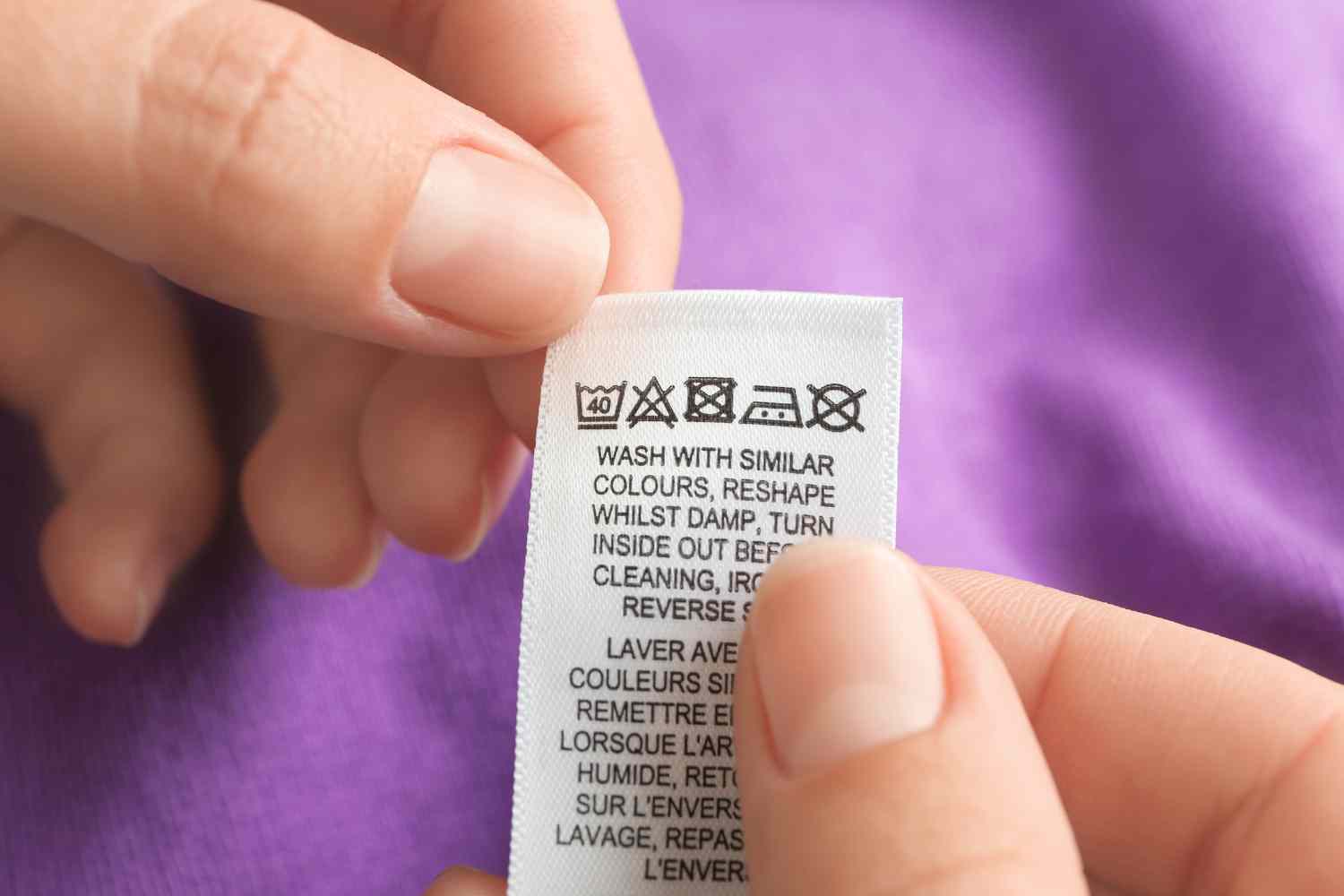
Doing laundry seems trivial, but how many times has a sweater felt felt or a shirt lost its color? It all starts from the labels: small symbols that tell us exactly how to treat each fabric.
By respecting the indications on the clothing labels and the washing machine instructions we can guarantee a longer life for our garments. Here’s how to interpret the symbols on the labels regarding washing, drying and ironing.
For some, doing laundry is a really complicated task. You never know how to combine colors, fabrics, which temperatures to choose, whether to spin or not. Furthermore, today’s washing machines are efficient and quiet but not always easy to use. They offer dozens of programs, weigh the clothes, allow you to increase the washing intensity based on the dirt. But before even using the washing machine, it is important to understand how to wash clothes: temperature, spin, wash times, detergents, bleach or drying mode. Clothing labels talk about all these aspects and we must be very careful if we want our favorite items to last a long time.
Before pressing ‘start’, take two minutes to read the label: it can avoid costly mistakes and ruined items.
By hand or in the washing machine
The symbol indicating washing is the basin. This symbol can appear in many ways.
At what temperature
The temperature is important because some colored or delicate fabrics can be ruined by high temperatures: this is the case with wool or silk. For this reason, if we want garments that are always shiny and like new, it is very important to respect the temperature indicated on the label.
Generally in leaders the ranks are indicated with numbers and only exceptionally with dots.

While regarding the number it is easy to understand how many degrees centigrade it corresponds to, for the dots we must know the symbol well and do some calculations.
The dots start from a minimum of 1 = 30º to a maximum of 6 = 95º. Each additional dot is calculated with 10 more degrees. For example:

Delicate items
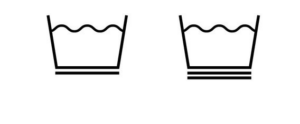
Another symbol that is difficult to interpret is the basin with a dash underneath. In this case if there is no mark under the basin it means that it is a normal wash. Instead, one dash means reduced washing and 2 dashes, delicate washing. In this case it means that we must choose a short wash, at low temperatures and with a very light spin (max 800).
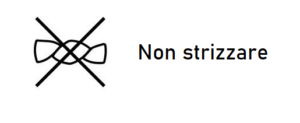
For example, if the symbol of a wrung cloth with an X on it appears (similar to a candy), it means that those items cannot be wrung. In this case, if by hand, we will not wring, and if in the washing machine we will have to remove the spin cycle completely. This could be the case when washing silk or wool garments.
Bleach yes or no
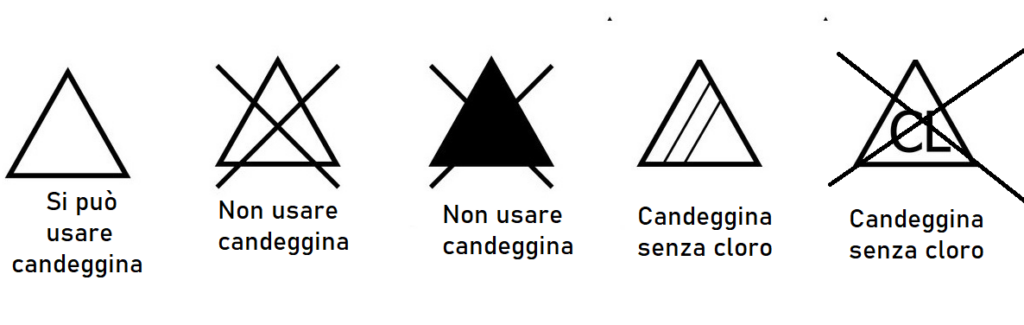
The symbol relating to bleaching is the triangle. Therefore the empty triangle indicates that the garment can be bleached with any type of bleach. While if there is an X on it or if the triangle is black, the item cannot be bleached. If, however, the triangle has two diagonal lines inside or the writing CL with an For example, in the case of colored cotton clothes on which stain removers or bleaches can be applied for delicate or colored garments.
When to take them to the dry cleaners
Some items cannot be washed either in the washing machine or by hand and it is preferable to take them to the dry cleaners, where they will be dry cleaned with special solvents. In this case it is advisable to look at the symbols with the circle.
The empty circle means dry cleaning is recommended. While if there is a circle with an If there is a W inside the circle, it means that the garment is dry and water cleanable.
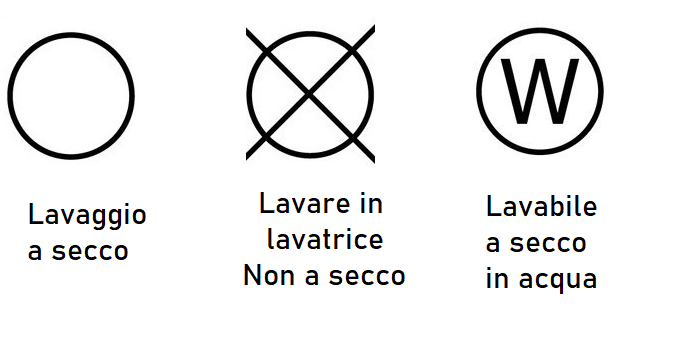
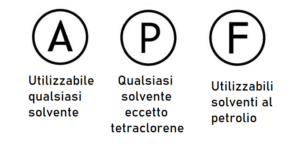
Even in dry cleaners, staff will have to pay attention to the type of solvent allowed. And the circled symbols A, P and F indicate respectively:
Use of the dryer
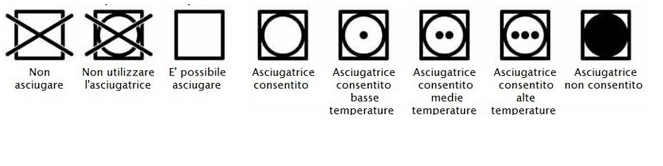
For those who have a dryer, it is very important to know the corresponding symbols. Furthermore, in some cases, some items should not be dried flat or in the sun. The drying symbols are the ones with the square and there may be other symbols inside.
How to hang clothes
Some items may lighten when exposed to the sun, while others may become distorted. For example, wool should not be exposed to the sun, because if light it would yellow. The same wool cannot be hung on the drying rack, because the garment would become deformed. It is therefore a good idea to interpret the symbols to hang your clothes correctly and not ruin them.
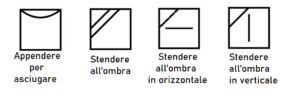
If we see a square with a thread at the top it means that the garment can be hung.
If there are two oblique lines at the top left, the head must lie down in the shade.
Instead, the horizontal or vertical lines inside the square indicate that the dress can be hung vertically or must be laid out horizontally.
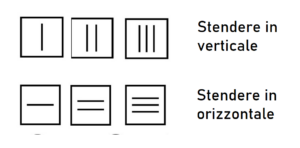 Wool or viscose items should always be dried flat, on a towel, to prevent them from deforming. Avoid direct sun even for black clothes, which can fade quickly.
The symbols of the iron
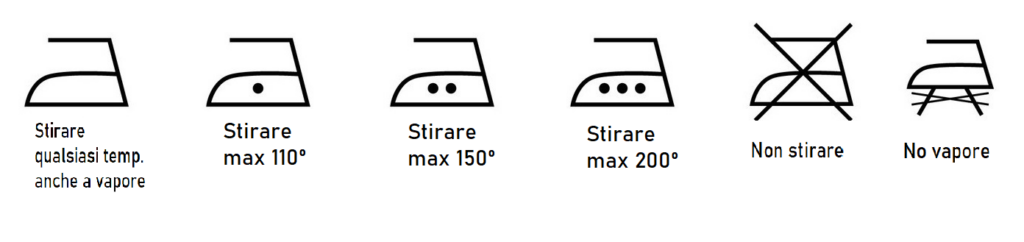
Even with regards to the use of the iron, it is useful to carefully observe the labels. This way we will avoid unpleasant burns on our favorite clothes.
The iron symbol alone means that the garment can be ironed at any temperature and even with steam. This will be the case for cotton and linen garments.
However, if there is an X on the iron, it means that that fabric should not be ironed.
If you see two oblique lines under the iron and an X above it, you are faced with a ban on using steam.
While in other cases there may be dots inside the iron, which indicate the maximum temperature to use.
A classic trick: iron the garments inside out, especially dark or printed ones, to avoid shiny marks.
In short, with a little experience and a little logic we could easily interpret these symbols which at first glance seemed like hieroglyphics. This way, doing perfect laundry and respecting our beloved clothes will be child’s play.
Knowing the symbols on the labels is not just a question of order or precision: it means taking care of your clothes, saving money and respecting the environment. And in the end, perfect laundry is truly within everyone’s reach.
You may also be interested in:
