
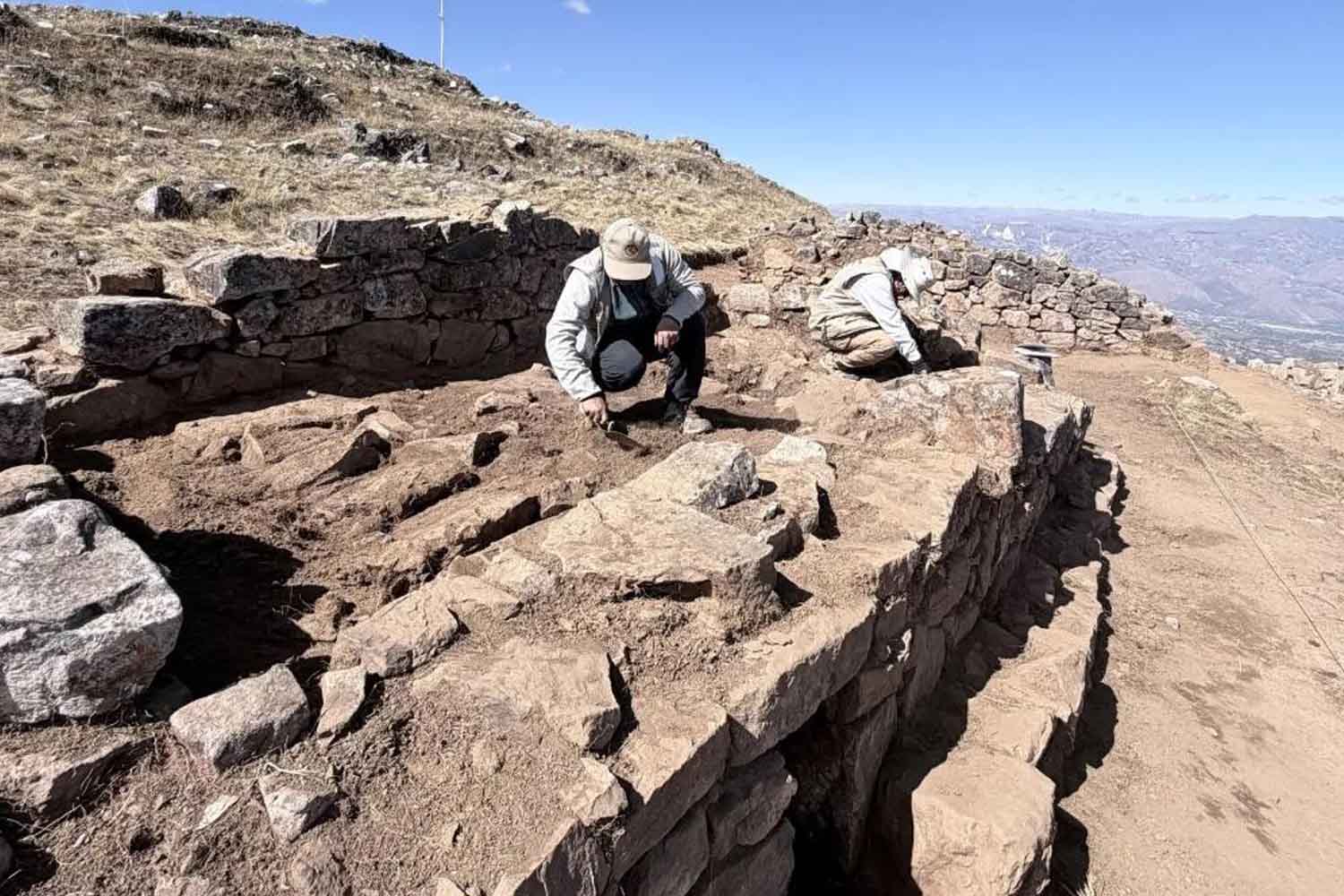
Twelve circular buildings follow the mountainside forming a crescent. A few meters away, inside another structure, two conduits pass through stone walls covered by large slabs. The place is windswept and is located at around 3,400 meters above sea level. Enough so that archaeologists began to suspect that that air current was foreseen all along.
It happens at Wancasangain the district of Condebamba, in the Peruvian region of Cajamarca. During the first campaign of Proyecto de Investigación Arqueológica Wancasanga 2026the group led by archaeologist Jerry Solano Calderón has identified what could be a complex of colcasthe warehouses used by the Inca to store food and other resources. The interpretation is still ongoing: twelve circular structures, a fragment of Inca pottery and a system capable of passing air are several clues, however. The data released by the research group concerns the excavations in sectors C and D of the site.
Those two led under the stones
In sector C, archaeologists opened several excavation units. In Unit 02 the twelve circular buildingsarranged along the ground in a regular arrangement. In Unit 01, however, an isolated construction with two ducts emerged.
Oswaldo Ezeta Latoche, archaeologist of the project, describes side walls built with worked and partially squared stone blocks, topped by large slabs that would have acted as a roof. The configuration would have allowed air circulation inside the building. The location also helps: the complex is located towards the western edge of sector C, precisely where the incidence of wind is greatest.
Here the hypothesis becomes particularly interesting, because the Incas really built deposits with the air in mind. Research published by the Qhapaq Ñan project of the Peruvian Ministry of Culture describes the colcas such as buildings often placed on slopes and peaks, with circular, rectangular or quadrangular plans and ventilation ducts at the bottom. The similarity with Wancasanga explains the interpretation proposed by archaeologists, without magically transforming it into an already closed and packaged certainty.
To preserve food, altitude, stone and cold air were enough
The wind, in those parts, was practically part of the furniture. The Qhapaq Ñan Identification and Registration Guide from the Peruvian Ministry of Culture explains that the colcas they were used to store corn, potatoes, clothes, weapons and other goods also intended for soldiers, officials and workers traveling along the Empire’s road network. Many depots were built in elevated areas precisely because cold wind could enter through the openings and help keep foods in suitable conditions for storage.
The same guide points out a frequent difference in shape: mainly cereals such as corn were stored in circular structures, while rectangular ones could house tubers such as potatoes. In Wancasanga, however, more data will be needed before establishing what exactly the newly excavated buildings contained.
A precedent studied directly by the Ministry shows how refined the system could be. In colcas in the Cañete valley, archaeologists found environments located in well-ventilated areas and designed to promote homogeneous air circulation. The excavations also revealed remains of agricultural products preserved inside them. In short, engineering began long before opening a door and putting a sack of corn inside.
A piece of pottery takes you back to the Inca period
What gave archaeologists another chronological reference was a much smaller find than the buildings: fragments of an aribalothe characteristic ceramic container linked to Inca production, found inside one of the structures.
The find strengthens the attribution of the complex to the Tahuantinsuyo period, together with the architectural characteristics observed in the field. Alone, however, a ceramic fragment does not allow us to establish the function and chronology of every building in the area. The excavations will also have to clarify the relationship between the twelve circular constructions and the one equipped with the two conduits.
Wancasanga, moreover, had already started moving again before the first stones appeared from the 2026 excavations. In November 2024 the Municipalidad Distrital de Condebamba had organized cleaning interventions in the archaeological area. In March 2026, the Ministry of Culture of Peru then included Wancasanga among the sites registered in Cajamarca after the reconnaissance conducted in 2024 and 2025, bringing the information into the national SIGDA system for the protection of pre-Hispanic archaeological monuments.
The 2026 research also takes up an initial survey carried out in 1989 by the architect José Pineda Quevedo. Today archaeologists, anthropologists and conservation specialists participate in the excavations; the inhabitants of Chauchabamba are involved in the activities on the site and in the workshops organized in local schools. The Yachayhuasi Museum of Cajabamba collaborates on the photographic documentation of the finds.
To understand whether those twelve buildings were really part of a single warehouse system, further campaigns, dating and analysis of the materials will be needed. Meanwhile, Wancasanga returned a rather eloquent combination: circular deposits, strong winds, conduits under stones and Inca pottery. At 3,400 meters, where today we put on a jacket to protect ourselves from the cold air, someone may have built an entire warehouse just to let it in.
