
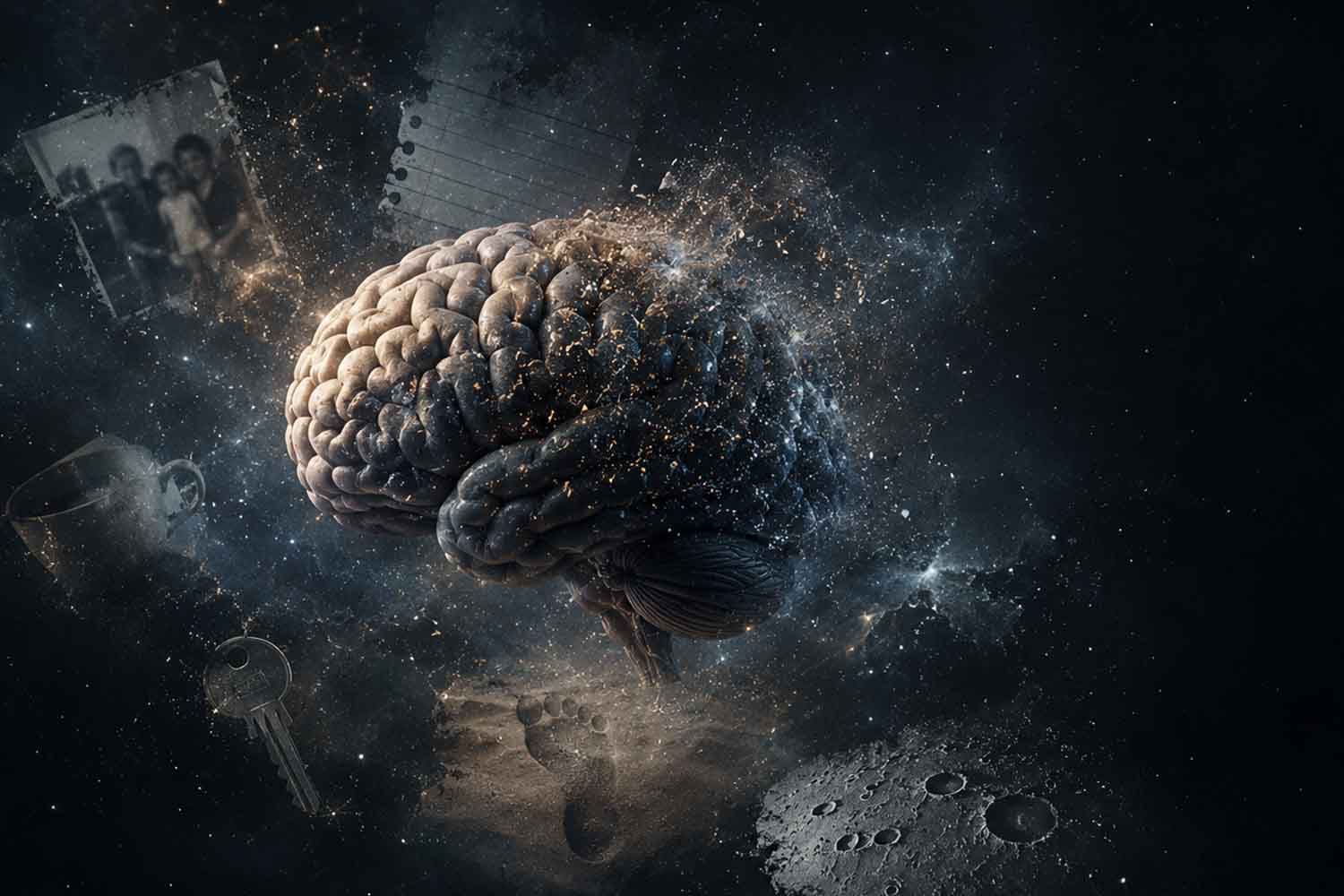
A brain that appeared by chance in the void, with an entire life ready inside: your mother’s face, the first day of school, a forgotten password, that bad impression that still comes to mind while you wash the dishes. The Boltzmann brain paradox it starts from here, from an almost ridiculous, yet mathematical, idea: in a universe large enough, old enough and disordered enough, a random fluctuation could also produce a consciousness complete with memories.
The problem, of course, comes soon after. Because those memories would seem real. They would have details, emotions, continuity, maybe even nostalgia. Except that behind it there would be no childhood, no history, no past to recover. Just a statistical combination out of the noise of the universe, like a receipt printed by a cash register disconnected from the store.
Physics usually reassures us with the second law of thermodynamics: entropy increases, time goes in one direction, traces remain behind us. A footprint comes after the foot, a photograph after the shot, a memory after the experience. A new study, however, calls into question this very security and shows an annoying flaw: to trust the law that makes memories reliable, we use registers, data, experiments and documents which are themselves forms of memory. It’s a closed loop. Elegant, uncomfortable, not suitable for those who just wanted to know where they put their keys.
A study by David Wolpert, Carlo Rovelli and Jordan Scharnhorst, published on Entropytook up the paradox without dismissing it as a seminar oddity. The work tries to separate some ideas that often end up tangled in scientific discussion: hypotheses of the pastsecond law of thermodynamics, reliability of memories, and Boltzmann’s brain hypothesis. The result is inconvenient: physics alone seems incapable of telling us which point in time we should take as an anchor to reconstruct everything else.
A trace towards yesterday
The second law of thermodynamics is one of the most famous rules of physics: entropy tends to increase. Said without a lab apron, tidy things become messier much more easily than the opposite. An egg breaks, coffee mixes with milk, a clean room becomes a refugee camp of socks, cups and chargers. The inverse path exists in microscopic equations, but in everyday life it has the grace of a unicorn.
This is where our trust in the past comes from. Recording something requires a physical process. The sand deforms under the foot, a film is exposed, a neuron changes state, a file is saved on a medium. Every memory needs an arrow: something before, a trace after. Without this asymmetry, memory would lose its job.
The problem comes when you look more closely at the mathematics. Equations related to entropy growth can be treated in a time-symmetric manner. If you start from a low entropy moment, you can calculate that disorder will increase going forward. With the same type of reasoning, however, going backwards we can also obtain a growth of disorder towards the past. The world we know tells a different story: yesterday it seemed more orderly than today, at least enough to allow traces, archives, fossils, photographs, laboratory notes.
To avoid the short circuit, the Past Hypothesisthe hypothesis of the past: the universe would have started, at the Big Bang, from a state with exceptionally low entropy. From then on the disorder would begin to rise, leaving room for the arrow of time, memory, natural history and everything we call “before”. It’s a powerful framework, one that’s been used for decades. Even this framework, however, requires an initial choice: fixing a certain moment as a privileged point. The study insists right here. That choice must be added from the outside, because the physical laws considered in the model do not impose it on their own.
The closed loop of certainty
The most annoying part of reasoning concerns documents, experiments, tests. We usually think like this: we know that the second law works because we have observations, measurements, laboratories, notebooks, articles, instruments. The whole apparatus of science seems like a mountain of receipts.
Except that those received are physical memory. A saved data, a written note, an astronomical photograph, a repeated measurement: all this belongs to the same family of traces. And the traces, in the standard explanation, are reliable because there is an arrow of time based on the increase in entropy.
Here the snake bites its own tail. The second law makes the records of the past reliable; the records of the past convince us that the second law holds. The work of Wolpert, Rovelli and Scharnhorst does not turn this into evidence that we live inside a deception. It would be too comfortable a leap and even a little theatrical. It signals something more subtle: many quick refutations of Boltzmann’s brain put their foot on less solid ground than they seemed.
The Santa Fe Institute summarizes the issue as follows: the paradox arises from the tension between the asymmetry that we attribute to time and the formal symmetry of some tools of statistical physics. Our memories might appear as records of a real past, or as structures produced by random fluctuations. The hypothesis remains extreme, however the way in which it is rejected often brings with it assumptions already full of the past.
The year one thousand in the laboratory
To make the problem clear, the authors propose an almost provocative variant: the 1000 CE hypothesis. Let’s imagine setting the minimum entropy not at the Big Bang, but around the year 1000. From then on, everything would work as in our ordinary experience. Subsequent documents, modern experiments, recent historical memory, contemporary science: everything could remain coherent.
The fracture would concern what precedes that temporal anchor. Profound history, cosmic evolution, the remote past would become the product of a fluctuation. It sounds absurd, of course. In the work, however, absurdity serves to show the mathematical relatedness between hypotheses that we treat with very different degrees of respect. The Past Hypothesis, the Boltzmann brain hypothesis and this variant from the year 1000 share a structure: they all choose a single moment to which to attach the rest. Change the chosen point. It changes our level of annoyance.
The physics here touches a philosophical edge without the need for special effects. A law is not enough to decide which memory deserves trust. An additional assumption is needed, a kind of initial pact with time. Usually we accept it because it works very well: it allows us to do science, build models, predict phenomena, distinguish a trace from a hallucination. Functioning, however, does not always coincide with founding oneself.
Memory, science and a small act of faith
The important thing to keep in mind is this: the study does not say that our memories are false. He doesn’t claim that this morning’s breakfast was invented by the cosmos out of boredom, nor that the photo in the phone is a thermodynamic trap. Work shifts the weight of demand. He asks how much of our security comes from equations and how much, instead, from a starting hypothesis that makes those equations usable in the world we inhabit.
For daily life, little changes. We will continue to trust memory enough, with all its very human and very earthly distortions. We will continue to look for the keys where we remember leaving them, to believe in the scars, in the archives, in the messages sent at three in the morning with terrible grammatical intentions. For physicists, however, the annoyance remains interesting. Boltzmann’s brain becomes less of a cosmological joke and more of a reminder: when we talk about the past of the universe, we are also choosing the kind of past we are willing to consider real. Memory wants to seem like a safe. Physics just took some of the paint off her door.
