
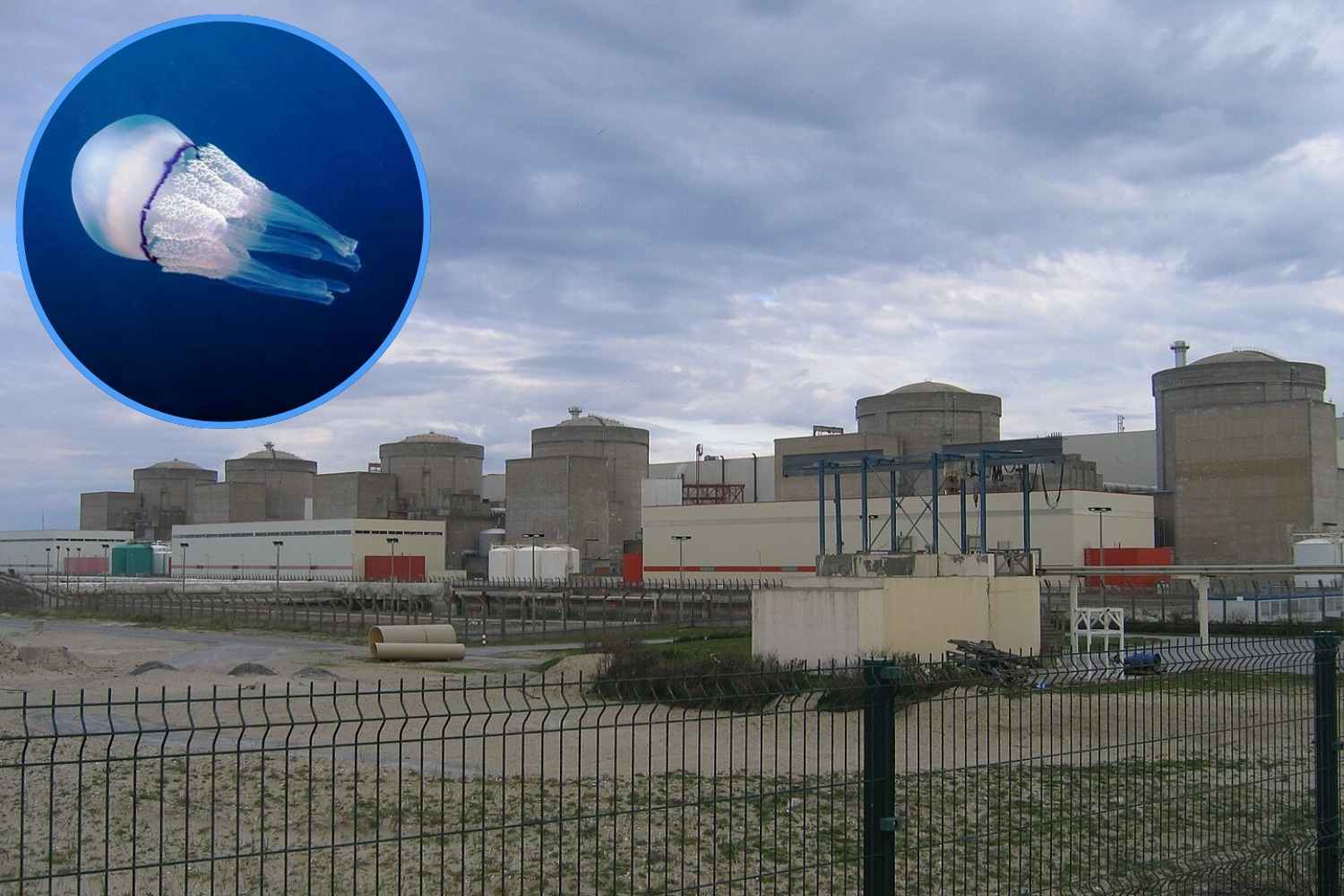
Between 10 and 11 August, in the north of France one of the most powerful nuclear power plants in Western Europe has stopped suddenly. Not for a technical failure or a safety alarm, but due to an unexpected guest: a “enormous and unpredictable” swarm of jellyfish.
A sudden stop
It happened in Gravelines, a town of 11 thousand inhabitants of the far north of France, a few kilometers from the North Sea, where six reactors of 900 megawatts each feed millions of homes. Four of these (2, 3, 4 and 6) automatically turned off when the water sockets for cooling aspired the jellyfish, obstructing the filter drums of the pumping stations. The other two were already stopped for scheduled maintenance.
Edf, the operator of the plant, explained that the event had no consequences on the safety of structures, staff or environment, and that the jellyfish were stuck in the non -nuclear part of the system. Among the species involved there would be the English barrel jellyfish, which can reach 90 cm in diameter, and perhaps the Medusa Luna Asiale, an invasive species reported for the first time in the area in 2020.
Like jellyfish they have passed the filters
The nuclear engineer Ronan Tanguy told the BBC that the gelatinous body allowed the animals to circumvent the first protection systems. Trapped in the secondary filters, they reduced the flow of water necessary to keep the temperature under control, causing the automatic shutdown of the reactors for safety.
Because it happens (more and more often)
It is not the first time that has happened: Gravelines had had a similar episode in 1993, and other plants in Scotland, Sweden, Japan and even in the Philippines have undergone interruptions for the same reason. Also at the BBC, the marine biologist Derek Wright of the Noaa explained that “the jellyfish reproduces faster when the water is warmer and, since areas like the North Sea are heating up, the reproductive window is expanding”.
The waves of sea heat, combined with milder winters and a prolonged autumn, allow the jellyfish to remain active for longer periods. Excessive fishing, which reduces natural predators, and the spread of species transported by ships through the waters of ballast, contribute to proliferation.
The role of the central ones themselves
The coastal systems, although producing energy at low emissions, release the warmer water at sea than that taken for cooling. This “thermal pollution” can create micro-habitats in favor of the growth of jellyfish and other marine organisms.
Future consequences and risks
In the case of Gravelines there have been no problems of energy supply, but if similar events were to take place during consumption peaks, the consequences could be more serious. In 1999, an invasion of jellyfish in a plant in the Philippines contributed to a blackout that left millions of people without current.
Researchers from the University of Bristol are working on early alert systems based on sea observations and predictive models. The idea is to identify the formation and the movement of large swarms days in advance, so as to be able to intervene before they reach the plants. But the challenge is complex: the jellyfish moves pushed by variable currents and in a difficult way to predict.
Don’t you want to lose our news?
