
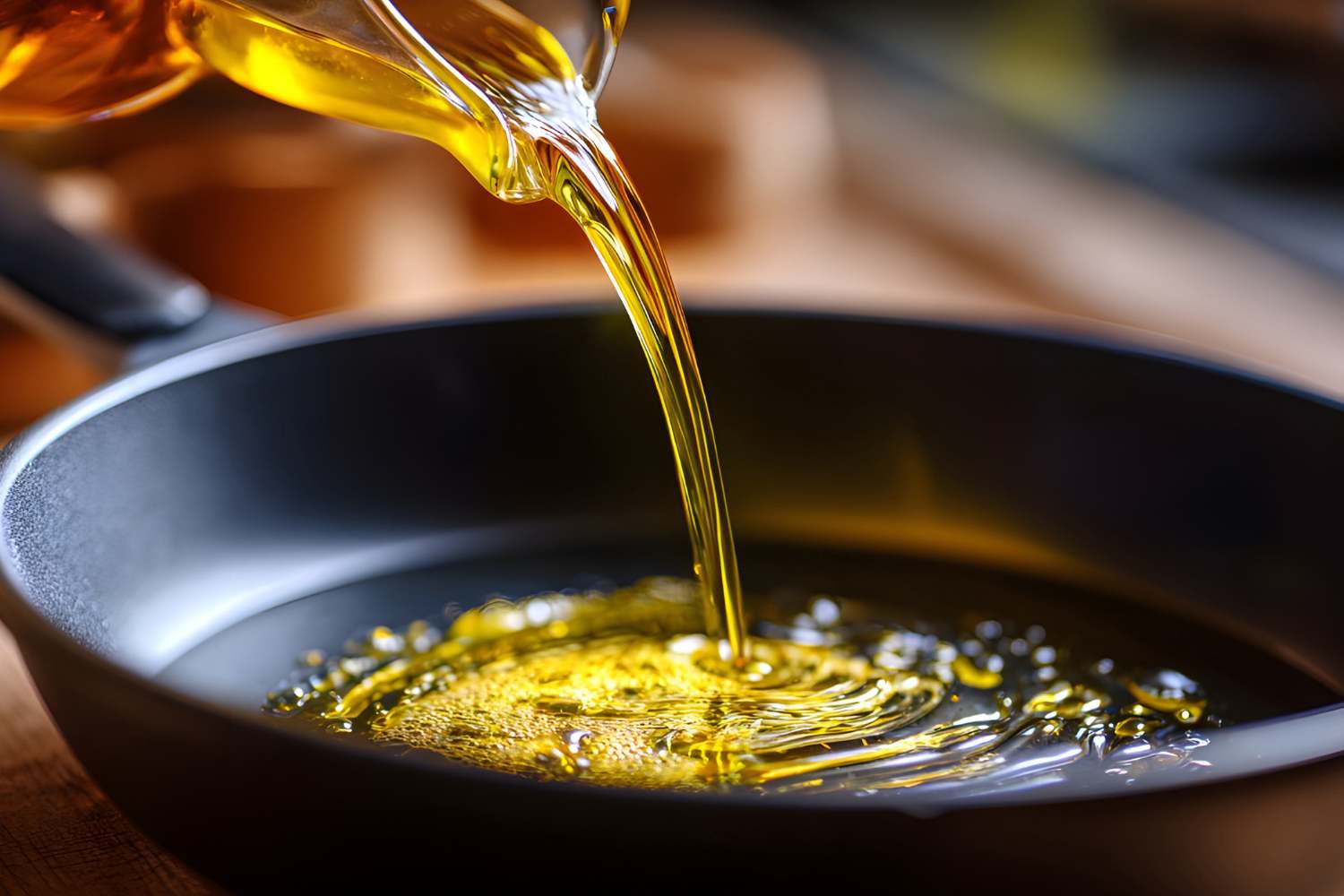
When it comes to frying, the choice of oil is often guided by habit or price. Yet it is a decision that has concrete repercussions on the quality and safety of what you eat. At high temperatures, an unstable oil produces oxidized compounds and irritating volatile substances: choosing poorly is not just a question of taste, but of health.
Emanuela Bianchi, food technologist at Altroconsumo, clearly indicates the criteria to follow: rather than the smoke point – often used as the only yardstick – the fatty acid composition of the oil counts. Oils rich in polyunsaturated fatty acids are chemically fragile and oxidize rapidly under heat. Those rich in monounsaturates, on the contrary, are more stable and better resist the high temperatures typical of frying, generally between 160°C and 180°C.
Let’s see the characteristics of the main oils.
Corn oil
Corn oil is among the least suitable for frying. Its composition is dominated by polyunsaturated fatty acids, which makes it highly unstable to heat: it degrades quickly, worsening both the quality of the fried food and the safety profile of the oil itself. Its use is more suitable for raw condiments.
Sunflower oil
Traditional sunflower oil is among the most purchased in Italy, often for frying. However, as Bianchi explains, it is rich in polyunsaturated fatty acids and tends to deteriorate rapidly with heat, especially in domestic contexts where the temperature is not always constant. The neutral flavor makes it appreciated, but it is not a sufficient characteristic to make it suitable for frying.
The case of high oleic sunflower oil is different, obtained from varieties of plants selected to contain a much higher percentage of oleic acid. In this case, its composition becomes comparable to that of olive oil, with a significantly higher heat stability than traditional sunflower oil. On the label it is recognized by the wording “high oleic”: if present, the oil can be considered a valid alternative for frying.
Peanut oil
Peanut oil has been an established choice for home frying for years. Its composition – around 50% monounsaturated fatty acids, with a good share of saturated ones – guarantees good resistance to high temperatures, even during prolonged frying. The neutral taste does not alter the flavors of foods. It should obviously be avoided if you have a peanut allergy.
Extra virgin olive oil
Extra virgin olive oil is often considered too valuable or unsuitable for frying, but from a technical point of view it is one of the best choices. It is rich in oleic acid — a heat-stable monounsaturated acid — and contains natural antioxidants such as polyphenols, which actively slow down oxidation processes. This makes it more resistant to degradation than many refined oils, which despite having a high smoke point lack this natural protection.
As Bianchi points out, quality makes the difference: an extra virgin with low acidity and a good concentration of polyphenols offers the best performance. The more delicate aromas tend to attenuate with heat, so its use in frying does not lead to a “waste” of its most valuable organoleptic characteristics.
The wording “for frying” is not a guarantee
An element that the expert invites you to pay attention to is the words “frying oil” on some labels. This is not a technical certification: it generally indicates a refined oil with a high smoke point, but does not provide information on the fatty acid composition nor on the actual stability to oxidation.
For a more informed choice it is useful to check the type of oil, the presence of the wording “high oleic” in the case of sunflower, and the possible antioxidant content.
Pay attention to the frying temperature
The frying temperature is not only a question of results in the pan, but also of safety. Once the smoking point is exceeded, the oil rapidly degrades, forming irritating substances and oxidation products which compromise both the quality of the fried food and its safety. The signs are recognizable: appearance of visible smoke, acrid odor, and — in the case of an oil that has already been used several times at excessive temperatures — dark color, viscous consistency and foaming. When these signs appear, the oil should be eliminated.
The ideal temperature for the vast majority of frying is between 160°C and 180°C, but not all foods behave in the same way. Fish, due to its delicate structure, requires a temperature between 165°C and 175°C: too low it absorbs oil and becomes soft, too high it burns on the surface leaving the inside raw. Vegetables, rich in water, require higher heat – between 170°C and 180°C – to quickly evaporate liquids and maintain crunchiness and colour. Breaded products and batters, on the other hand, require higher temperatures, between 175°C and 185°C, to immediately form a crust that seals the inside: with oil that is too cold, the breading becomes soaked and falls apart.
In all cases, the fundamental rule is to keep the heat as stable as possible: sudden changes compromise both the quality of the oil and that of the fried food.
Reuse of oil
Each heating cycle accelerates the oxidation and degradation processes, making the oil progressively less stable and increasing the presence of unwanted by-products. In the domestic context, Bianchi recommends not reusing the oil, or at most doing so a limited number of times and only for similar types of frying, as long as it does not show obvious signs of deterioration.
There is no fixed number of uses considered safe: it depends on the type of oil, the temperatures reached, the cooking duration and the fried foods. With each use, the residues that accumulate further accelerate degradation: for this reason, if you decide to reuse the oil, it is essential to filter it carefully before storing it. It should then be kept in a closed, opaque and clean container, in a cool place away from light. The most reliable evaluation remains the sensorial one: the appearance, color and smell of the oil say more than any usage count.
