
There is violence that leaves deep wounds even when there is no memory of what happened. It is precisely that void, that impossibility of reconstructing a story, that is the center of the new French national campaign dedicated to raising awareness of chemical subjugation, a form of violence in which a person is rendered incapable of reacting or remembering through the use of substances.
Lending his face to the campaign is Gisele Pelicotwhich has become a symbol of the fight against sexual violence after the trial which brought to light the abuse suffered for years by her husband and dozens of men and which had a huge impact on French and international public opinion.
The project, promoted by the #MendorsPas association (“Don’t make me sleep”) together with the Havas Paris agency, is based on an idea as simple as it is powerful: representing the silence left by a violence which, precisely because it is not remembered, seems impossible to talk about.
When the memory is erased
The campaign film, directed by director Rebecca Zlotowski, brings some people in front of a camera. The question is always the same:
“Can you tell me what happened?”
But the answers aren’t coming. In front of them are familiar or close figures: a companion, a colleague, a grandfather. People who should represent trust and security. Yet, the story is interrupted and there remain hesitations, pauses, silences.
Until a whispered sentence:
“I cannot.”
And here comes the message of the campaign:
“There are crimes that we cannot talk about, because we do not remember them.”
A phrase that tries to give shape to one of the most destabilizing aspects of chemical submission: some victims may know that something doesn’t add up, perceive that something serious has happened, but not have the elements to reconstruct the events. The absence of memory thus becomes part of the violence itself.
The film, accompanied by an original composition by the artist Ysé, ends with the intervention of Gisèle Pelicot, who invites anyone who has a doubt not to ignore it and to ask for help by contacting CRAFS, the French reference center for aggression facilitated by the use of substances.
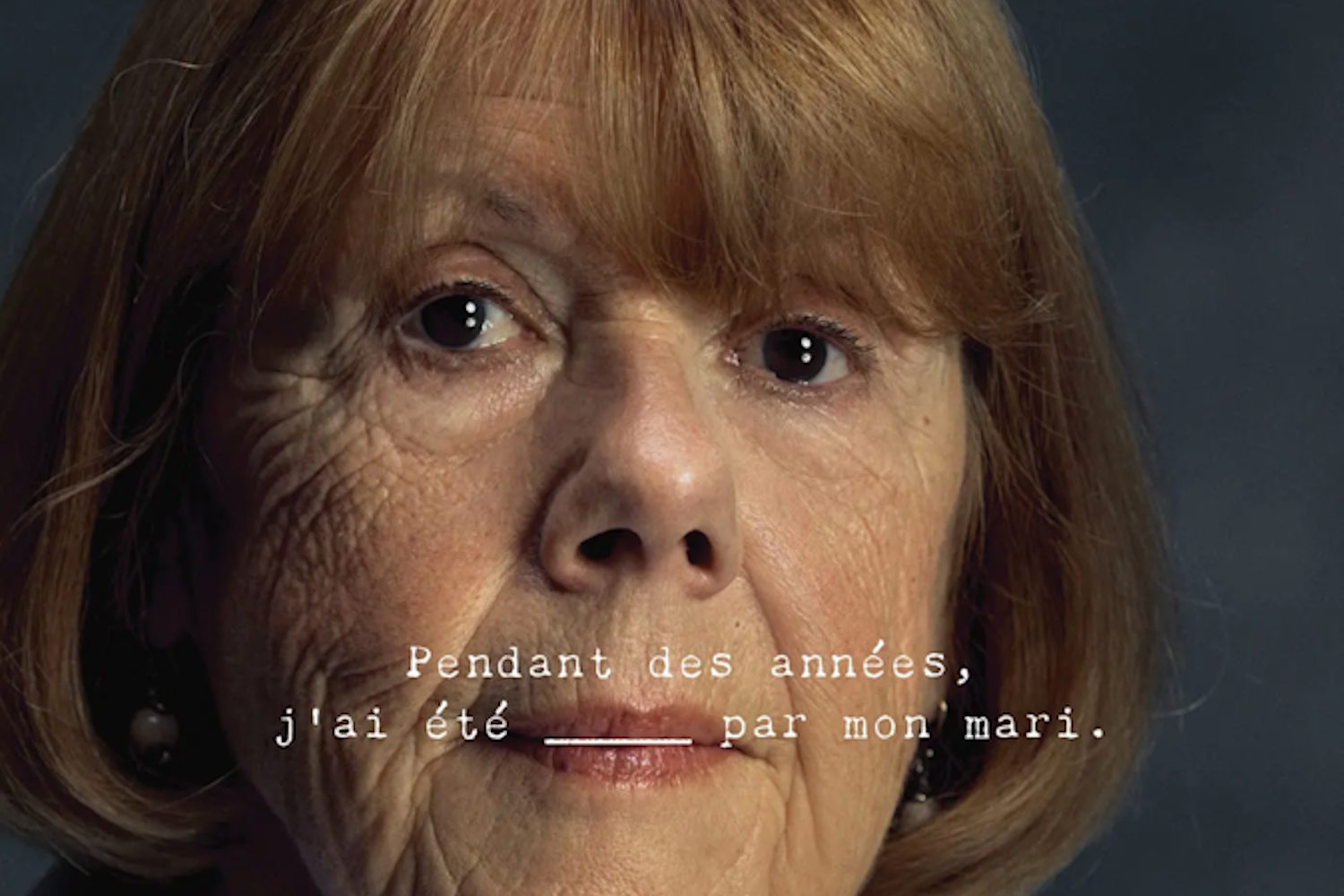
The same concept is taken up in the billboard campaign created by the photographer Alice Moitié.
Eight portraits show people accompanied by incomplete sentences, such as:
“For years I was ______ by my husband.”
In place of the missing word, a ribbon appears covering the mouth of the photographed subject. The very strong image thus tells of a double void: that of the memory and that of the words necessary to describe it.
It is not just an aesthetic choice, but a way to make visible a condition that is difficult to explain: something happened, but the person involved may not be able to talk about it.
Chemical submission isn’t just about strangers
One of the objectives of the campaign is also to overcome a still widespread idea: that this violence occurs above all in nocturnal contexts, at the hands of strangers, for example in clubs. According to data released by the #MendorsPas association, however, 75% of sexual assaults linked to chemical submission occur within the circle of people known to the victim.
A fact that also shifts attention to places considered “safe” and to the dynamics of trust that can be violated.
The campaign will be spread until October 18th through television, press, digital billboards, online platforms and social networks.
Not remembering doesn’t mean nothing happened. And having doubts can already be a sufficient reason to seek help.
