
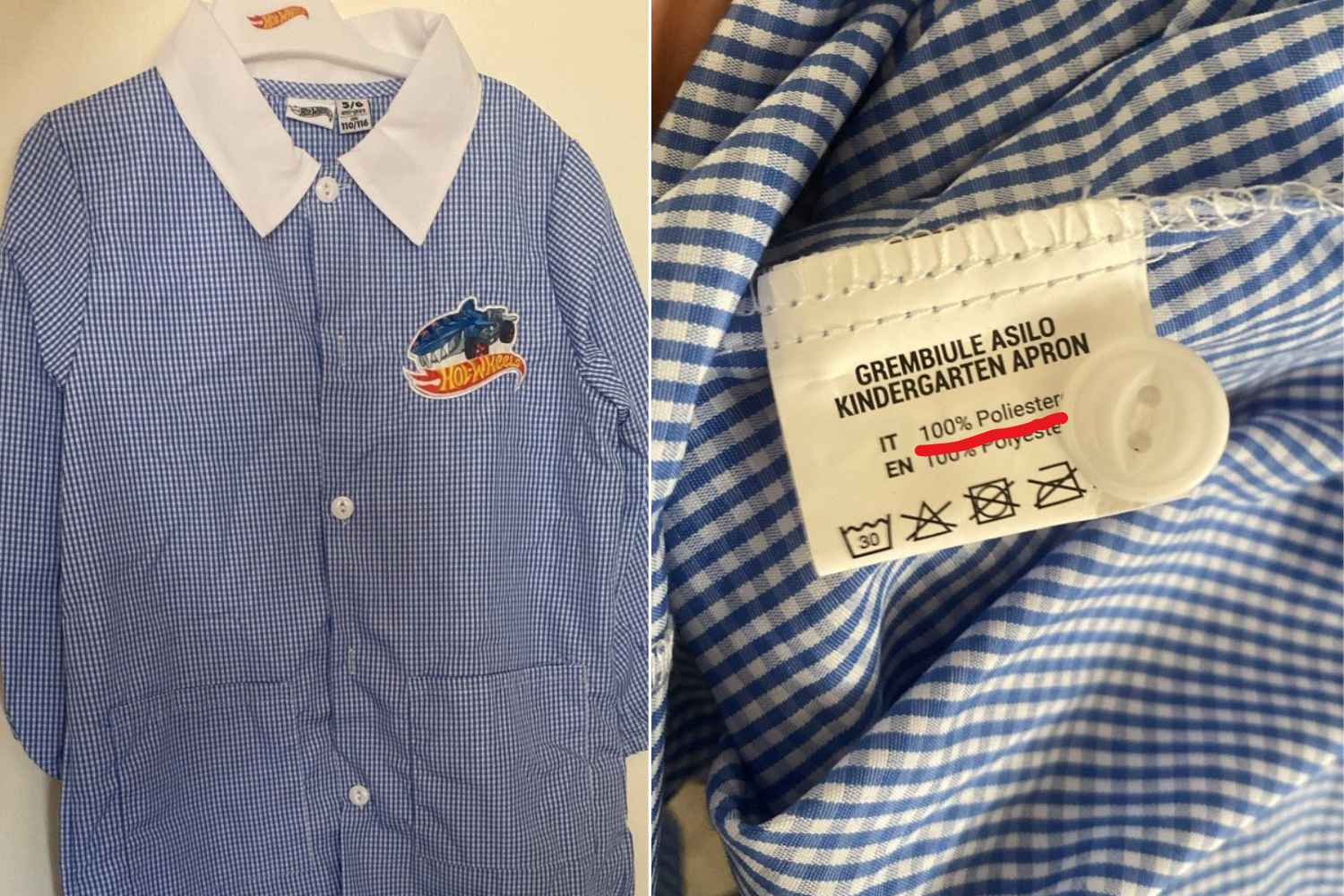
September means school, backpacks to prepare, notebooks to buy and, for many families, also the search for an apron. An apparently simple purchase, which however can reserve a surprise. Have you noticed how incredibly difficult finding a 100% cotton apron is becoming?
This was reported to us by one of our readers, who found herself faced with a situation that is now anything but rare: on the shelves and in online shops aprons are mainly made of polyester, or in mixed fabrics where the synthetic component is largely prevalent.
And then a question arises spontaneously: how is it possible that a garment that a child wears for several hours a day, for months, is now almost always made of synthetic fibres?
View this post on Instagram
The cotton apron you can’t find anymore
Just look for a school apron to realize how much the offer has changed.
Polyester appears continuously in compositions. In some cases we find mixed fabrics, with a very high percentage of synthetic fibre; in others, aprons are even offered in 100% terital, a synthetic fiber belonging to the polyester family, often valued for its characteristics such as resistance, practicality and durability.
And this is precisely where the paradox arises. We are used to thinking of the apron as a simple, resistant, possibly fresh and washable garment, intended to be used daily by a child. Yet today, if we explicitly look for a 100% cotton model, we risk having to search much longer and, above all, having to put a heavy hand on our wallet.
Because alternatives exist, but they often belong to a completely different price range. If you want cotton, you have to pay a lot more. A synthetic or mixed apron from large retailers can cost approximately 15-20 euros. However, when looking for 100% cotton models, it is not uncommon to come across prices of 35, 40, 50 euros or even more.
Of course, it doesn’t mean that every cotton apron has to cost little, nor that the price is determined exclusively by the composition of the fabric. Quality, production, brand, workmanship and durability of the garment come into play. But the disproportion remains important and raises a question that deserves to be addressed: why should choosing a natural fiber for a school item for everyday use turn into an almost “premium” choice?
Shouldn’t it be the other way around? Or at least shouldn’t it be possible to easily find both options, without the natural one automatically becoming the more difficult and expensive one?
@GreenMe
Is polyester bad for children?
It is important to be clear about this. To say that a polyester apron, because it is synthetic, can be dangerous for a child would be a simplification that we cannot support based on the composition of the fabric alone. The problem is another and mainly concerns the environmental impact of synthetic fibers and the production model that has established itself in the textile sector.
Polyester, in fact, is a synthetic fiber obtained from raw materials of fossil origin. And today it has become practically omnipresent in our wardrobes: according to the European Environment Agency, synthetic fibers represent a huge share of textiles and polyester has overtaken cotton as the most used fiber in the textile sector since the late 1990s.
It is therefore not just a question of aprons.
Then there is an aspect that makes this discussion even more interesting. When we wash and use synthetic fabrics, plastic microfibers may be released. It’s not just a hypothesis: the European Environment Agency considers the unintentional release of microplastics from synthetic textiles to be a recognized source of pollution.
European Commission estimates reported by the EEA indicate that textiles are the fourth largest source of unintentional releases of microplastics into the European environment, after paints, tires and plastic pellets. The estimated quantity falls within a very wide range, between 1.6 and 61.1 thousand tonnes, depending on the assumptions and estimation methods used.
But be careful: this does not mean that every polyester apron is some sort of “microplastic factory”, nor that cotton is automatically the most sustainable choice of all.
In fact, the EEA itself underlines that even natural fibers release microfibres and that the environmental impact of a textile does not depend only on the type of fibre, but must be evaluated along the entire life cycle: from production to the life of the garment, through use and washing, up to reuse and the end of life.
But this doesn’t change the starting question: why is it now so difficult to find a garment in natural fiber? The school apron is just the tip of the iceberg.
A few days ago, entering a second-hand market, I happened to look at the clothing department with different attention than usual. There were different brands, clothes of all kinds and for every season, yet the feeling was evident: an impressive amount of garments are made entirely or largely of synthetic fibres. Polyester, polyamide, acrylic, elastane. The phenomenon is so widespread that it now seems almost normal.
And this is perhaps the most surprising aspect: plastic is no longer just in bottles, packaging or disposable objects. It got right into our clothes.
We find it in t-shirts, fleeces, trousers, children’s clothes, underwear, sportswear and, of course, also in school aprons.
The EEA highlights how synthetic textiles are now deeply integrated into European daily life and highlights the environmental impacts linked to their production, use and end-of-life management.
And so cotton becomes almost a luxury
The paradox, then, is not that the polyester apron exists. The paradox is that if a parent simply wants to choose a natural fabric for a garment that their child will wear every day, they may find themselves forced to search much longer and spend double or triple as much.
And this should make us think.
Because the issue is not just about personal taste or preference for one fabric over another. It’s about what kind of textile market we have built and what materials we now consider normal. We’ve made synthetic fiber the standard choice and natural fiber the go-to alternative. And when we finally find it, we often have to pay a lot more for it too.
This is not to argue that everyone should buy exclusively cotton, nor that a polyester apron is automatically a product to avoid. It’s about asking why a parent who wants to buy a 100% cotton apron almost has to go on a treasure hunt.
At a time when we are constantly talking about reducing the impact of fashion, combating fast fashion, extending the life of clothes, encouraging reuse and making the textile sector more circular, it would perhaps be appropriate to start again from even the simplest things.
From an apron. From a t-shirt. From a pair of trousers. From garments that should be able to be chosen not only based on colour, price or ease of washing, but also on the material with which they are made. Because if even finding a simple cotton school apron has become a challenge, perhaps the problem is not the apron. This is how we have become accustomed to dressing in plastic.
