
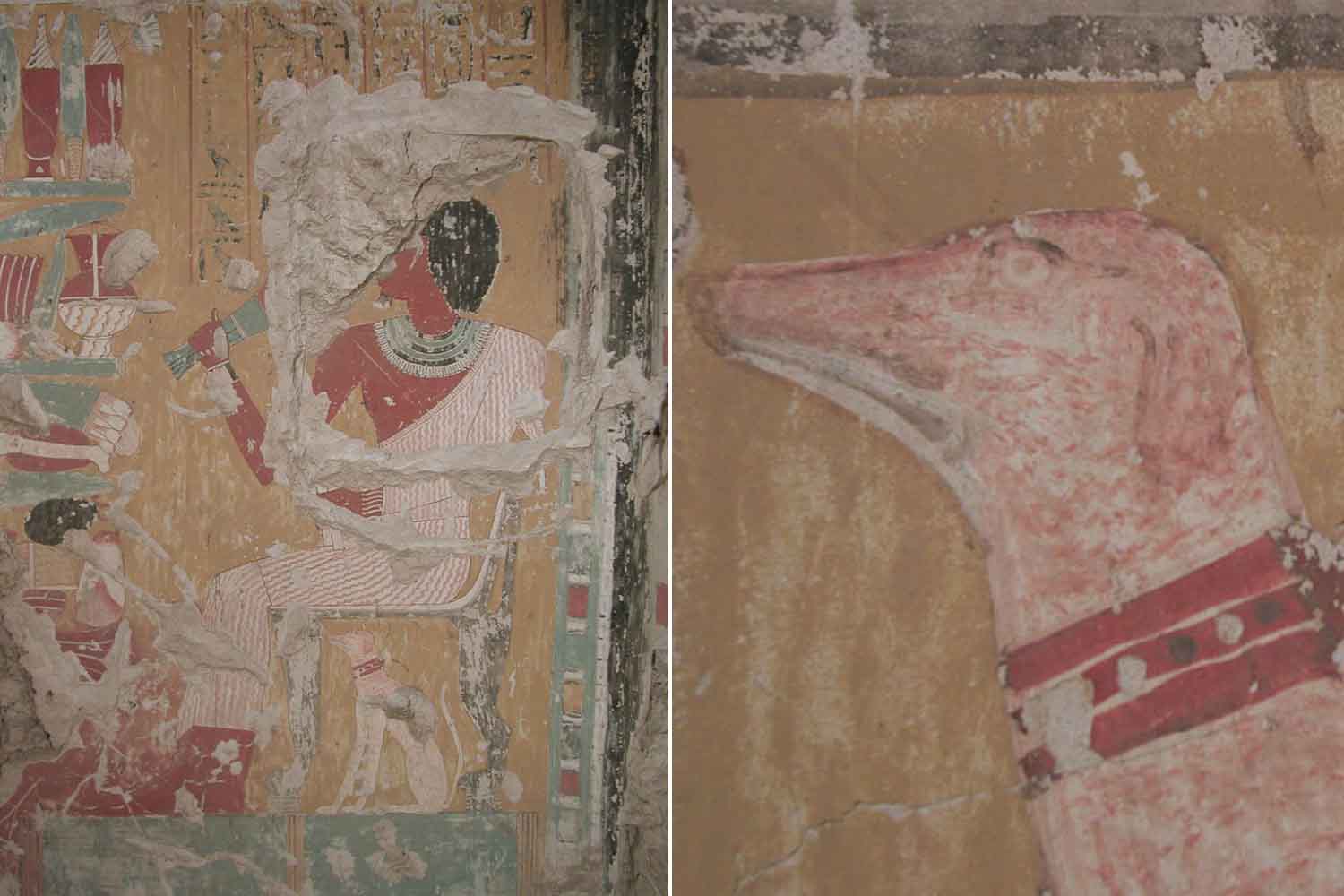
Under the chair of an Egyptian official who lived about 3,500 years ago there is a white dog, with a collar and strange reddish streaks on its body. Someone had painted him with some care, even adding his name next to his head. For over a century, however, that writing had escaped scholars. Now we know what it was called: “He of the afterlife”. A rather challenging name for a dog, even in ancient Egypt.
It was deciphered by Chelsea Kaufman, a researcher at Johns Hopkins University, who published the discovery on Journal of Egyptian Archaeology. The dog appears in the TT21 tomb of User, a scribe and administrator in the service of Pharaoh Thutmose I, in the Theban necropolis of Sheikh Abd el-Qurna, near present-day Luxor. The burial belongs to the 18th Dynasty, although its precise dating is still debated.
Three dogs under the chair, but one had a particular name
In User’s tomb there are at least three funerary scenes depicting a dog sitting under the owner’s chair. All wear a collar and have the characteristics of greyhounds depicted in New Kingdom art: slender body, drooping ears and curved tail. Two names were already known thanks to the documentation published by the Egyptologist Norman de Garis Davies in 1913: “The Strong” and “The Faithful”. Names that we could still easily find on some medals today. The third dog, painted on the eastern wall of the internal chamber, was however without a name. Or at least that’s how it seemed.
Examining some photographs of the paintings, Kaufman spotted traces of hieroglyphics behind the animal’s head. He then used DStretch, a digital tool that increases the contrast of images and allows him to distinguish pigments that are now difficult to see with the naked eye. And here the writing appears on the yellow background of the fresco: dwȝ.tytranslatable as “He of the afterlife”a name associated with Anubis, the canid-headed god linked to mummification and the protection of the deceased.
According to Kaufman, the religious reference is very likely. There is also a possible alternative reading of the name, with the meaning of “pupil”, which the researcher considers less plausible. We don’t know, however, why User chose that name for his dog.
An unusual cloak and a hieroglyph that resembles it
Then there is the detail of the cloak. The dog is depicted with a white body crossed by reddish, wavy streaks, a pattern that Kaufman has not found in other canine representations of ancient Egypt. Those stripes are curiously reminiscent of the folds of the dress worn by User himself, depicted above the animal carrying a bouquet of flowers near his face.
This could be an intentional choice by the artist, although we don’t know if the dog actually had a similar coat. The other peculiarity is hidden right in the writing. The ancient Egyptians used some hieroglyphics, called determinantsto clarify the meaning of the words. In dog names, when this symbol appeared, it was almost always a standing animal.
In the case of “He from the Underworld”, however, the hieroglyph depicts a sitting dog, just like the one painted under User’s chair. Among documented Egyptian canine names, there is only one other known example of this type of symbol, engraved on a dog sarcophagus dating back to the Middle Kingdom.
The other two dogs in the tomb also have hieroglyphics adapted to more closely resemble the animals depicted, but only this one is depicted sitting. The artist therefore seems to have paid particular attention to the identity of the three animals. Why he chose an even more unusual treatment for the third, however, remains unknown.
Why did the ancient Egyptians write the names of their dogs in the tombs?
With this discovery they rise to There are 97 ancient Egyptian dog names present in the repertoire used by Kaufmanalthough the attribution of some is still debated. The evidence spans many centuries, from the Old Kingdom to the Ptolemaic era. Some names recalled the character of the animal, others its physical appearance, still others the deities. In some cases they were the same ones used for people. More than half of the known names come from private graves. And their presence could have a meaning that goes beyond affection for a pet.
In Egyptian funerary beliefs, preserving a person’s name and image was linked to the possibility of keeping their identity alive in the afterlife. The same concept may also have been extended to the dogs depicted next to their owners. Kaufman suggests that writing the name of the animal in the tomb could serve to guarantee its symbolic survival after deathpreserving its memory together with that of the owner.
This does not allow us to know the personal relationship between User and his dogs, nor to establish whether the name “He of the Underworld” had a particular religious meaning for the official. However, a documented choice remains: three animals represented next to the owner, each with its own name. And one of them even had a hieroglyph that looked like him. After about 3,500 years, we know what it was called again.
