
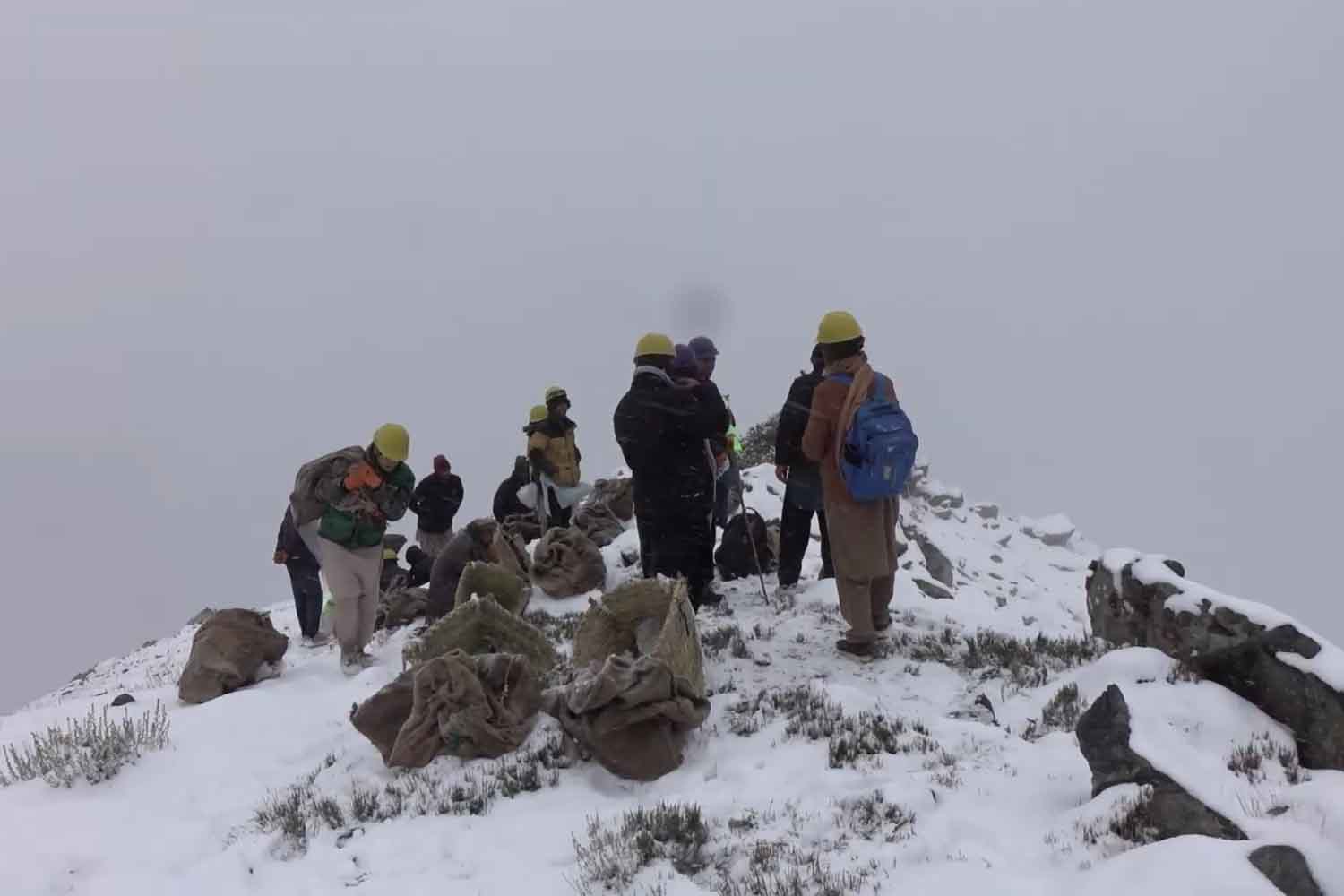
The ice is detached from different glaciers, loaded into baskets and carried on the shoulders up to above 4,000 meters above sea level. One part is dark, full of earth and debris; the other is clear, almost transparent. According to Baltistan tradition, ice is “male” and ice is “female”. The destination is a cavity in the mountain where the two will be placed together, covered and left in the cold for years. This is how a “glacier wedding” begins.
In Gilgit-Baltistan, a mountainous region administered by Pakistan in disputed Kashmir, this indigenous practice is called Gang Khswaan expression that a document from the GLOF-II project of UNDP Pakistan translates as “to nourish with deep affection”. The objective is decidedly material: to conserve ice at high altitude and obtain, if the site manages to stabilize, melt water useful to the villages in the months when it is needed to irrigate fields, water animals and support daily life.
How to “marry” a glacier at 4,000 meters
Biology, here, can sit outside the cave. “Male” and “female” belong to the traditional classification of ice: the one defined as female is white or blue and relatively clean, the male one is darker and mixed with rocks and sediments. The meaning attributed to the two categories is ancient: the first is considered more generous with water, the second slower and more resistant. Even the scientific literature that has studied glacier grafting describes this distinction as part of the knowledge of local communities: male and female are cultural categories, not physical properties of ice.
The site is chosen in a very cold spot with little exposure to the sun, generally above 4,000 metres. The material is placed in a natural cave or in a specially dug cavity. The booklet created by the GLOF-II project, promoted by the Pakistani Ministry of Climate together with UNDP with the support of the Green Climate Fund, describes layers of ice accompanied by apricot kernels, wheat husk, water and coal. Protections are built on top to limit exposure to the sun.
The entire operation is intertwined with prayers, songs and rituals. The UNDP document says that the elders place the ice in the cavity, a sort of lullaby is sung to the “baby glacier” and verses from the Koran are recited. For a few years the place was then left undisturbed.
Does “artificial glacier” really work?
Simply talking about “new glaciers” risks suggesting something bigger and better demonstrated than what we know. A study published in 2021 on Sustainability analyzed glacier grafting in three villages of Gilgit-Baltistan: Gole, Pari and Balghar. The researchers collected 160 household-level questionnaires and found a positive perception of the technique with respect to the availability of water for irrigation, arable land and food security. However, these are data obtained above all from the assessments of the families involved, not from the direct measurement, over years, of the mass of ice and the additional flow of the waterways.
Even the Baltistan Culture & Development Foundation, which today works with communities to recover the practice, specifies that its effectiveness is not yet fully scientifically proven. The Gang Khswa is therefore a traditional system of ice preservation and accretion with results reported by communities; the size of the hydrological effect remains to be better measured.
Anthropological research on ice cultivation techniques in the western Himalayas also debunks the word “glacier”. The resulting formations may resemble persistent patches of ice more than glaciers in the classical glaciological sense. Whether these small masses produce measurable increases in water available for agriculture remains a matter of debate.
Ten sites recovered while the “Third Pole” loses ice
Meanwhile, the practice is back on the ground. The Baltistan Culture & Development Foundation reports that it has completed glacier grafting interventions in ten locations in Baltistan, involving elderly, young people and local communities. The project received British financial support through the Foreign, Commonwealth & Development Office. The same organization also built six ice stupasconical towers in which water is frozen in winter and stored until spring melting.
The need to retain water in the mountains has a much bigger context than those ice baskets. The International Center for Integrated Mountain Development calls the Hindu Kush-Himalaya the “Third Pole”: it contains the largest volume of land ice outside the polar regions and feeds large river systems on which approximately 240 million people in the mountains and 1.65 billion in downstream areas depend. The HI-WISE report describes a cryosphere undergoing unprecedented human-scale changes, with accelerated glacier melt, snow loss and permafrost thawing.
In Gilgit-Baltistan alone, agriculture thrives on that water: according to ICIMOD, around 90% of the region’s cultivated land is irrigated with water fed by glaciers. When the ice retreats, the points from which the traditional channels depart can also shift and the availability of water during the agricultural season becomes more fragile.
Then there is the opposite problem, that of the water arriving all at once. UNDP lists 3,044 glacial lakes in the northern regions of Pakistan; 33 are considered at high risk of sudden ruptures, the so-called GLOFs, capable of discharging millions of cubic meters of water, mud and debris downstream. Around 7.1 million people in Gilgit-Baltistan and Khyber Pakhtunkhwa live in areas exposed to this danger.
Pakistan, according to its most recent climate documentation, contributes approximately 1% of global greenhouse gas emissions and remains highly exposed to the impacts of global warming. In these mountains, adaptation also takes on very non-futuristic forms: ice inside a basket, a climb on foot, a cave chosen because the sun reaches it as little as possible.
Gang Khswa alone cannot secure the water of a region affected by such rapid changes, and its physical effectiveness still requires better data. Meanwhile, in the mountains of Baltistan, the work remains very concrete: ice collected elsewhere, baskets on the shoulders, a climb above 4,000 meters and a cavity cold enough to preserve it. The “marriage” comes later.
