
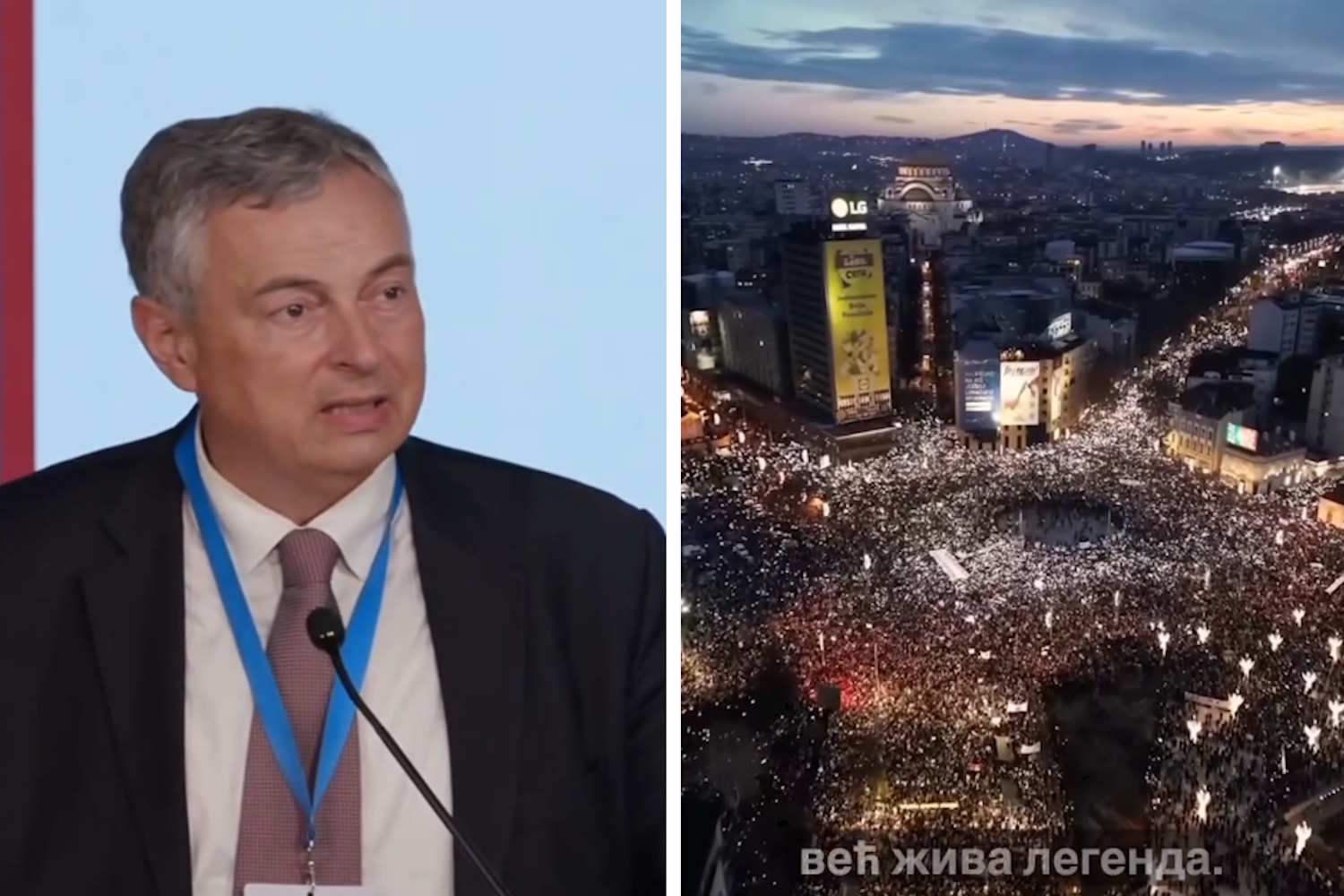
They started from the universities, filled the streets, crossed cities and villages, organized blockades and demonstrations. For almost two years they have asked for justice, transparency and accountability from a government that seemed impossible to send home. And in the end the Serbian students managed to turn that protest into an electoral victory.
In Serbia, the movement born after the collapse of the Novi Sad railway station shelter, which cost the lives of 16 people, defeated the Serbian Progressive Party (SNS) of Aleksandar Vučića nationalist and populist leader who dominated Serbian politics for over a decade, maintaining close relations with Russia.
The early parliamentary elections on 25 October thus mark a turning point in the recent history of Serbia. According to provisional data released by the Electoral Commission on the morning of October 26, with over 96% of the seats counted, the Student List won 52.54% of the votes against 39.29% of the coalition led by Vučić. Projections give it 140 seats out of the 250 in Parliament, enough to govern without allies.
It was Vučić himself, shortly after the polls closed, who acknowledged defeat.
It is clear that we lost this election, he admitted to his party’s supporters.
In Belgrade the news sparked celebrations. Thousands of people took to the streets, amidst flags, chants and motorists honking their horns. A night that marked the end of the long political dominance of Vučić and his party.
View this post on Instagram
The dead of Novi Sad
To understand how a student movement managed to defeat such a deep-rooted political apparatus, we need to go back to November 1, 2024. That day, in the city of Novi Sad, in the north of Serbia, a concrete shelter of the train station collapsed on the people underneath. Sixteen lost their lives.
The tragedy raised questions about the conditions of the structure, which had been renovated shortly before, about the safety of the works and the responsibilities of the authorities, while accusations of corruption, negligence and lack of controls fueled a protest that simply called for accountability to be ascertained and justice for the victims.
Students began to occupy universities, organize assemblies and block lessons. The demonstrations progressively spread to other cities, involving professors, workers and people who until then had remained far from politics. The request for the truth about Novi Sad thus became a broader challenge to the system of power built over the years by Vučić, accused by opponents of having weakened the independence of institutions, limited media freedom and favored a system in which political control prevailed over transparency.
From an incident that should have raised above all a question of public safety and responsibility, one of the largest protest movements in contemporary Serbia was born.
How students beat Vučić
As the months passed, the students built a mobilization network capable of reaching very different territories, from large cities to smaller communities, transforming university assemblies into a tool of political organization. Thus was born the Studentska list, the student list, made up not only of young university students but also of teachers, professionals and representatives of civil society, chosen through the movement’s participation mechanisms.
According to the Election Commission, 68.78% of eligible voters went to the polls, a figure significantly higher than the 58.77% of the previous parliamentary elections in 2023 and among the highest recorded by Serbia after the dissolution of Yugoslavia.
Long queues formed in front of the polling stations throughout the day, including in embassies and consulates abroad. In Vienna, where a large Serbian community lives, hundreds of people waited to be able to vote. In the United States, some voters had to show up at the polls in the middle of the night, due to times set based on Belgrade time.
Who are the students who defeated Vučić?
The Student List is not a traditional party and is not born from a single ideology. It brings together people with different political orientations, united above all by the request to put an end to Vučić’s system of power and to reform the institutions. The program aims to strengthen the independence of the judiciary, fight corruption, make public procurement more transparent and recover illegally acquired assets. Among the proposals there are also social measures, such as free school books and less expensive medicines.
But the movement also presents contradictions: during the celebrations many supporters raised three fingers, a gesture that recalls the list number on the ballot paper, but which is also historically linked to Serbian nationalism. A controversial symbol, especially for minorities and for the more progressive component of society.
View this post on Instagram
In any case, the students managed to unite very different voters around the request for change, but now they will have to demonstrate that they can transform that unity into a concrete government proposal.
What changes now for Serbia and Europe?
Vučić’s defeat closes a long political phase. The Serbian Progressive Party has governed since 2012, while Vučić held the position of prime minister from 2014 and that of president of the Republic from 2017, until his resignation in September 2026, presented in order to be able to run again for the leadership of the government.
Over the years, its executive has promoted infrastructure investments and economic development policies, but has also been harshly criticized for strong control over the media, pressure on institutions and accusations of corruption.
The Student List could now govern alone, if the 140 seats expected from the projections are confirmed, but the electoral victory is only the first step. Delicate questions remain open, starting with relations with the European Union and ending with the independence of the judiciary and Serbia’s position towards Russia and Kosovo. On an international level, the movement has not yet defined a unitary line, since within it there are positions in favor of European integration and more nationalist orientations, while the hypothesis of a referendum on the path to joining the EU has also been mooted.
Meanwhile, Serbia is not an isolated case. From Italy to Spain, from Albania to France, from Brazil, where youth mobilization contributed to Lula’s re-election, to Argentina, Chile and India, the squares tell different stories, but united by a common request: a more just and dignified future.
There are those who mobilize for the right to education, those for democracy, those against the high cost of living, for the climate, for decent wages, for a house or for the defense of rights and the end of wars.
For years we have said that young people are no longer interested in politics, that they are indifferent, disillusioned, incapable of imagining a different future. Yet, what is happening tells another story: young people are taking to the streets, organizing themselves, making their voices heard and, as Serbia demonstrates, they can even change the political course of a country.
