
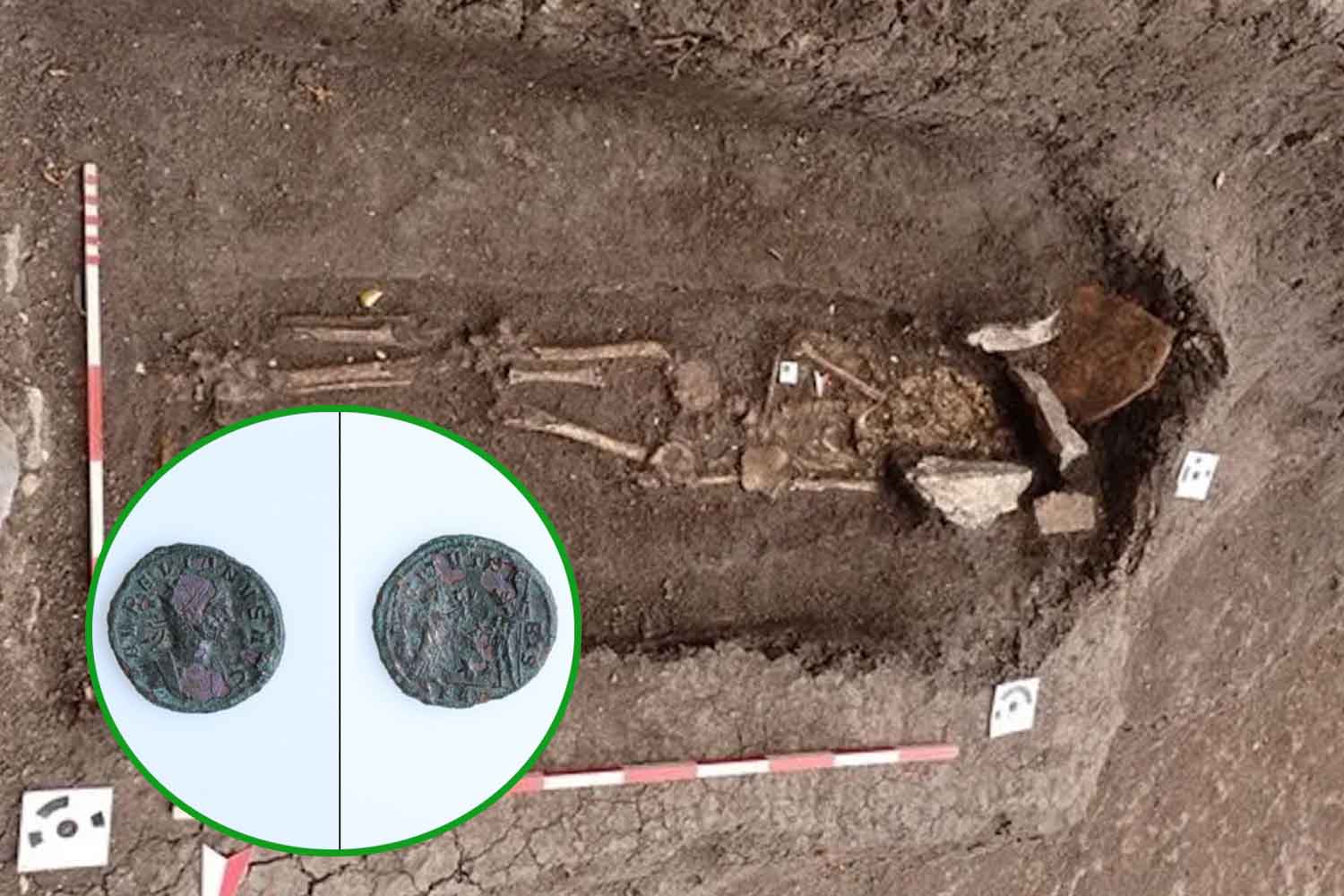
Someone, about 1,750 years ago, buried a child with two gold earrings and a coin. Just one, perhaps enough to pay for a trip that no one would have wanted him to undertake so soon. The tomb resurfaced in Stara Zagora, in Bulgariaduring preliminary excavations for the construction of a residential building with garage. And that small coin, minted under Emperor Aurelian, brought archaeologists back to one of the best-known funerary traditions of antiquity: payment to Charon, the ferryman of souls.
The discovery is part of a Roman necropolis with 135 burialsidentified by archaeologists from the Regional Historical Museum of Stara Zagora. The cemetery was located outside the walls of the ancient Augusta Traiana and was used from the end of the 2nd to the 5th century AD. Between pits, tiles and stone slabs, one of the tombs preserved those three objects. We know very little about the child, however.
A coin from 274-275 AD next to two gold earrings
The burial was oriented with the head towards the west and the feet towards the east. Archaeologists have recovered a pair of gold earrings and an antoninianus, a Roman coin introduced in the 3rd century AD, issued during the reign of Emperor Aurelian and minted in Serdica, now Sofia, between 274 and 275 AD
A rather precise dating, at least for the coin. The museum also attributes the burial to the same period, although an object may have been placed in a tomb sometime after its manufacture. However, for archaeologists it represents an important reference: the child cannot have been buried before that coin was minted.
Other details are missing. We do not know the precise age, biological sex or cause of death. The gold earrings indicate that precious objects were placed in the tomb, but they are not enough to establish which social class the family belonged to. That coin remains, placed next to the body. And here Charon enters the scene.
Charon’s Pence: Why Did the Romans Bury the Dead with a Coin?
According to Greek mythology, which later also merged into Roman traditions, Charon ferried the souls of the deceased across the waters that separated the world of the living from that of the dead. The service, apparently, was not free. To cross the river you had to pay an obol, a small coin. From this belief derives the funerary custom of leaving money to the deceased, often in the mouth or near the body, so that he could undertake the journey to the afterlife.
The presence of the antoninianus in the tomb of Stara Zagora could recall precisely this tradition. The Bulgarian museum, however, has not confirmed the ritual interpretation: in the official communication he describes the coin as part of the funerary objects and uses it to date the burial.
On the other hand, finding money next to a dead person does not necessarily mean being faced with Charon’s offering. The archaeologist also explains it Claudia Perassi in research The coins in burial: beyond “the offering for Charon” (in time and space)published in 2023. The deposition of coins in Greek and Roman tombs took on different meanings depending on the period, place and funerary practices. Interpreting them all as a payment to the ferryman risks attributing the same meaning to gestures that could have had different motivations. In the case of the Bulgarian child, therefore, the hypothesis remains plausible, but there is no evidence that would allow us to establish why that coin was left there.
©Regional History Museum – Stara Zagora Martin Kolev
Under a future residential building, 135 Roman tombs
The infant burial is only part of the Stara Zagora discovery. Archaeologists have identified a necropolis used for almost three centuries, with tombs built in different ways: some simple pits in the ground, others covered with tiles, bricks or stone slabs. Even the funerary rites were not all the same. On 135 burials, only four contained cremation remains. In the other cases the deceased had been placed in the ground. A variety that allows us to observe different customs in the same funerary space, frequented by successive generations.
The necropolis belonged to the ancient Augusta Traiana, an important center of the Roman province of Thrace, built in the area of present-day Stara Zagora. During the imperial age the city became an important administrative and economic center, so much so that it obtained the right to mint its own money.
The one found in the child’s tomb instead came from Serdica, another city in Roman Thrace. A detail that adds information on the circulation of money in the region, as well as providing a chronological reference for the burial. We don’t know if that coin was really intended for Charon. We know that someone placed it next to a child, along with two gold earrings, and that for about eighteen centuries no one touched them again.
