
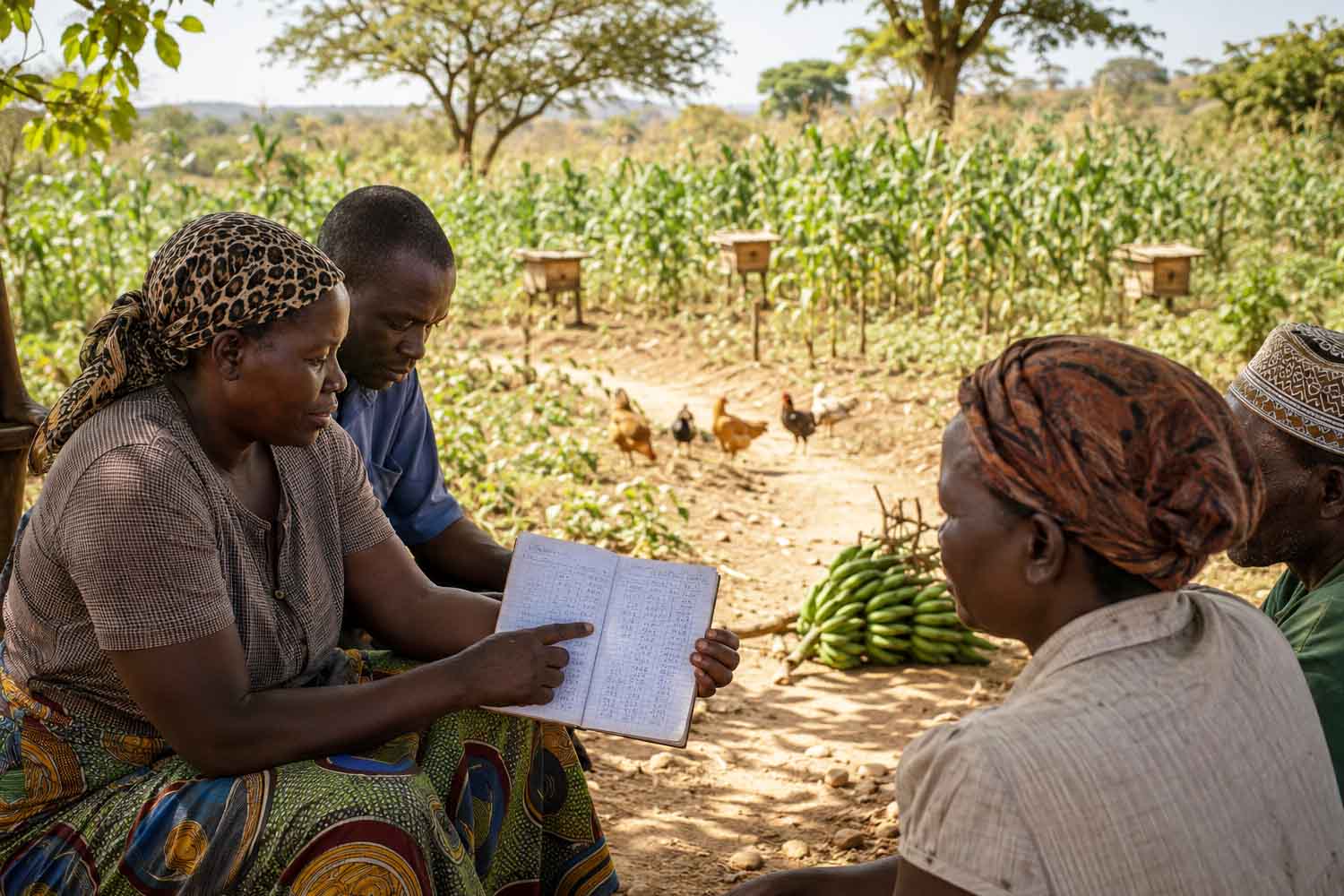
In the ten villages of Tarime district in northern Tanzania, a project targeting 850 small farmers is facing erratic rainfall and depleted soils with diverse crops, trees planted in the fields, beehives and chicken coops. Women, meanwhile, have acquired greater space in savings groups and in decisions about money, production and family activities. The project began in July 2022 along the Mara River basin, a resource shared by Tanzania and Kenya on which over 1.2 million people depend.
The scene changes within a few villages. In Kitenga, farmers report improved maize crops with rotation and organic fertilizer. In Kewamamba they report that the trees have helped reduce erosion and provide shade for crops. In Turugeti some women lead VICOBAs, small community banks powered by members’ savings. In Surubu, however, intermediaries continue to nibble away at earnings. Same climate, very different possibilities for defending oneself.
These results are collected by a study published in PLOS One by Edwin Estomii Ngowi and Angela M. Jesse, researchers at Sokoine University of Agriculture. The evaluation involved 265 farmers, 48% women, along with six focus groups, interviews, project documents and field visits.
The study follows what happened in Tarime between 2022 and 2024 through data, interviews and field visits. It does not allow us to attribute every improvement observed to the project: rainfall, access to markets and available resources change from one village to another. However, it shows where the interventions took hold and where they stopped when roads, equipment and rights were still missing.
A single harvest is too big a gamble
Before the project, many families depended mainly on corn and cassava, entrusting a large part of their income to the rainy season itself. The interventions have introduced rotation, organic fertiliser, varieties adapted to drought, legumes grown together with cereals and agroforestry: trees in or at the edges of the fields to retain the soil, limit erosion and make the microclimate around the crops less hostile.
In the data made available by the authors, 201 out of 265 participants declare having adopted at least one climate adaptation practice. In Kewamamba, farmers credit trees with reducing erosion; in Kitenga they link rotation and organic fertilizer to better harvests. Rainwater harvesting and efficient irrigation remain more difficult to spread, because they require materials and structures that a lesson alone cannot make appear.
The soil is still exposed to rain that arrives late or decides to skip the season. So part of the project left the fields and entered the courtyards: beekeeping, chicken and goat breeding, fish farming, soap production, tailoring, food processing and small business.
In qualitative materials accompanying the study, Kewamamba farmers describe more than 120 beehives, two fish ponds and activities related to the sale of poultry, bananas, peanuts and vegetables. The earnings, according to the testimonies collected, are used to buy food, pay for school or improve homes.
A beehive leaves the sky exactly as it is and adds honey to sell when the corn yields little. The chickens can pay for seed, feed or school fees while the field waits for the next season. In these parts, “diversifying your income” means preventing missed rain from entering all the rooms of the house.
Women enter the accounts
In Turugeti some women have taken the lead of VICOBA, groups in which participants pay small sums and can obtain loans from the common fund. That money was used to finance chicken coops, beehives and other activities. Credit, here, can take the form of a handwritten notebook and a meeting in which someone decides to trust.
The training covered financial management, productive activities and participation in family decisions. In Turugeti women reported greater confidence in administering resources; in Kitenga they participate in the management of VICOBA and in the forums in which it is decided how to use money and land. In Surubu some have started tailoring and soap production businesses. Much less decorative matters than an occupied chair during a meeting.
Land ownership proceeds at a decidedly slower pace. A World Bank assessment finds that formal property documentation is uncommon in Tanzania, but men are more than three times more likely than women to declare themselves sole owners. A woman can then administer a loan, choose seeds, and contribute to the harvest by working on land that continues to have someone else’s name.
On a national scale, another World Bank analysis estimated that reducing the agricultural productivity gap between men and women could increase Tanzania’s agricultural production by 2.7% and lift around 80,000 people out of poverty each year. The cost of inequality is also paid in poorer harvests and poverty: women work the land, while decisions more often remain with men.
The beehives arrived before the suits
The bees welcomed the project with their usual collaborative spirit: they continue to sting. In Kewamamba, however, beekeepers said they did not have enough suits, gloves and equipment to harvest honey safely. Some use hives little for fear of stings.
Soon after come the roads. In Kitenga, farmers explain that they have to sell their bananas cheaply to intermediaries because transporting them to the market is difficult. There is also a lack of warehouses and facilities for storing or processing perishable products; some families say they lose half their bananas. A better harvest can only become a higher mountain of ripe fruit, when everything else is missing after the field.
Even public indications can complicate the job. The project teaches people to reduce their dependence on chemical fertilizers, while government subsidies make them more accessible. Farmers receive training and an economic incentive that point in two different directions. Crop rotation works; that of the indications a little less.
The authors propose solar warehouses and cold rooms shared by groups of villages, the recovery of secondary roads to the Tarime market and small funds to buy beekeepers’ protection. They also suggest that each trained farmer shadows two other farmers during the following season. Refrigerators, roads, suits and people talking to each other: the most advanced solution, sometimes, looks a lot like the things that have been missing for years.
In Turugeti a woman opens her savings notebook; in Kitenga the bananas are still waiting for a road. The hives arrived before the suits, the crops before the warehouses. The good idea runs. Infrastructure takes its time.
