

Looking for solutions for theclean and renewable energya research group led by National University of Singapore He conducted a series of experiments from which it emerged that a flow of droplets similar to rain in a tube managed to turn on 12 LEDs. Are we close to a turning point?
The phenomenon that hides behind this experimentation is far from new: it is in fact well known for some time that, when two materials come into contact, the charged particles present on their surfaces can generate, through rubbing, static electricity. Likewise, the water that flows on some surfaces can acquire or lose charge.
And among other things a team of researchers from theUniversity of Melbourne and of the RMIT University recently discovered that Water can generate an electric charge up to 10 times higher as far as the phenomenon of stick-lip.
In practice, scientists discovered that when a drop of water remains “blocked” on a small obstacle or an irregular surface, and the accumulated potential energy generates sufficient kinetic energy to make it “jump or slide beyond the obstacle, and therefore one irreversible charge never reported before.
But what’s new compared to the common hydroelectric energy?
When running water moves a turbine, it generates electricity, and this is decidedly known and also applied on an industrial scale for some time. However, thehydroelectric energy It is limited to places with large volumes of water, such as rivers.
For smaller and slow water volumes, an alternative is exploit the charge separationa phenomenon that produces electric charges while water flows through a channel with an electrically conductive internal surface.
However, the separation of charges is extremely inefficient because it is limited to the surface on which the water moves. Previously, scientists have actually tried to increase efficiency making a greater surface available through micro or dwarf channels for a continuous flow of water.
But the water does not naturally pass through such small channels and, if pumped, requires more energy than it is generated. Today’s search, on the other hand, produces electricity using larger channels, so that rainwater can cross them.
The water that falls through a vertical tube generates a substantial quantity of electricity using a specific flow scheme: the cap flow – explains Siowling Soh, which guided the work – this cap flow pattern could allow you to allow collect the energy of the rain For generate clean and renewable electricity
How scientists have solved the problem
The team designed a simple configuration in which the water comes out of the bottom of a tower through a metal needle and sprays drops of the rain size in the opening of a 320 millimeter vertical polymer tube and 2 wide.
In this way the front collision of the drops at the top of the pipe causes a cap flow, with short water columns interspersed with air bags. And, while the water flows inside the tube, the electric charges separate. The water is therefore collected in a cup under the tube, with the cables positioned at the top of the tube.
Result? The piston flow system converts Over 10% of water energy Which falls through electricity pipes: the piston flow produces 5 orders of magnitude more of electricity compared to a configuration in which the water flowing in a continuous flow.
Since the speeds of the head drops are much lower than those of the rain, the researchers suggest that the system could be used for collect electricity from the drops of rain that fall.
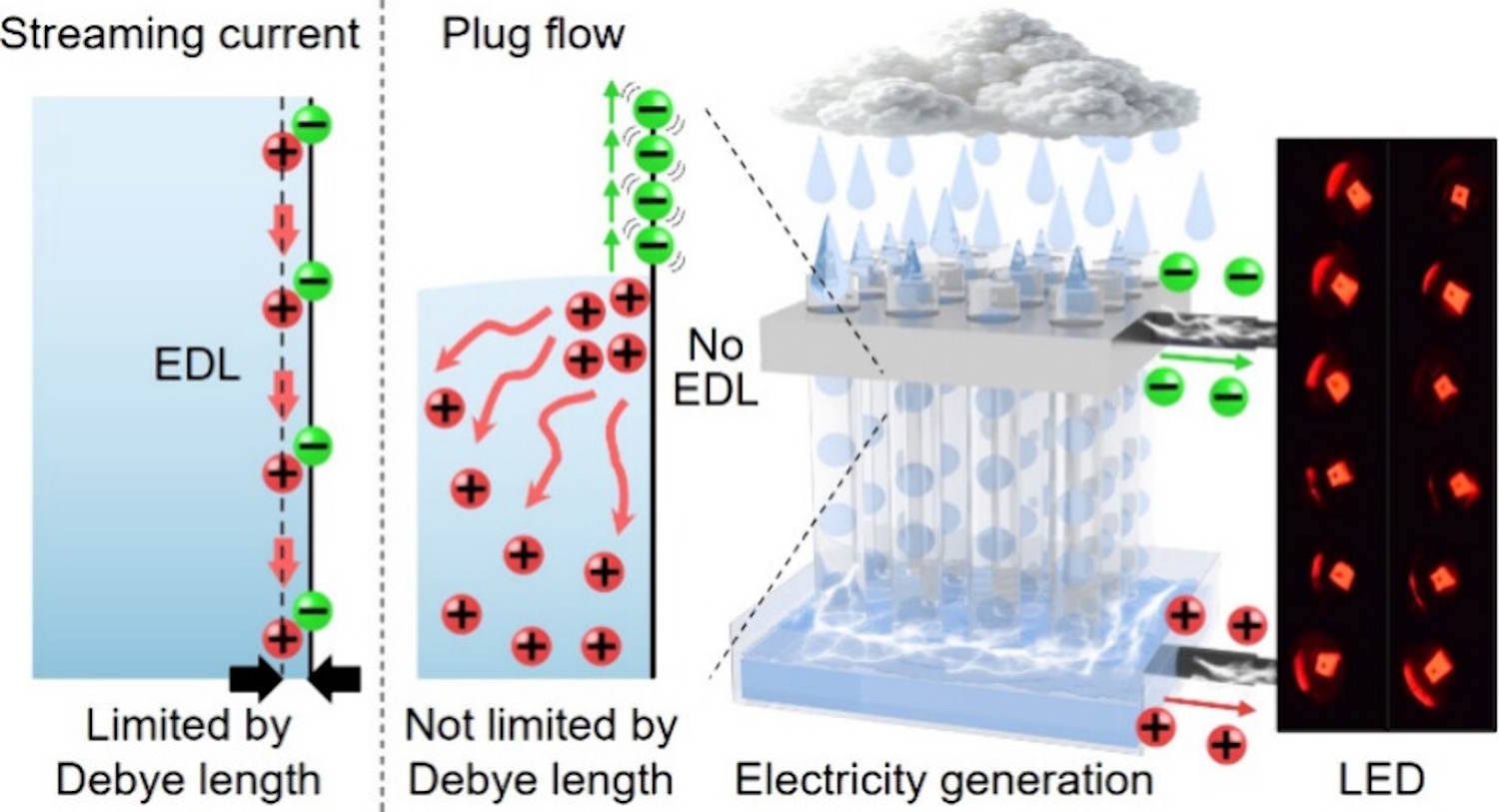
In another experiment, the researchers instead observed that the water flow through two tubes, simultaneously or in sequence, generates double energy. Using this information, they then channeled the water through four pipes and the system has powered 12 LEDs uninterruptedly for 20 seconds.
Among other things, researchers say that thePiston flow energy It could be easier to install and maintain compared to hydroelectric power plants and could be useful for urban spaces such as roofs. But of course this is only a first, very important, step.
The work was published on ACS Central Science.
Sources: Eurekalert/ ACS Central Science
