
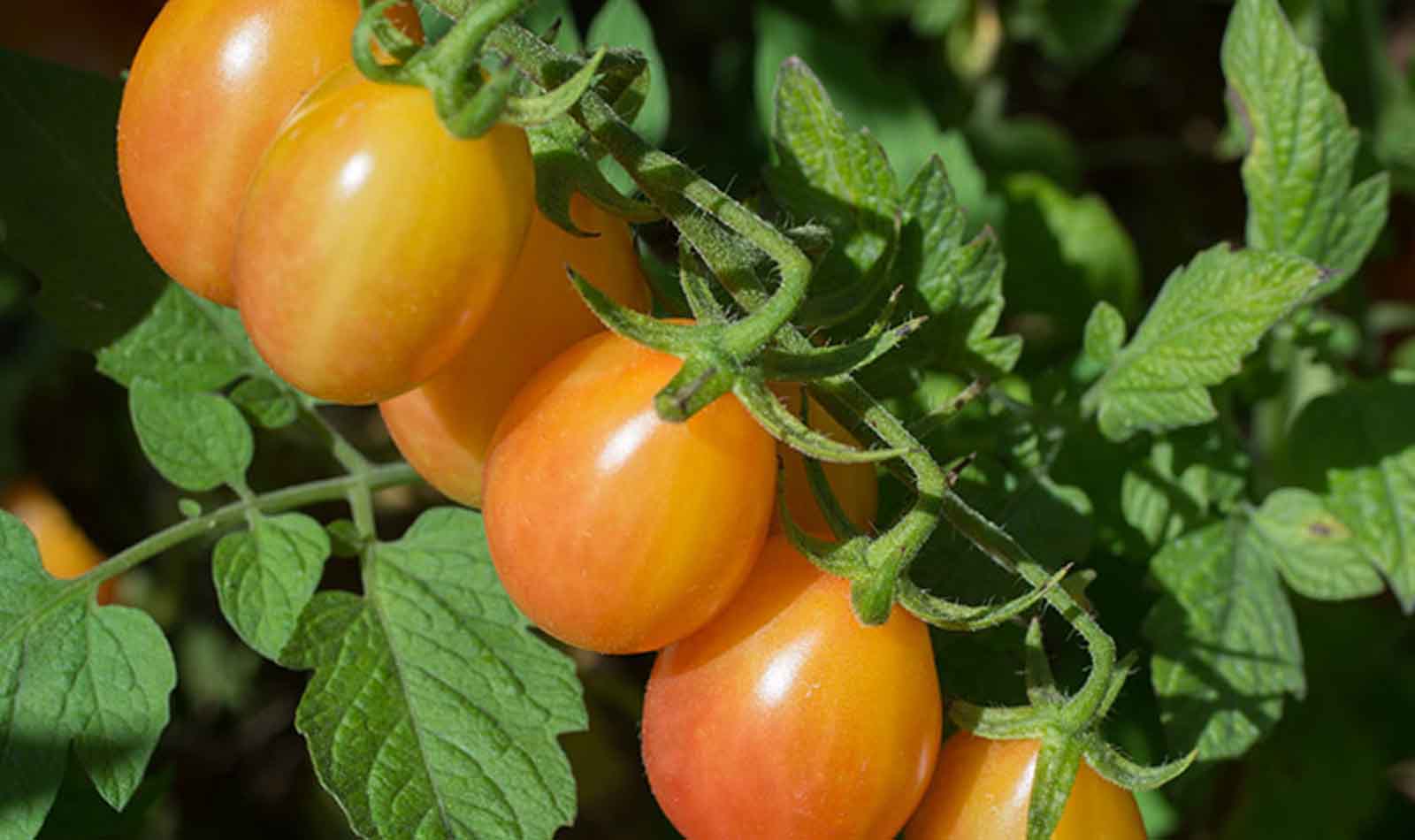
It’s small, two-toned, resistant to splitting, and has a flavor that makes you want to get another one right away. It’s called Scarlet Sunrise and it’s the latest arrival in the world of tomatoes: a yellow grape tomato with a light red hue, the result of over ten years of work by researchers at Rutgers University in New Jersey.
It was officially presented at the end of August during a public tasting, and those who tried it – including some journalists – praised its strong taste and crunchy texture. But Scarlet Sunrise is not just good to eat: it also tells a story of patience, biodiversity and sustainable research.
A cross between past and future
The idea was born in 2012, when Peter Nitzsche and Tom Orton, two experts from Rutgers, began working on a new variety of cherry tomato. They didn’t want to invent something from scratch, but combine the best of two already existing varieties: a very resistant and compact red tomato, and an ancient two-color variety, with an exceptional but fragile taste.
The problem? The red color in tomatoes is a dominant trait, so each new cross always seemed to bring back the same old classic red tomato. To obtain a two-colored, tasty and resistant fruit, the two researchers had to resort to a technique called backcrossing, which involves crossing the hybrids several times with one of the parents to stabilize the desired traits.
The work was long and meticulous: pollinations by hand with tweezers and brushes, year after year, with a lot of patience and no shortcuts.
A tomato that can be grown in 70 days and resists well
The result is a tomato ready in about 70 days, with a compact skin, which does not break easily, and with a perfect balance between sugars and acidity. It is meant to be eaten raw, perhaps straight from the garden to your plate.
But there’s more: Scarlet Sunrise aims to enhance local producers, in a market increasingly dominated by large Californian and Mexican agricultural companies. In this context, the strategy of New Jersey growers – where the tomato is a true tradition – is clear: not to compete on quantity, but on taste, as Nitzsche explained:
It doesn’t have to be aesthetically perfect. It has to be good.
And in fact, those who have tasted it confirm it.
During the official presentation, journalist Matt Cortina confessed to having returned to the tasting counter several times.
It’s one of those tomatoes that makes you want to eat more.
Rutgers has already obtained varietal protection from the United States Department of Agriculture and is seeking collaborations with producers and seed companies to make the seeds available to local growers and, in the future, also to home garden enthusiasts.
Scarlet Sunrise was actually supposed to launch as early as 2020, but Covid halted global seed distribution. Now, however, everything is ready to bring this cherry tomato to the tables – and into the gardens – of those looking for something good, sustainable and different from the usual.
There is still one detail that researchers are working on: the plant today can grow up to 2.5 meters in height, which is not ideal for those with limited space. For this reason, new, more compact versions are already being tested, also suitable for small urban gardens or pots on balconies.
The tomato of the future looks to the past
Scarlet Sunrise is part of a long New Jersey agricultural tradition. In the 1930s, Rutgers collaborated with Campbell’s Soup Company to develop canning tomatoes. Today, the university looks forward, but with the same spirit: producing varieties suitable for consumers, not just for industry.
In 2024 alone, New Jersey produced more than 60 million pounds of tomatoes, worth more than $36 million. Small numbers compared to American agricultural giants, but with great added value: quality and flavor.
And it is precisely from here that Nitzsche and Orton start again: with the desire to make Scarlet Sunrise even more suitable for everyone, without losing its qualities. Their goal? Continue to improve it, to make the tomato an increasingly tasty, resistant and easy to grow product.
You might also be interested in:
