
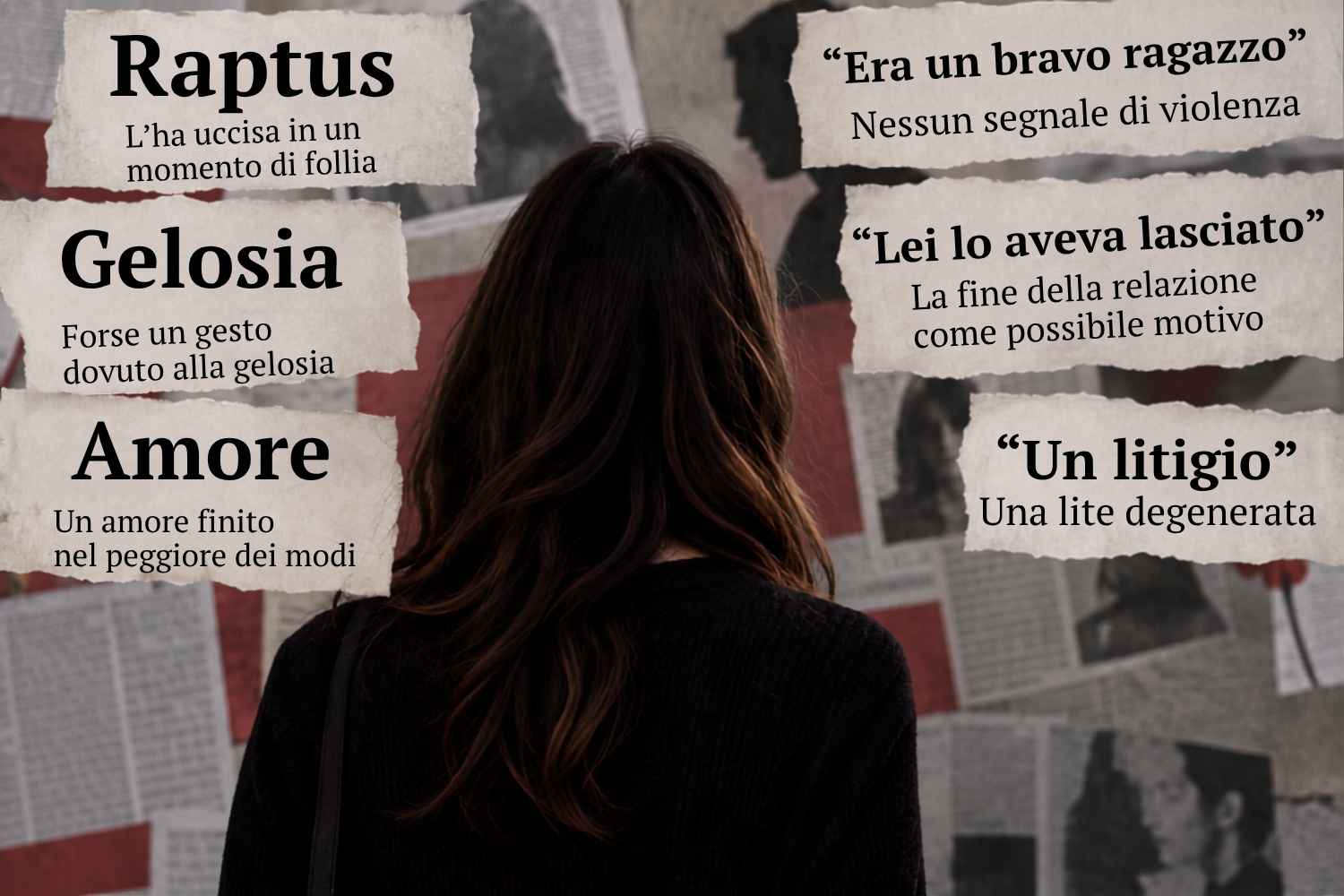
The best words are the ones we haven’t said yet. Or written. The best words that we journalists, and journalists, have used to describe violence against a woman, abuse, femicide, are those that are still waiting for the send button.
You, poor woman, “fragile victim“, he, “normally mild-mannered manAnd in the middle a wrong narrative of violence which is sometimes described as a fatality, a drama, a “tragic event”, surrounded by singular pathological justifications for an action – that of the guilty party – which instead is Always entirely voluntary. The last one is precisely the case of Lorena Isceri, who was even talked about in the last “voyage” in that car just to want to romance.
From rapture to delirium to momentary madness: we said them all, forgetting that – in all cases – that woman was killed after having reported her ex hundreds of times, who had been living in a state of anguish for months due to his threats, who had already been attacked. No furious outbursts, therefore, just the mathematical, linear, cold scheme of an aggressor who is, was, an active and aware male subject.
The difficult question to resolve, then? Also and above all the position of those who tell the facts. Every time a woman is killed, the media narrative risks repeating the same mistakes: transforming violence into a sudden destiny, seeking explanations in the alleged madness of the attacker, delivering to the news the story of a passion or, worse, of a story that seemed happy, instead of calling things by their name.
Language is never neutral: it can shift attention from the responsibility of those who act to the life of those who suffer, it can insinuate guilt into the victim, it can normalize violence as the inevitable outcome of a conflictual relationship. Talking about a femicide therefore means choosing your words carefully: avoiding romanticising the murder through love, jealousy or passion; do not justify the aggressor with psychological extenuating circumstances; do not transform the victim’s story into a secondary detail compared to the act of whoever killed her.
Even in the news, even before the send button, there is a responsibility.
The choice of images (which makes the difference)
Well, even the images we use are no different. When we talk about violence against a woman, it’s not just the words that have weight: a photograph chosen to accompany a piece of news is never neutral: it suggests an emotion, builds a perception, directs the gaze of the reader. For this reason, images are also part of the responsibility of those who inform.
Let’s think again about the feminicide of Lorena Isceri. Many have told the story with its executioner with photographs of the happy, smiling, in love couple: a kiss, a hug, a private moment that belonged to a time before the violence. A dinner and a glass of wine. But what do those images really say? Do they tell the victim or does he tell about a relationship that no longer exists? Do they restore dignity to the murdered woman or do they bring attention to the couple, to the man, to an alleged love affair that ended badly?
When a romantic photo is chosen to narrate a feminicide, the risk is that of creating a distorted narrative at the same time: that of a passionate tragedy, of a degenerate love story, instead of narrating precise violence and responsibility. It is the same mechanism that for years has led us to use words like “jealousy” or “sick love” to describe crimes that are based on possession and the desire to control.
In the case of Lorena Isceri, recounting her killing through happy images of the couple means adding a further wound, superimposing the memory of a relationship on the reality of the violence, as if that were the key to understanding what happened. But a woman is not killed because a love story ended badly, but because someone chose to exercise violence on her.
Images should accompany a news story, not change its meaning.
Beyond words: the handbook to talk about violence against women
The Coordination for Equal Opportunities of the National Council of the Order of Journalists distributed the handbook “Beyond words. Stalking, mistreatment, violence, rape, feminicide: how to communicate violence against women”a tool designed to help those who provide information to talk about these phenomena with greater awareness and responsibility.
We have said it a thousand times and continue to repeat it: a femicide is not just an individual story, but is part of a broader social phenomenon. For this reason, journalism must connect the single episode to the context of gender violence, to the cultural stereotypes and to the power dynamics that still run through society.
Only in this way can news also become a tool for awareness and prevention.
HERE you will find the ODG handbook.
