
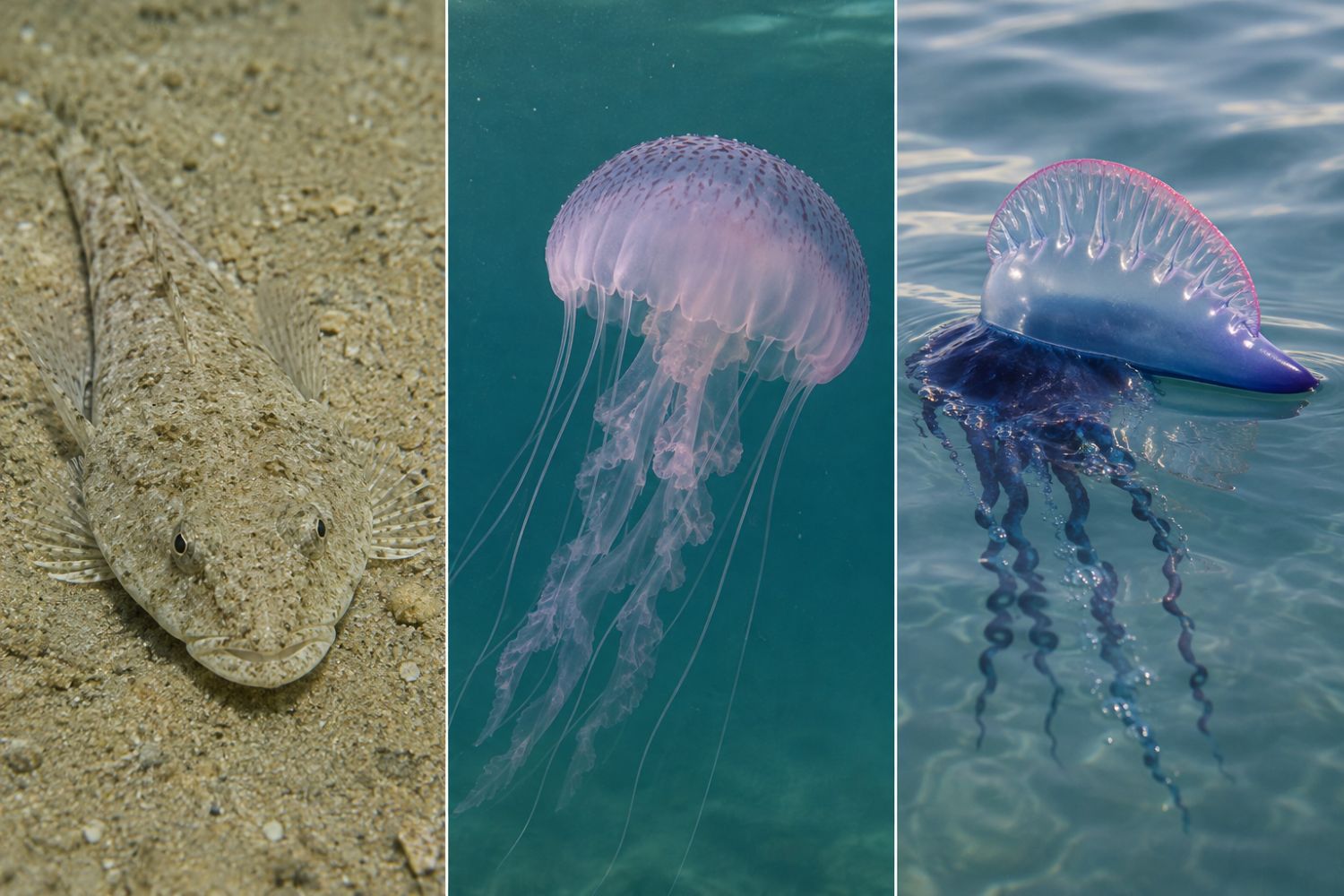
With the arrival of summer holidays and days spent at the seaside, the risk of encountering some marine animals capable of causing painful stings also returns. For this reason, the French ANSES has relaunched the topic, recalling which are the most common along the coasts, how to recognize them and above all what to do in case of contact.
Jellyfish, weevers (or spider fish) and Portuguese caravels do not represent a serious danger in most cases, but a reaction can be very painful and, in some situations, require medical assistance. Knowing how to behave can therefore make the difference.
Weavers
Among the most frequent encounters along the Mediterranean coasts is the one with the spider fish, also known as weever. This small fish lives on shallow sandy bottoms and manages to blend in almost completely with the surrounding environment, making it difficult to notice its presence.
The problem arises above all when it is accidentally stepped on by swimmers who walk barefoot in the water. The poisonous spines present on the dorsal fin and on the gill covers can cause a sudden sting, accompanied by very intense pain.
The affected area can quickly become red and swollen, with a burning sensation that can last for several hours. In most cases the situation resolves without serious consequences, but more rarely complications such as infections, local lesions or limited movement can appear if the sting affects areas close to the joints.
Spiderfish venom is sensitive to heat: immersing the affected part in hot water, at a temperature that does not cause burns, can help relieve the pain. If the symptoms are particularly intense or persist, it is still advisable to contact a doctor.
Jellyfish
Jellyfish are among the best-known marine animals and, in most cases, their stings cause local reactions without major consequences. Their gelatinous body is equipped with tentacles covered in stinging cells which, upon contact with the skin, release substances capable of causing irritation.
The sting generally causes immediate pain, a burning sensation, redness and marks on the skin that may resemble lines or streaks. The itching can persist for a few days.
In case of contact it is important to get out of the water, both to avoid new bites and to reduce the risk of accidents due to pain or fright. The affected area should be rinsed with sea water, never with fresh water, which could encourage the release of further stinging substances. Any tentacles remaining on the skin should be carefully removed using a hard surface, such as a card or similar object, avoiding touching them directly with your hands.
Portuguese caravel
The Portuguese caravel is not a true jellyfish, even though it may seem like one. It is a siphonophore, that is, a marine organism made up of a colony of small specialized individuals that live together as if they were a single animal. Its most recognizable feature is the air-filled float, blue-purple in colour, which allows it to remain on the surface of the sea, while its long stinging tentacles extend under the water.
Its presence varies according to sea conditions, currents and winds, but in recent years some specimens have also been reported in the Mediterranean. The main danger is its stinging tentacles, which can reach considerable lengths and which can continue to be active even when the animal is beached.
Contact can cause immediate and very intense pain, accompanied by redness, swelling and skin lesions. In some cases, more general symptoms may also appear, such as nausea, difficulty breathing, muscle cramps or sudden discomfort which, if it occurs in water, can increase the risk of drowning.
The most important rule is therefore never to touch a Portuguese caravel, even if it seems immobile on the beach.
In case of contact, the first thing to do is get out of the water and not rub the affected area, because this could encourage the release of more poison. ANSES recommends rinsing with sea water and, in the specific case of the Portuguese caravel, with sea water to which edible vinegar has been added if available. Tentacles remaining on the skin must be removed carefully, without touching them directly with your hands. In case of general symptoms or breathing difficulties, you should contact a doctor immediately.
How to protect yourself while bathing
To reduce the risk of unpleasant encounters, it is important to pay attention to reports of the presence of marine animals and prefer, when possible, controlled bathing areas. In shallow sandy bottoms it may be useful to use water shoes to protect yourself from spiderfish bites, while any animal found in the sea or on the beach should be left where it is.
Jellyfish, spiderfish and Portuguese caravels are part of the marine environment and an encounter with them does not necessarily mean an emergency. However, knowing these animals and knowing how to behave allows you to deal with a sting in the correct way and continue to enjoy the sea in safety.
