
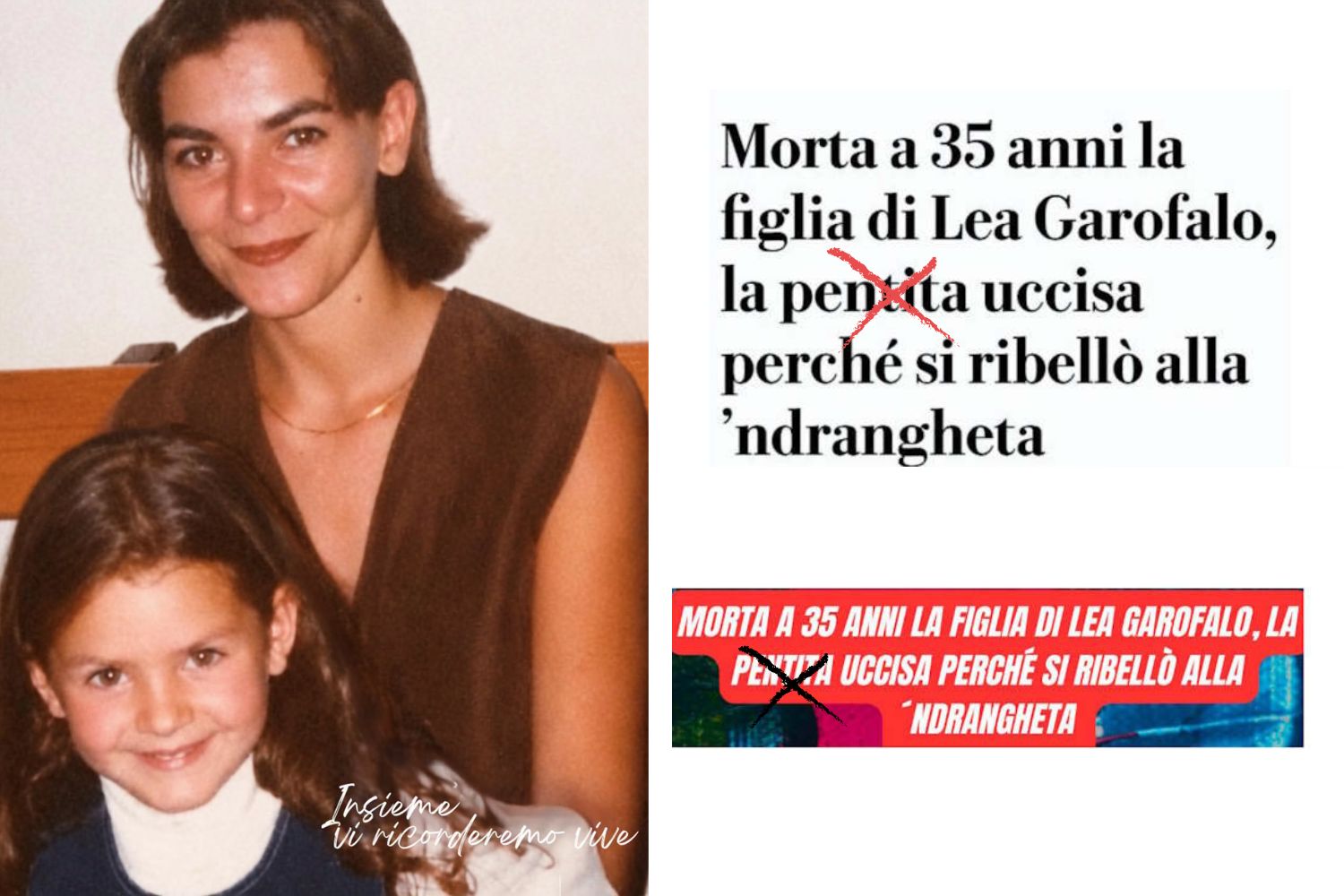
After the suicide of Denise Cosco, Lea Garofalo’s daughter, some headlines called her mother a “repentant.” A word that has entered common language, but which in this case is inappropriate: Lea Garofalo was a witness of justice. The difference is not only in the terms, but it tells profoundly different stories.
The death of Denise Cosco, daughter of Lea Garofalo, has brought one of the most painful events in the fight against the mafia back to public attention. A story made of violence, loneliness, courage and a long battle to obtain justice. When telling it, however, some media outlets used the term “repentant“, generating reactions and discussions. A definition which, in common language, is often used to indicate those who decide to collaborate with the judiciary against organized crime, but which in Lea’s case is incorrect.
Lea Garofalo was not a person belonging to a mafia organization who had decided to dissociate herself from her criminal past. She was a witness for justice: a woman who, despite not being affiliated with the ‘Ndrangheta, chose to tell what she knew, breaking the silence imposed by fear.
Who was Lea Garofalo
Born in 1974 in Petilia Policastro, in the province of Crotone, Lea Garofalo grew up in a family context marked by the ‘ndrangheta. Having lost her father, killed during a mafia feud, at 14 she met Carlo Cosco, a member of a rival clan, with whom she had her daughter Denise in 1991.
Over time she decides to break with that environment and tell the investigators what she knows about the criminal dynamics that surrounded her. For this choice he enters the protection program together with his daughter, abandoning his life and living far from his places of origin.
On November 24, 2009, she was lured to Milan by deception by her ex-partner Carlo Cosco and killed. His body is destroyed in an attempt to erase all traces. His remains were found only years later. Since then Lea Garofalo has become a symbol of the courage of those who choose to oppose the mafias and silence.
Who was Denise Cosco
Denise, daughter of Lea and Carlo Cosco, grows up under protection with her mother, living a childhood marked by escape, isolation and the need to hide her identity.
After Lea’s killing, Denise continues the protection journey until 2018, building a new life away from the spotlight with the support of the Central Protection Service, Don Luigi Ciotti and Libera.
Its existence has been profoundly marked by mafia violence, but also by the search for a possible normality. A story that tells the price paid by the children of those who decide to challenge organized crime.
Today a courageous and suffering young woman died – says Don Luigi Ciotti, founder of Libera and the Abele Group, in a note. Courage and suffering represented the two extremes within which Denise’s entire life moved, the two levels of the scale that she tried for a long time, with all her strength, to keep in balance. Today, however, something in that very fragile balance has been broken forever.
The difference between “repentant” and “witness of justice”
The distinction between the two figures is fundamental. In the Italian system the category of “repentant” does not formally exist, but the correct term is collaborator of justice.
The justice collaborator is a person who has been part of a criminal organization, often with a role within it, and who decides to collaborate with the judiciary by providing information on the group’s activities, its members and responsibilities, sometimes including their own. The term “repentant” has entered journalistic and common language, but is also used in some criminal circles with a negative meaning, to indicate those who break the bond of silence.
The justice witness, on the other hand, is a person unrelated to the criminal organization who becomes aware of relevant facts and chooses to report them or tell them to investigators. He does not have to “repent” of a criminal past: he makes a choice of civil responsibility, often paying a very high price in personal and family terms.
Lea Garofalo belonged to this second category.
Because words matter
Words are never just words. Especially when they tell of broken lives, difficult choices and people who had the courage to stand against something bigger than themselves.
Calling Lea Garofalo a “repentant“means risking losing the deepest meaning of her story. Lea didn’t have a past in a mafia organization from which to distance herself: she was a woman who had known that reality closely and who, at a certain point, chose to no longer remain a prisoner of it. She chose to speak, to tell, to rely on justice.
For this reason Lea was a witness of justice. A definition that is not a bureaucratic detail, but conveys the meaning of his choice: not repentance for something he had committed, but the courage of a person who decided to break the silence, even knowing that that decision would change his life forever.
And Lea’s story is inevitably intertwined with that of Denise: behind every choice against the mafia there are often people who pay a huge price, even when they did not choose that battle. Denise has experienced first-hand the weight of a life turned upside down, of a necessary protection, of a pain that is impossible to erase.
His story reminds us that it is not enough to celebrate the courage of those who choose justice: we must be able to accompany him, protect him, truly support him.
As Don Tonino Palmese, president of the Pol.is Foundation of the Campania Region, recalled:
The death of Denise, daughter of Lea Garofalo, a witness to justice, an innocent victim who was able to rebel against the tight grip of the ‘Ndrangheta, does not just require us to reflect. They would be obvious words and would not serve to bring Denise back to life. It imposes presence, protection, community on us.
They are words that go beyond memory and ask us for collective responsibility, because remembering does not just mean pronouncing names and dates, but asking ourselves what we can do so that those who choose the path of legality do not have to feel alone.
Lea Garofalo was not a “repentant”. She was a witness of justice. A woman who had the courage to say no to silence and who, for that choice, paid the highest price.
