
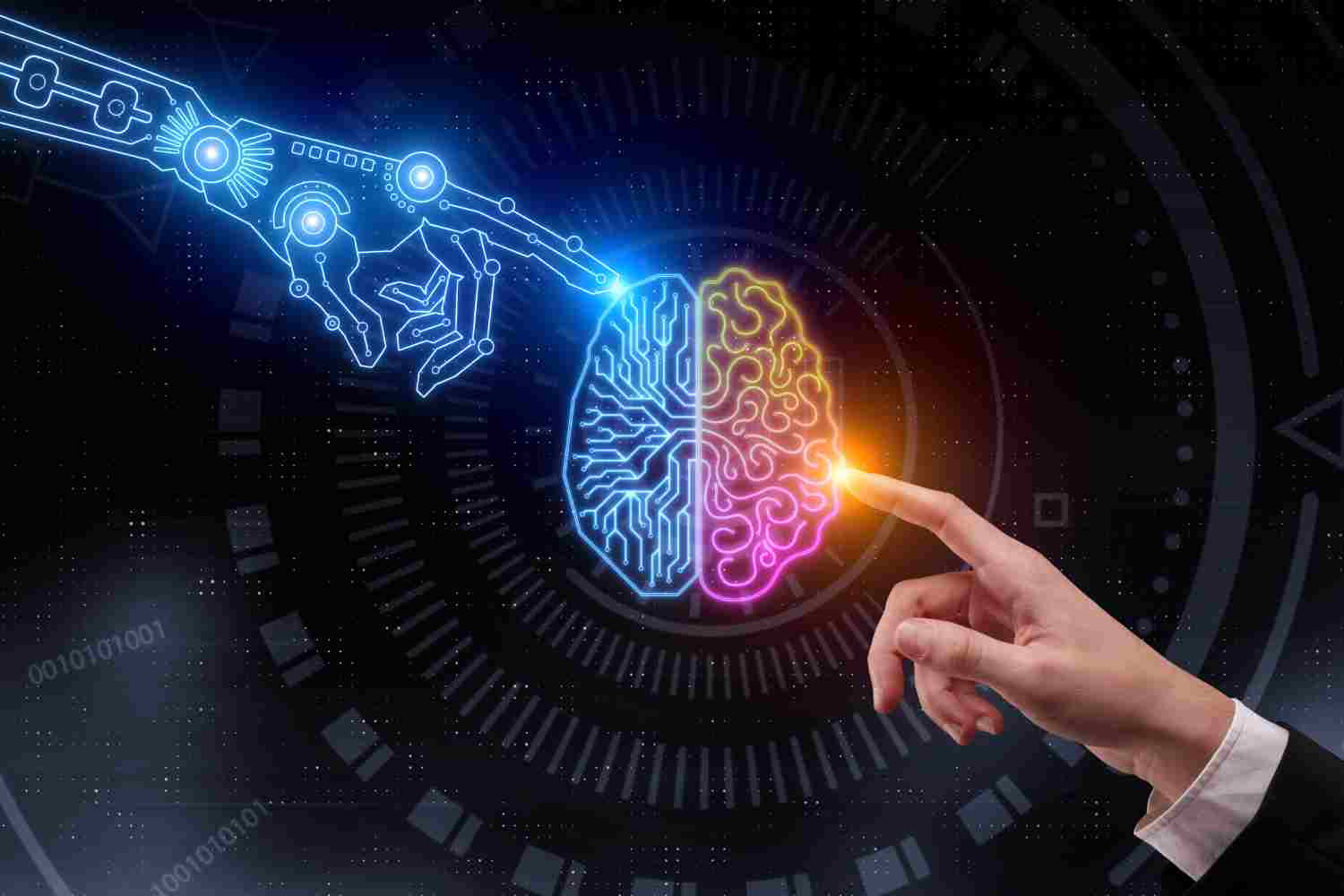
In the era ofartificial intelligence Who promises to make us more productive and efficient, are we perhaps becoming less capable of thinking? It is the uncomfortable question that emerges from a newly published MIT study, and the answer may not like us.
The team of Media Lab of the Massachusetts Institute of Technologyled by the neuroscientist Nataliya Kosmynamonitored 54 young adults, all residing in the Boston area. Everyone was asked to write three essays inspired by the tests of the Sat (the university admission test in the United States, known to evaluate the writing and critical thinking skills of the students): one independently, one using Google, one with the help of chatgpt.
The results of the study “Your Brain on chatgpt“(June 2025) They are unequivocal: the regular use of generative chatbots can significantly alter brain activity, reduce memory, weaken critical thinking. A revolution, yes – but downwards.
During the sessions, the participants were monitored through electroencephalogram (EEG), to measure brain activity in 32 regions. The results are, in no uncertain, disturbing terms: the group that used chatgpt showed the lowest levels of neural activation, both in the Alfa, Theta and Delta bands (associated with creativity, attention and memory), and in the ability to retention of information. Worse: the participants did not remember almost anything about the texts produced with the IA, and they struggled to rewrite them without support.
“It’s as if the brain went off slowly, delegating everything outside,” explained Kosmyna. “Is called cognitive offloading – excessive cognitive outsourcing – and has a price that we could pay dearly “.
Cognitive debt and the price of comfort
To force with force is the concept of cognitive debt: a slow and progressive loss of the ability to elaborate, create, learn. Less you write thanks and by virtue of your mind, the more difficult it becomes to do it later. And the risk is amplified for the youngest, whose brain is still being developed. “What really pushed me to publish this study immediately, without waiting for the equal review, is the fear that in six to eight months some politicians decide: ‘We make a GPT nursery school. I think it would be absolutely negative and harmful,” said Kosmyna.
The effects, documented along more months, go beyond brain performance. The texts generated with chatgpt were described by the evaluators as repetitive, not very personal and cognitively dishes. Standard sentences, predictable structures, almost no stylistic variation. “Derivative texts”, they call them researchers. An observation that asks questions not only about the AI, but on the identity of the writer: many participants did not recognize themselves in their own essays.
Not all technology is the same
An interesting confrontation also emerges between the two used tools: Google and Chatgle. Participants who have relied on traditional research have maintained a good level of brain activation and higher personal satisfaction. They selected, selected, filtered – in other words: they thought. Chatgpt, on the other hand, seemed to encourage more passive use: it copys, pastes, just reformulates. In the long run, you stop thinking.
The illusion of efficiency
The study is not an ideological attack on technology. But it is an invitation – strong, authoritative – that uses it critically and aware. The IA can be an ally, if integrated into an active learning process. This is demonstrated by the fourth phase of the experiment: the “trained” participants in autonomous writing have been able to exploit the IA in a more targeted, intelligent way. It is not a question of rejecting innovation, but of not anesthetizing thought in the name of comfort.
Kosmyna, who today works on a new study on the use of AI in software programming, warns: the first data are even more alarming. If automation enters too early and too deep in the fundamental cognitive processes, the risk is a generation unable to analyze, create, problematize.
The implications are profound and go far beyond the academic field. We speak of school, of course, but also of professional training, creativity, citizenship. Because knowing how to write is not just a technical competence: it is a form of thought, an exercise of identity. And stopping practicing it may mean to stop, slowly, to be autonomous.
