

100% electricity from certified renewable sources, a water footprint that will be calculated and monitored in detail for the first time, approximately 85% of existing locations and plants, reducing the need for new construction. And then the most gender-balanced in the history of the Winter Games, with approximately 47% of female athletes competing.
They are the XXV Milan Cortina Olympic and Paralympic Winter Games of 2026, gentlemen, presented with a drum roll as the most sustainable ever. But environmentalists and associations complain that the reports are missing many numbers and data.
In short, is that vaunted sustainability authentic or a sugarcoated narrative?
The numbers that the Milano Cortina Foundation claims
On the official declarations front, there are some positive elements. The Milano-Cortina 2026 Foundation says that the event will use electricity coming 100% from certified renewable sources and that, for the first time, the water footprint of the Games will also be calculated and monitored. An important step forward, at least on a methodological level.
Another often cited data is that on the facilities: approximately 85% of the competition venues already exist, while the remaining should be temporary or reconvertible. In theory, this would reduce land use and the impact of new construction, one of the historic Achilles’ heels of the Winter Olympics.
On a social level, Milan-Cortina 2026 also presents itself as one of the most inclusive editions ever, with female participation estimated at around 47%, a record for the Winter Games.
A network of 20 national and territorial associations – including Libera, Italian Alpine Club, WWF Italy, Italia Nostra, Legambiente, Mountain Wilderness Italy and CIPRA Italy – will monitor the transparency of the works and public spending introduced for the Milan-Cortina 2026 Olympic and Paralympic Winter Games with the campaign Open Olympics 2026launched in May 2024.
When it comes to the real sustainability of the Milan-Cortina 2026 Winter Games, the problem is not only what the data tells us, but above all what it doesn’t tell us. And it is precisely in the information gaps that the most relevant critical issues emerge.
The data that is missing (and that makes the difference)
The first major issue concerns the actual environmental impact of the works and the event as a whole. To date, there is no reporting of the CO₂ footprint for each individual infrastructure. The only data available is an aggregate estimate provided by the Milan-Cortina Foundation: 1,005,000 tonnes of CO₂ equivalent for the entire cycle of the Games (2024 estimate). To give an order of magnitude, it is as if all the inhabitants of Milan took a return flight from Rome to New York. An important number, which however remains opaque if it is not possible to understand where the emissions come from and which works weigh the most.
The second critical point is economic transparency. The Open Milano Cortina 2026 portal indicates the overall costs of the Works Plan, but does not say who is paying the increases. In the original decrees the sources of financing were specified; in the portal, however, this information has disappeared. We know how much it costs, but not which public or private entities are absorbing the extra costs, nor with what effects on budgets.
The third element concerns subcontracting. The names of the companies appear, but without economic amounts and without CIG codes. This makes it impossible to cross-reference the data with the ANAC platform, evaluate market concentration or understand the real weight of individual companies. In practice, the subjects are visible, but their economic role remains in the shadows.
The Open Milano Cortina portal covers only a part of the Olympic machine. Many of the “non-data” depend on the fact that the Games system involves a plurality of subjects – state bodies, regions, municipalities, investee companies, foundations – without a single and coherent information framework. The result is partial transparency, which makes an overall assessment of sustainability, costs and impacts difficult.
Three civic questions still open
Three civic questions remain frighteningly open, due to the difficulty of accessing certain, complete, updated, organized data, say the Associations.
How many works really exist and how much do they cost?
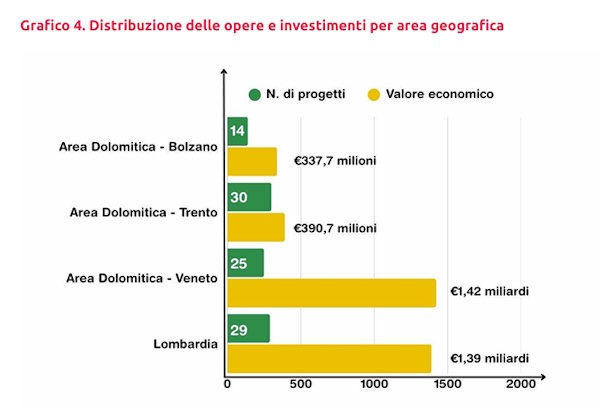
The portal lists 98 works, but many are missing, in particular those of ANAS and especially those of local authorities. The Lombardy Region alone, on the “Beyond Games 2026” platform (with non-downloadable data), indicates 78 interventions for 5.17 billion euros, of which 44 are works and 3.82 billion not present in the Open Milano Cortina 2026 portal. A void that alters the perception of the real cost of the event.
How much does it really cost to hold the Games and ensure health and safety?
The so-called “Lifetime Budget” of the Milano Cortina Foundation, updated to 2025, would amount to 1.7 billion euros, but the document is not public. The private nature of the Foundation, although formally legitimate, severely limits the right of access to information. On the security front, the Sports Decree allocates 271 million euros, however subtracting 43 from the Fund for victims of mafia and usury. On the healthcare level, a single plan is missing: each Region proceeds independently, without an overall estimate of costs.
What is the role and how transparent is the Paralympic Commissioner?
The Sport DL assigns the Commissioner 328 million euros to spend between September and December 2025. The initial estimate for the Paralympics was 71.5 million: an increase of 359%. The powers attributed to the Commissioner are very broad and affect Simico SpA and the Foundation, but the first quarterly report, expected by 5 December, has not yet been published.
The network is already collaborating with French civil society ahead of the 2030 Winter Games, to affirm a simple but radical principle: not a stone moves without transparency.
