
Imagine organizing a beach holiday in August and discovering that the heat makes it difficult to even spend a few hours on the beach (someone has already experienced it this year…). Or book a skiing week and find mountains with less and less natural snow. It doesn’t necessarily happen everywhere and in the same way, but the climate with which we have associated some of our favorite destinations for decades is certainly changing. And the Mediterranean is one of the territories destined to suffer the most.
According to the new Destination Climate RiskScan report, presented on the tourism day of COP31 in Antalya, by 2050, 63% of the Mediterranean tourist destinations analyzed could find themselves under double pressure: an increase in exposure to climate risks and, at the same time, weather conditions less favorable to the activities that today attract millions of visitors.
But there is another fact that shows how profound the ongoing transformation is. A second report, the Communities at the Helmjust released by the WWF on the occasion of COP31, warns that up to 20 million people in the Mediterranean could be forced to leave their homes by the end of the century due to rising sea levels, in the absence of effective climate measures.
Two different studies, two different time horizons, a common problem: climate change is not only transforming the landscape, but is putting pressure on the economies and communities that depend on that landscape.
By 2050 almost 2 out of 3 Mediterranean destinations will be under pressure
The Destination Climate RiskScan, created by Travel Forward, Risklayer and the Center of Expertise Leisure, Tourism and Hospitality (CELTH), examined 2,588 tourism regions in 263 countries and territories, comparing exposure to different climate hazards with the conditions needed to carry out activities such as swimming, sightseeing, skiing or hiking.
@Destination Climate RiskScan
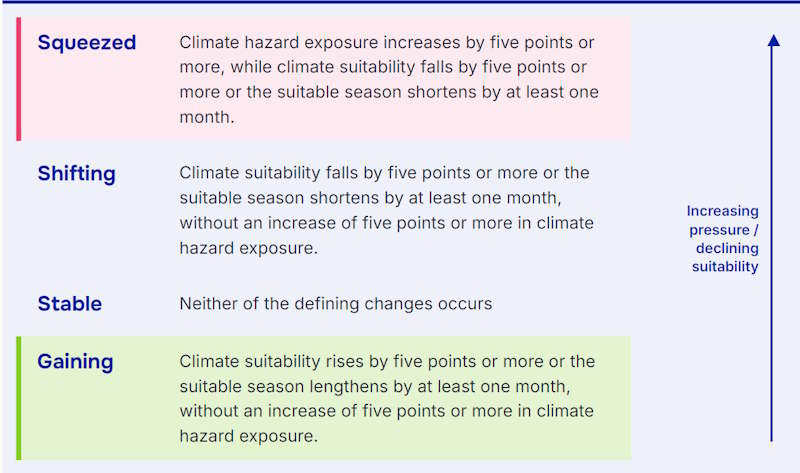
The researchers use the English term squeezedliterally “crushed”, to indicate destinations that risk finding themselves caught between two phenomena: on the one hand extreme heat, drought and intense meteorological events; on the other, a reduction in the period of the year in which the climate is favorable for tourism.
@Destination Climate RiskScan
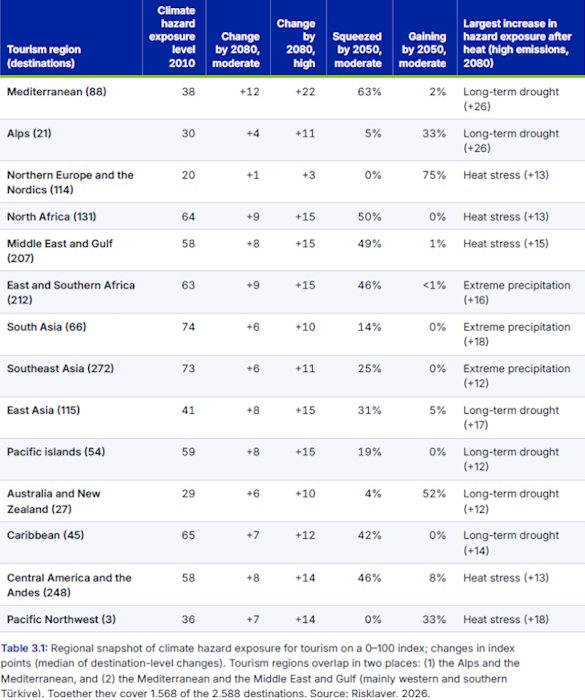
On a global scale, this condition could affect 36% of destinations by 2050 in a moderate emissions scenario. The percentage rises to 62% if emissions remain high.
In the Mediterranean, however, the share already reaches 63% in the intermediate scenario, considering the 88 areas analyzed in the region. This does not mean that two out of three tourist destinations will disappear, nor that they will become impossible to visit. It means they may simultaneously face increased climate risks and a reduction in conditions conducive to traditional tourism activities.
@Destination Climate RiskScan
In other words, a beach resort might continue to attract tourists, but at different times of the year. A city of art may have to rethink visits, routes and services during the warmer months. A ski destination may need to focus more on activities that don’t depend on snow.
What could change in Italy
For a country like Italy, where seaside tourism, cultural heritage and mountains represent three pillars of the tourist offer, the implications are particularly relevant. Let’s think about Rome, Florence or Venice: visiting monuments and historic centers in the summer months could become increasingly tiring during heat waves, especially in urban areas with little shade and high temperatures.
It does not mean that these cities will lose their tourist appeal, but that the ideal season to visit them could progressively shift towards spring and autumn. The report estimates that, in the Mediterranean, the average length of the climatically favorable season for tourist visits could be reduced by approximately 2 months by 2080 in the high emissions scenario.
Seaside tourism could also change. Warmer water isn’t necessarily good news for vacations: High temperatures, droughts, wildfires and extreme weather can make staying in coastal locations less comfortable or more challenging.
The Dolomites
The report dedicates a specific study to the Dolomites, included among the six pilot cases used to evaluate the vulnerability and possibilities of adaptation of tourist destinations. The analysis concerns in particular Skirama Dolomitesthe tourist area of western Trentino, where a significant part of the local economy depends on winter sports. While maintaining a relatively low overall climate risk classification, the area now has signs of pressure linked above all to the decrease in natural snow and intense precipitation.
The problem does not only concern the possibility of skiing. Less snow means questioning the length of tourist seasons, the use of water for artificial snow, the maintenance of slopes and the safety of mountain infrastructures. According to RiskScan projections, in the Alps the average months suitable for skiing on natural snow could go from around two in 2010 to less than one by 2080 in a moderate emissions scenario, to zero in the high emissions model.
These are regional climate estimates that do not take into account differences in altitude or artificial snow and should not be interpreted as a prediction of the closure of individual ski areas. But they certainly indicate a precise direction: continuing to base the mountain economy exclusively on the ski season will become increasingly risky.
The WWF report
If the Destination Climate RiskScan describes how the conditions for travel will change, the new WWF report shows what happens by looking at the Mediterranean from the perspective of those who live there all year round. In the Mediterranean basin, around 150 million people live near the coasts, where cities, ports, economic activities, infrastructures and entire communities linked to the sea are concentrated.
The Mediterranean is warming at a rate about 20% faster than the global average. At the same time, sea levels continue to rise: according to data reported by the WWF, the average rate of rise went from 1.4 millimeters per year in 1993 to 2.8 millimeters in 2018. Beach erosion, coastal flooding and the progressive loss of natural habitats therefore represent a threat that goes far beyond tourist attractiveness.
Recalling projections from the 2026 MedECC report, WWF warns that without effective adaptation, accompanied by rapid reductions in emissions, up to 20 million people could be forced to abandon their homes by 2100 due to the effects of rising seas.
A coast that is losing ground doesn’t just lose beaches for tourists. They can lose homes, economic activities, places of work and a part of their identity.
This is where the two relationships meet: climate change simultaneously puts pressure on those who visit an area and those who depend on that area to live.
It should also be considered that RiskScan, in its first version, does not yet directly include sea level rise, coastal flooding and erosion. The WWF report therefore adds a fundamental dimension that tourist classification alone is not yet able to represent.
Posidonia and the role of local communities
Faced with these scenarios, adapting does not just mean building new protection infrastructures.
In the report Communities at the HelmWWF and World Resources Institute underline the role of natural ecosystems and the people who know and inhabit the territory. An example is Posidonia oceanica, a marine plant typical of the Mediterranean whose meadows help protect the coasts from erosion, store carbon and constitute a fundamental habitat for numerous species. Protecting them therefore means intervening on multiple fronts: biodiversity, ecosystem stability, fish resources and the ability of coasts to deal with the effects of climate change.
But conservation alone is not enough if those who live and work along the coasts remain excluded from decisions. The WWF recalls that small-scale Mediterranean fishing guarantees over 114,000 jobs and generates more than 30% of the economic value of the fishing sector, despite representing only 19% of catches.
Could traveling at other times of the year be part of the answer?
The change in climatic conditions inevitably also poses a question to those who travel: should we start to rethink our way of choosing holidays? Visiting art cities in spring or autumn, when possible, can allow you to avoid periods of more intense heat. Choosing less crowded locations can help distribute tourist flows and reduce some pressure on the territories, as long as these destinations are equipped to receive visitors without compromising their environmental balance.
Greater attention to mobility, favoring trains and collective transport when available, can also help reduce emissions related to travel. These are useful choices, but they cannot replace structural interventions. What we need are shadier and greener cities, more careful water management, resilient infrastructure, protection of ecosystems and tourism policies capable of adapting to different seasons. And, above all, we need to reduce emissions.
The Mediterranean is not destined to stop being a holiday destination, but we can no longer take for granted that the climate, seasons and landscapes that have made it so attractive will remain unchanged. The most important question, however, is another: as we discuss where we will go on holiday in twenty-five years, millions of people must already be wondering how to continue living in the places they call home.
Find the full Destination Climate RiskScan report HERE.
HERE you can find the complete WWF report.
