
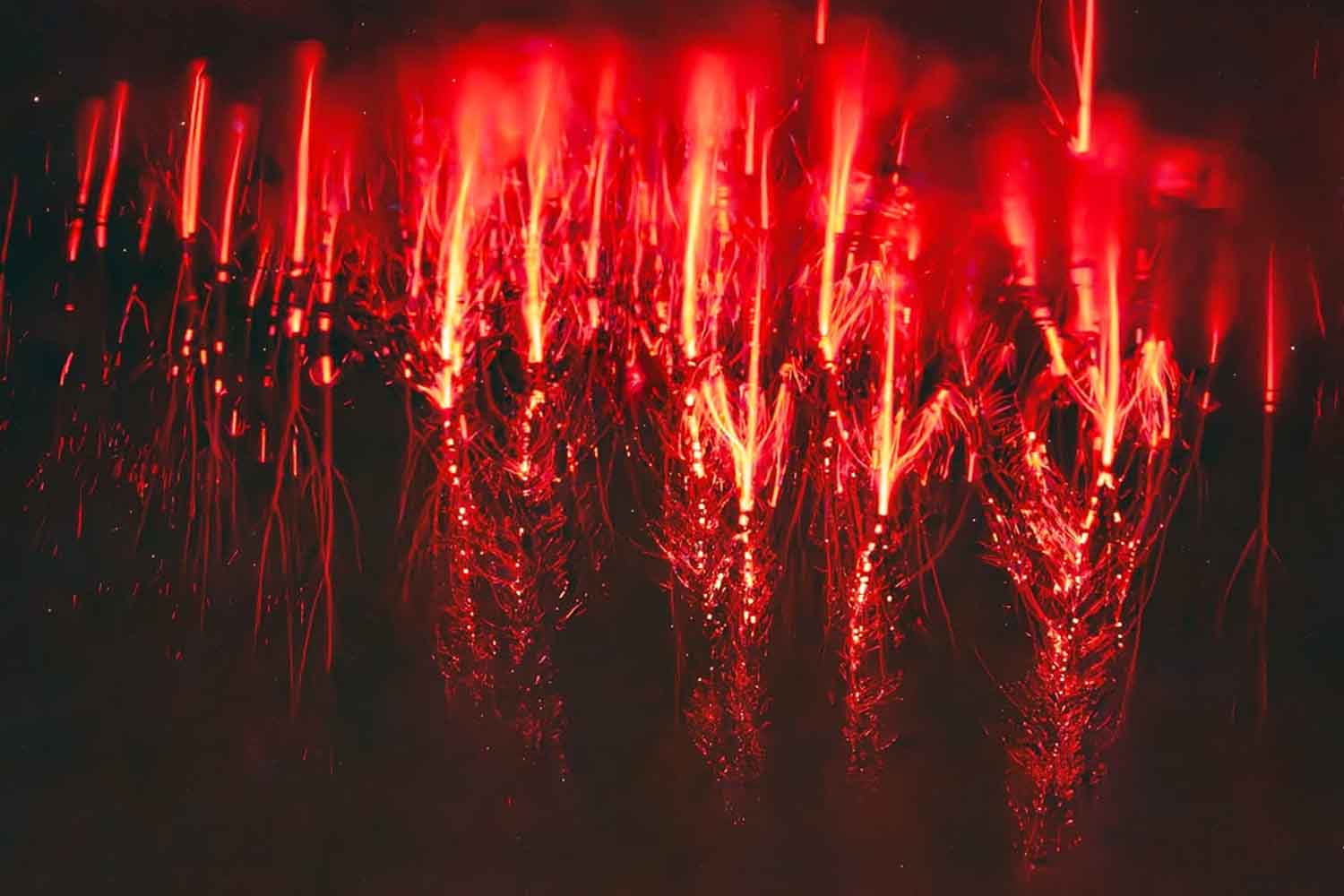
Gigantic red figures, similar to jellyfish with long luminous tentacles, appeared in the night sky of Corsica. This is not an optical effect nor an artificially created image, but a real atmospheric phenomenon that is rather difficult to observe: the red spriteselectrical discharges that develop far above thunderstorms.
Photographing them, on the night between 16 and 17 September 2026, was Florian Riou, who immortalized these particular lights above the village of Montemaggiore, near Calvi, in Corsica. The surprising thing is that the storm that generated the sprites was not over Corsica, but near Barcelona, Spain, at a distance estimated between 500 and 700 kilometers.
Riou had studied the storm forecasts on the Spanish coast and identified an observation point from which it would be possible to photograph the storms over the Corsican landscape. As the storm developed, his camera recorded a series of red flashes, including one particularly intense one.
The result, published on the photographer’s website, shows a phenomenon that occurs in the Earth’s atmosphere but which, due to its very short duration, almost always escapes our eyes.
What are red sprites and why do they form so high?
The red sprites, also called red elvesbelong to the dei family Transient Luminous Events (TLE), i.e. transient light phenomena. These are electrical discharges that occur over large storm systems, generally between 50 and 90 kilometers above sea level.
To understand how high they are, just think that a normal airliner flies around 10-12 kilometers from the earth’s surface. Sprites are therefore formed much higher up, in the region of the atmosphere called the mesosphere, not far from the conventional boundary of space, set at around 100 kilometers above sea level.
But how can lightning cause discharges at such great distances from the clouds? As NASA explains, it all begins during particularly intense storms. Some lightning strikes, especially positive ones that transfer large quantities of electric charge towards the ground, suddenly change the electric field above the clouds.
This variation can become intense enough to cause an electrical discharge in the very thin air of the upper atmosphere. The result is a flash that, rather than developing between the clouds and the ground like more familiar lightning, appears tens of kilometers above the storm.
Why are the sprites red and look like jellyfish?
Their color is not random. As the electrical discharge passes through the upper atmosphere, it transfers energy to nitrogen molecules in the air. When these release the absorbed energy, they emit light, predominantly red. The shape is also particular. Some sprites resemble vertical columns, others resemble upside-down carrots, while still others have a bright top from which numerous filaments branch out, just like the tentacles of a jellyfish.
The dimensions can be enormous: these structures can extend for tens of kilometers, despite being extremely short. A sprite can last just a few millisecondsa fraction of a second much shorter than the blink of an eye. This is why it is difficult to see it with the naked eye and even more complicated to photograph it. Despite their spectacular appearance, the sprites are not signs of anything anomalous or dangerous arriving from space. They are natural electrical manifestations, linked to the activity of terrestrial thunderstorms.
How is it possible to photograph a storm 600 kilometers away?
Distance, in this case, worked in the photographer’s favor. Storm clouds can hide sprites from those viewing the sky directly below the storm. From a sufficiently distant position, however, it is possible to see the part of the atmosphere that is above the clouds, where the discharges are produced.
This is exactly what happened in Corsica. Riou chose a panoramic point near Montemaggiore and aimed the camera towards the thunderstorms expected on the Spanish coast. The high altitude of the sprites allowed us to shoot them above the horizon, despite the considerable distance.
In the photograph, therefore, the lights seem to appear above the houses of the village, but in reality they were hundreds of kilometers away, in the atmosphere over Spain. To succeed in a shot like this you need a sufficiently clear sky, an unobstructed view towards the distant storm and photographic instruments capable of recording extremely rapid flashes.
Are red sprites rare? Science has been studying them for a few decades
Sprites are not necessarily exceptional events. Their apparent rarity depends above all on the difficulty of observing them: they last very little, they appear at high altitudes and often remain hidden by clouds. For nearly a century, civilian and military pilots have reported seeing strange flashes above thunderstorms, but convincing photographic evidence has been lacking.
That changed in July 1989, when researchers at the University of Minnesota accidentally recorded a sprite with a camera designed to take images in low-light conditions. Since then, scientists have begun to systematically study these phenomena, which have also been photographed by astronauts on board the International Space Station.
NASA documented a sprite taken from the International Space Station in April 2012, developing over an intense thunderstorm. Yet several questions still remain about the mechanisms that determine the formation, frequency and characteristics of these discharges.
Precisely to collect more observations, the US space agency has started Spritacular, a participatory science project that also allows photographers and enthusiasts to contribute to research by sharing their images. Photographs like the one taken by Florian Riou are particularly interesting because they make visible an electrical activity that continuously takes place above our heads, but which we normally cannot observe. Those gigantic red jellyfish therefore did not appear mysteriously in the sky: they are the manifestation, lasting a few milliseconds, of an electrical connection between thunderstorms and the highest layers of our atmosphere.
View this post on Instagram
