
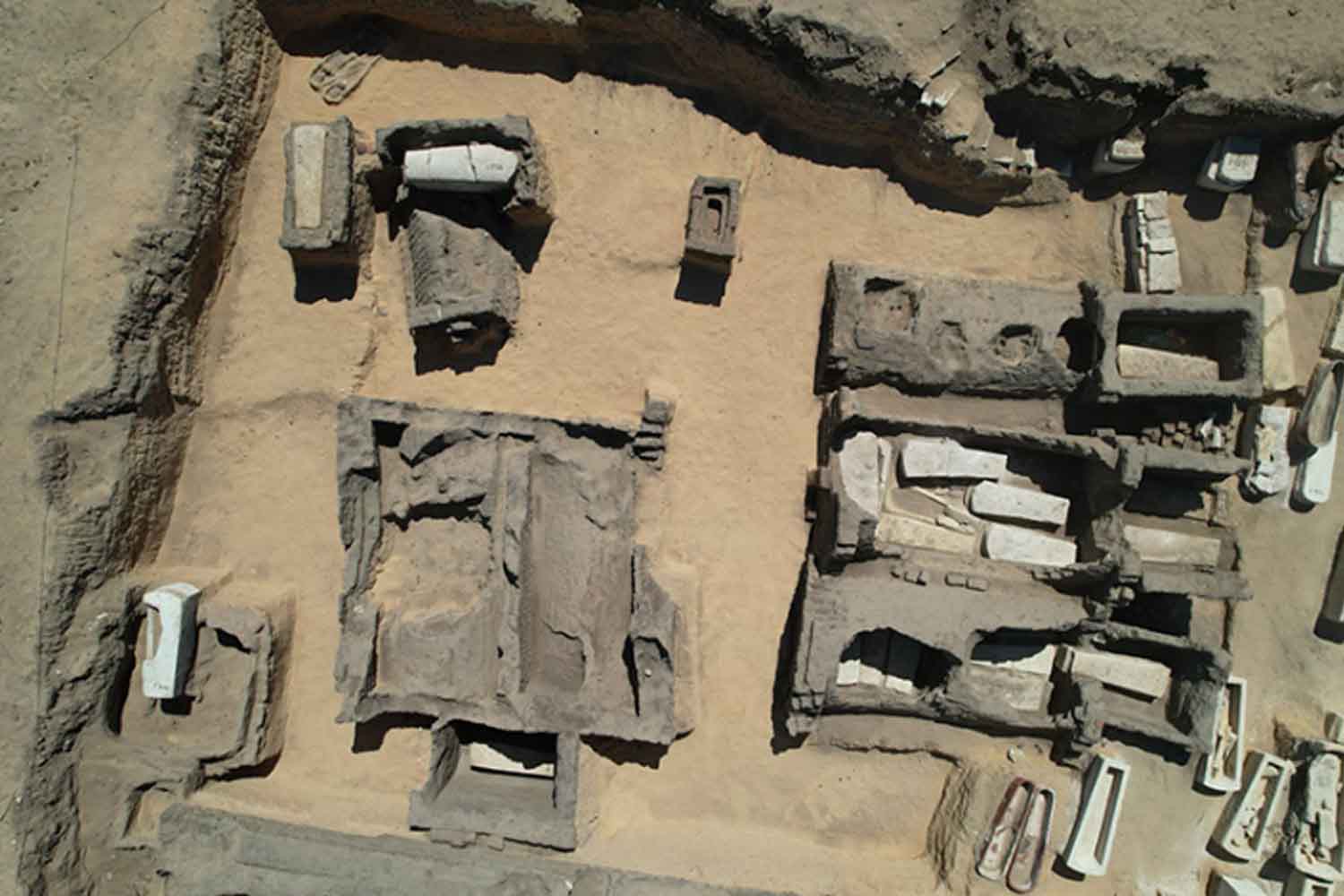
Small golden tongues, stone scarabs, statuettes destined to work in the afterlife in place of the deceased and even two falcons buried among the sarcophagi. At Tell Kom Abu Billo, in northern Egypt, archaeologists have unearthed a vast necropolis from over 2,000 years agowith hundreds of burials probably belonging to middle class people. A discovery that allows us to learn more about the religious beliefs of the Egyptians who lived far from the courts of the pharaohs.
The Egyptian Ministry of Tourism and Antiquities announced the discovery. The archaeological mission of the Supreme Council of Antiquities has identified tombs dating back to different eras, from the end of the Late Period to the beginning of Roman domination. Most of the burials date back to the 3rd and 2nd centuries BC, when Egypt was ruled by the Ptolemaic dynasty, of Macedonian origin.
©جمهورية مصر العربية
وزارة السياحة والآثار
The sarcophagi of ordinary Egyptians
The ancient city of Terenutis stood in Tell Kom Abu Billo, in the western part of the Nile delta, a short distance from Wadi el-Natrun. The region was known for the presence of natrona natural mixture of salts used by the Egyptians to dehydrate bodies during mummification. The archaeological site has been the subject of excavations since 1888 and, as documented by the Institut français d’archéologie oriental, still preserves the remains of homes, artisan workshops and a religious complex dedicated to the goddess Hathor.
The results of previous excavation campaigns also give an idea of the size of the necropolis. Between September 2023 and May 2024 they had already been recovered 227 limestone sarcophagi, 94 ceramic and the remains of 12 wooden burial coffinsas illustrated by the archaeologist Mostafa Rezk Ibrahim in a contribution presented to the Egypt Exploration Society.
Some sarcophagi reproduce human features, others have faces with almost caricatural features. Many have arrived today without lids or reduced to fragments. Yet, among the remains of the deceased, archaeologists were still able to recognize traces of the resins used for embalming and funerary coverings decorated in yellow, red, blue and gold.
Precisely the study of the funerary objects has led scholars to hypothesize that the necropolis mainly welcomed people belonging to the middle class of ancient Egypt. People about whom, compared to the sovereigns who occupy entire chapters of our history books, we know decidedly less.
©جمهورية مصر العربية
وزارة السياحة والآثار
Golden tongues and statuettes for the journey to the afterlife
Among the most curious finds are the little golden tonguesobjects related to the preparation of the deceased for the afterlife. Their discovery recalls that which occurred in December 2024 in the ancient city of Oxyrhynchus, where a mission led by the University of Barcelona had discovered 52 mummies from the Roman era, 13 of which preserved golden tongues inside their mouths. One even had two.
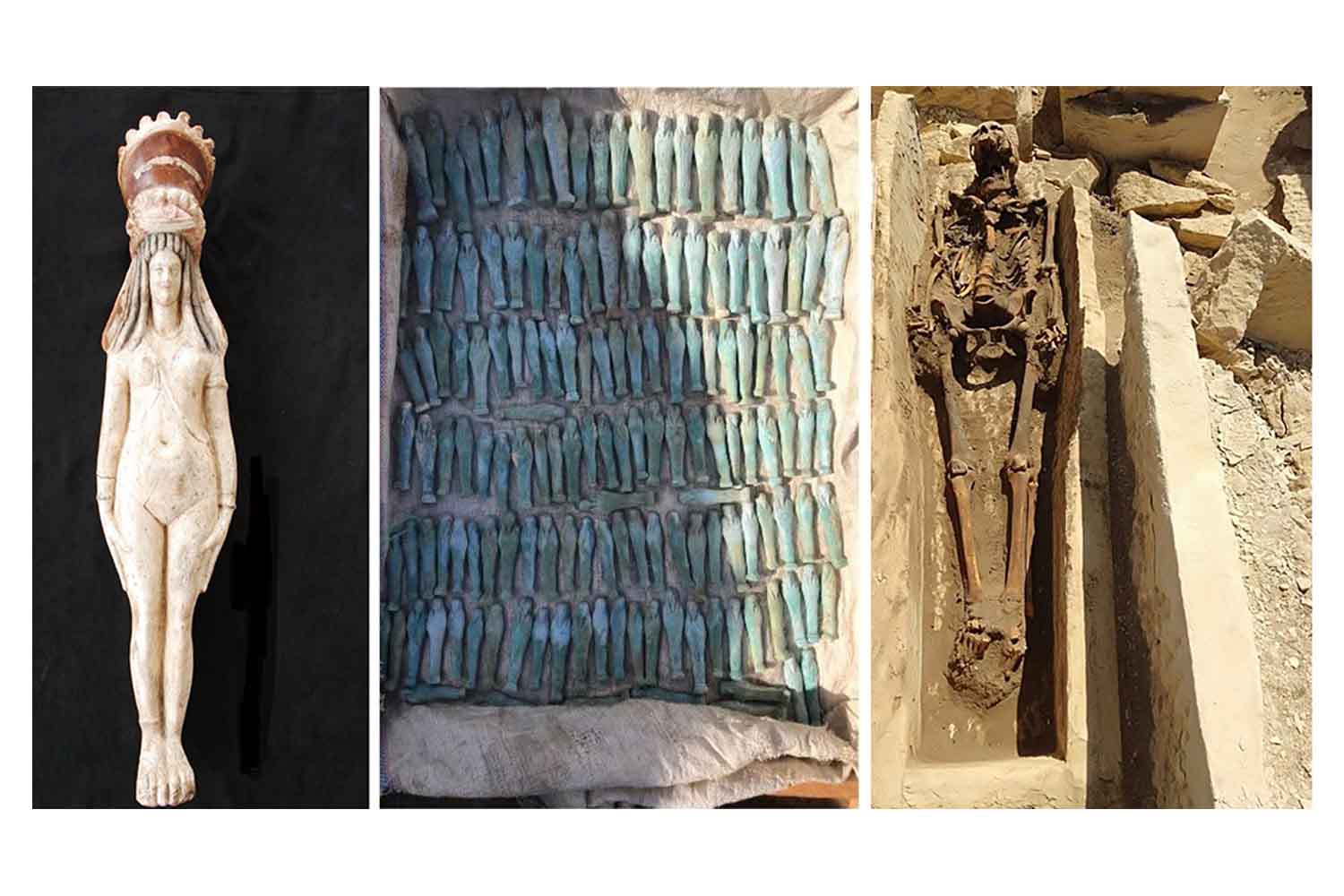
Alongside the jewels and amulets, archaeologists have recovered numerous ushabtismall funerary statuettes of different shapes and sizes, some still with hieroglyphic inscriptions. According to Egyptian beliefs, these figures would answer for the deceased when, in the afterlife, he was asked to do a job. Even after death, in short, there were tasks to take care of.
Scarabs have also resurfaced, one of which was made of lapis lazuli, eyes of Horus (symbols of protection), small sphinxes and tables intended for offerings. Among the sarcophagi, two burials of falcons have been identified, animals closely linked to the cult of Horus.
When Isis met Aphrodite
Among the terracotta fragments recovered during the excavations there is one particularly interesting: the lid of a container on which a goddess is depicted sitting on a lotus flower, intent on breastfeeding her child.
It’s about Isis-Aphroditewhile the little one in his arms is Harpocrates, the representation of Horus as a child. The figure of the goddess embodies the meeting between two cultures which, during the Hellenistic period, ended up mixing even in religious beliefs.
As the Metropolitan Museum of Art explains, Isis-Aphrodite brought together the aspects linked to the fertility of the Greek divinity with those of the Egyptian goddess. It was associated with marriage, the birth of children and rebirth after death. His statuettes, already widespread between the 3rd and 2nd centuries BC, found their place both in homes and in tombs.
The necropolis of Tell Kom Abu Billo therefore preserves evidence of a society which, despite going through profound political and cultural changes, continued to hand down many of its funerary traditions.
The excavations and restoration of the finds will continue in the coming months. In Terenutis there is still a lot to bring to light, especially of that part of the population that had enough resources to entrust their deceased with a small set of amulets, some jewels and a handful of statuettes. Objects which, after more than two thousand years, have survived even the names of those who owned them.
