
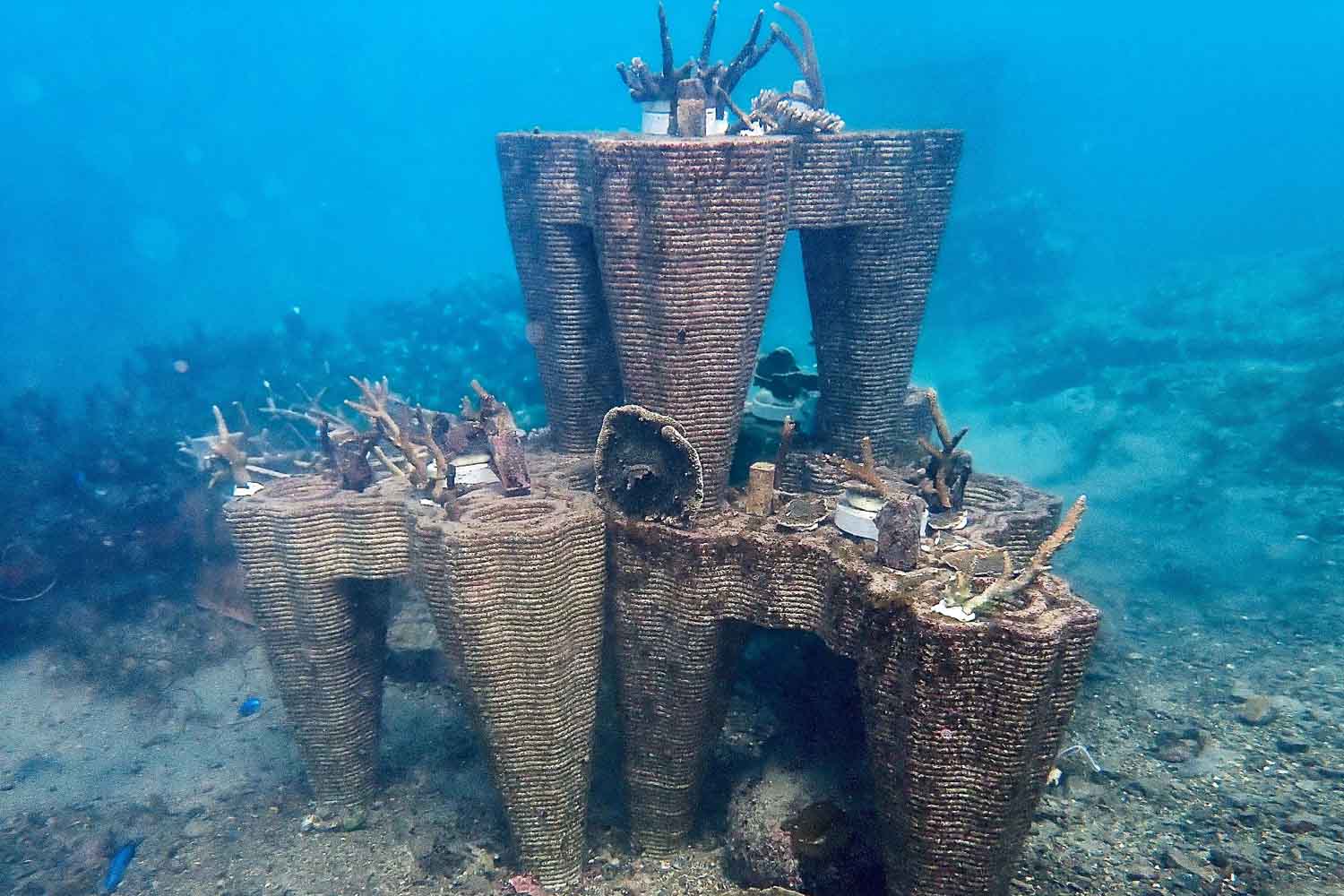
Twenty-eight corals transplanted onto artificial structures, all of which survived during the first tests at sea. And, in the meantime, fish, hermit crabs and even octopuses have also arrived among the cavities. In Taiwan, three young designers have found an ingenious way to help coral reefs to regeneratetransforming oyster shells and coral fragments into 3D printed modules. The project is called Reefvive and was selected among the top 20 global projects of the 2026 James Dyson Award.
The invention was born at National Taiwan Normal University, where Yin-Rui Liao, Yun-Lin Chen and Ying-Tung Kuo worked on a system to recover waste materials and return them to the sea in a completely different form. The objective is to offer the corals new anchoring points and create, at the same time, small habitats for the other inhabitants of the seabed.
An idea that is simple in its logic, much less so in its implementation. Because building something that remains stable underwater, promotes the settlement of corals and can be assembled directly on the seabed requires a few more precautions than a normal 3D print.
From oyster shells to new coral structures
The source material consists of oyster shells and fragments of coral skeletonsrecovered from local waste. Once processed, these materials are used to create the structures through three-dimensional printing, avoiding resorting exclusively to traditional concrete bases. As the designers explain in the official presentation of Reefvive at the James Dyson Award, to design the modules they were inspired by the so-called brain corals, recognizable by the surfaces crossed by sinuous grooves that recall the folds of a human brain.
The result is a structure with an irregular surface, designed to offer different attachment points for the coral fragments. Each module has three large openings that allow you to overlap multiple elements and build a three-dimensional barrier. Even seemingly secondary details have a precise function. The lateral ribs increase the friction between the surfaces, while three support feet stabilize the structure on the sandy seabed, reducing the movements caused by the movement of the water.
The modules can also be assembled without clips, screws or other additional fixing systems. A sort of underwater Lego, in short, with a rather important difference: here the pieces are used to build shelters for living organisms. Modularity also allows the layout of the structures to be adapted to the characteristics of the seabed, progressively expanding them and creating spaces of different sizes, which can be used by multiple marine species.
In sea tests, all 28 corals survived
To verify how the project worked, the group collaborated with the National Taiwan Ocean University, bringing the modules directly into the sea. During the experimentation they were installed 28 coralswhich according to the results communicated by the designers have maintained a 100% survival rate at the time of monitoring.
The data concerns this first experiment, the exact duration of which was not specified. However, it is an encouraging result, especially because the tests allowed us to verify in the field the functioning of the assembly systems, the stability of the structures and the possibility of fixing the corals to them.
The observations also held some surprises. As the National Taiwan Normal University itself reports, algae, fish, hermit crabs and octopuses were observed among the modules, which began to use the available spaces.
An interesting detail because coral reefs are complex ecosystems, in which the presence of cavities and irregular surfaces offers shelter to many organisms. Reefvive was designed precisely to respond to this need: to support transplanted corals and recreate part of the physical complexity of a natural reef, offering other marine animals new spaces to occupy.
Why recovering coral reefs is so important
Coral reefs occupy a very small portion of the ocean floor, yet support at least a quarter of marine species. They are key environments for biodiversity and also play an important role for coastal communities, offering protection from erosion and supporting fishing and economic activities. However, their survival is increasingly compromised by rising ocean temperatures, pollution and human activities.
According to the report Status of Coral Reefs of the World: 2020developed by the Global Coral Reef Monitoring Network with the support of the United Nations Environment Programme, between 2009 and 2018 the world lost approximately 14% of coral coverequivalent to approximately 11,700 square kilometers.
Among the main causes are episodes of whitening caused by thermal stress. When the water becomes too warm, corals can expel the microscopic algae with which they live in symbiosis, losing their color and an essential source of nourishment. If environmental conditions improve they can recover, otherwise they risk dying.
The restoration of degraded reefs therefore requires different interventions, from habitat protection to the reduction of environmental pressures. These also include the transplantation of coral fragments onto structures capable of supporting their growth. Reefvive intervenes precisely on this last aspect, proposing a solution that unites material recovery, 3D printing and marine habitat restoration.
Reefvive aims to expand testing and production
The project has already received an AI award Young Pin Design Awards 2026 and was selected among the 20 global finalists of the James Dyson Award.
The recognition also enhances the choice to use locally recovered materials, transforming two types of waste into elements intended to support new marine life. An approach that could make restoration interventions more flexible and encourage the use of resources available in coastal territories. Now the designers intend to expand the trials at sea, involve new sites and further refine the creation of the modules, with the aim of reaching larger-scale production.
The project sheet published by the National Taiwan Normal University tells the philosophy behind the invention: recover materials that have already been part of the marine environment and use them to build new supports intended for coral restoration.
For the moment, Reefvive has demonstrated that its modules can be installed in the sea, host transplanted corals and offer shelter to other organisms. The next tests will allow us to evaluate its behavior over time and the possibilities of use on larger surfaces. Meanwhile, on those small modules made from oyster shells, the first 28 corals survived the initial monitoring. And some octopuses have already found a home.
