
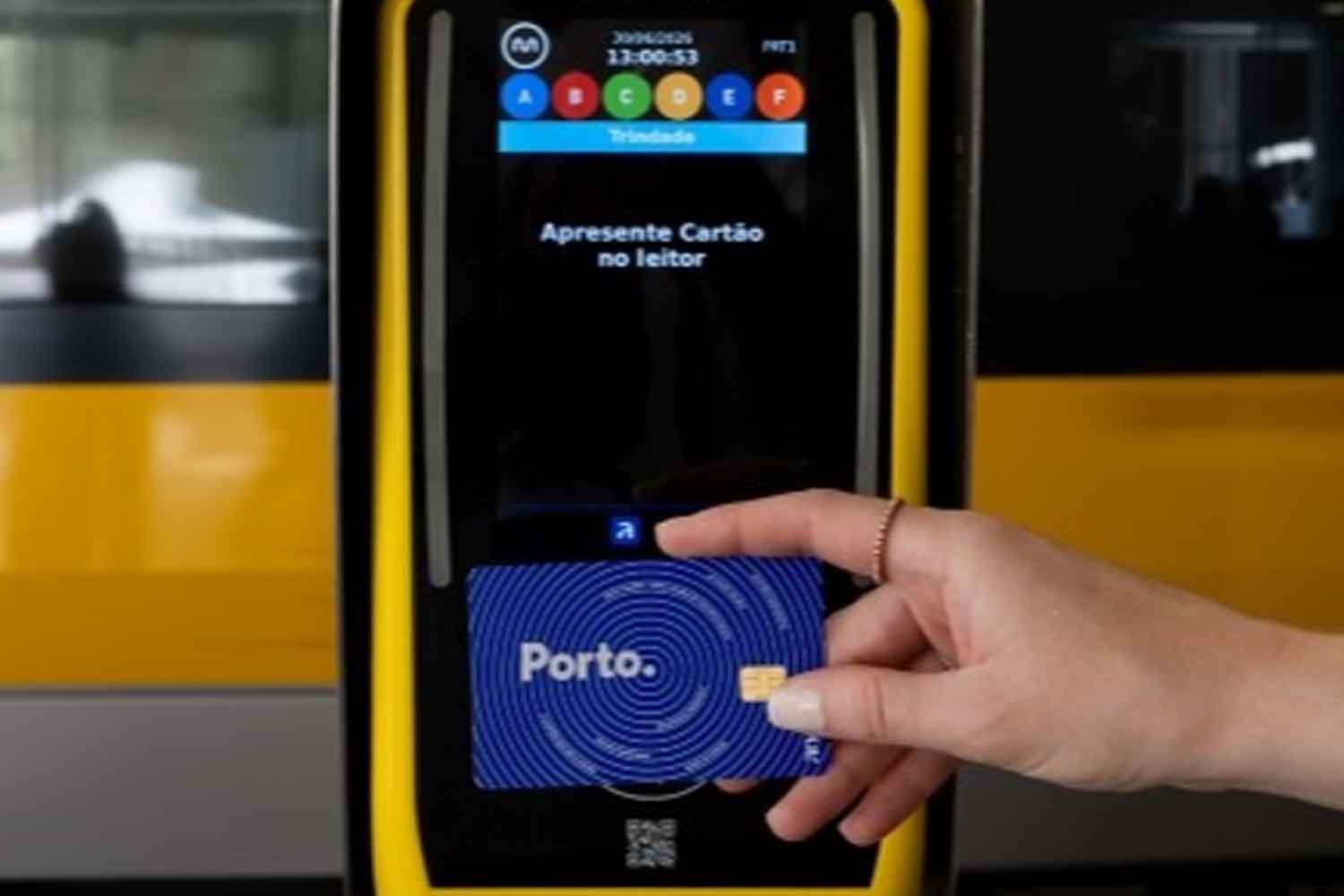
The validator still needs to be touched before going up. The bill, however, for those who live in Porto can stop at zero euros. From 10 July, residents of the Portuguese city can travel for free on public transport throughout the Metropolitan Area thanks to the new Free Metropolitan Pass associated with the Cartão Porto. Metro, STCP and Unir buses, CP urban trains, trams and, when operational, also the Porto-Gaia river connection: the ticket is annual, with no travel limit and no monthly top-ups.
It’s one of those measures that is so simple to explain that it’s almost surprising: you live in Porto, you have the right to a municipal card, public transport becomes a free service. The municipality puts up the money, the resident puts the card on the reader and can even cross city borders while continuing to travel throughout the entire metropolitan area. For once the invitation to leave the car at home comes accompanied by something more concrete than a campaign with a smiling bicycle on the poster.
A free subscription, really
The new pass is intended for Cartão Porto owners over 23.; children and young people between 4 and 23 years of age continue to use Passe Jovem, which is already free. The municipal card can be requested by those who have tax domicile in Porto and also by students who live and study in the city while maintaining tax domicile elsewhere. Those who reside in Porto and work in another municipality can use the qualification to reach their workplace, because the coverage includes the entire Metropolitan Area.
Membership was also built to avoid the small bureaucratic ordeal that often accompanies public benefits. Who already owns a Cartão Porto. with a chip you can update it at an Andante ticket office or at a Payshop agent; those who have a card without a chip can activate the service through the portal. The Municipality of Porto has also provided an online application for those who have yet to obtain the card. The renewal will arrive after one year, verifying that the residency requirement is still present.
Behind the zero on the passenger’s account there is naturally a public investment. The study accompanying the measure estimates a maximum annual cost in the order of 20.5 million euros. The mechanism chosen by the Municipality, however, contains an interesting precaution: the compensation is linked to the actual validations and has as its ceiling the value of the normal metropolitan season ticket, instead of automatically recognizing the same amount for each entitled person. In short, the Municipality pays for actual use up to the limit set by the pass. A financed free gift, therefore, and with the turnstiles that also act as accountants.
In Rome the resident still pays 250 euros a year
The comparison with Rome comes almost alone. In the capital, a resident who regularly uses buses, trams, subways and urban railways can purchase an annual Metrebus Roma season ticket for 250 euros. The personal monthly fee instead costs 35 euros. They are relatively low fares for those who use public transport every day, especially if they choose the annual one, but they remain an item in the family budget that has just disappeared in Porto.
And as soon as you move beyond the borders of Rome the figure rises. Metrebus Lazio annual passes which include the Rome area start from 404 euros for the AB zones and increase according to the distance, up to 688.40 euros for the longer ranges. Porto has chosen exactly the opposite direction: the resident leaves the city and continues to use the metro network for free even when his journey ends in another municipality.
Rome’s size would make a similar operation much more expensive. This is evident and the two municipal budgets cannot be superimposed with a calculator in hand. However, the Portuguese choice remains interesting on a political level: a part of the mobility resources is used to directly reduce the price perceived by people. If the problem is convincing someone to take public transport more often, removing the season ticket from the list of monthly expenses is a rather difficult incentive to misunderstand.
In Italy free access comes mainly by category
Italy, let’s be clear, has some interesting experiments. In Bologna the Municipality has built a very broad system of concessions: in 2026 it recalled that Bolognese students travel for free on buses and that significant reductions are available for residents with ISEE under 35 thousand euros and over 70s. According to the administration, 97% of urban or extra-urban annual season ticket users now access a free or discounted rate.
In Genoa, however, there are forms of free admission aimed at over 70 residents in the metropolitan area, with specific time slots. They are useful policies and can have a significant impact on the mobility of the people who benefit from them. However, the Portuguese model takes a further step: it uses residence as the main criterion and opens the service to adults regardless of income.
The difference can be seen above all in the message. Italian concessions often say: if you belong to this category, we will help you cover the cost of transport. Porto has decided to tell its residents something different: the city is paying for this trip.
Porto tries to remove a good reason to use the car
Free admission alone does not make a subway appear outside your home and does not increase the number of trips during rush hour. Frequency, reliability and capacity continue to weigh on the choice of those who have to arrive at work on time every morning. Porto, meanwhile, has eliminated an immediate and very concrete barrier: how much it costs to try every day.
And this is where the initiative deserves attention also from this part of Europe. In Italy we spend billions on new lines, buses, trams, railways and fleet renewal; the Ministry of Infrastructure and Transport continues to finance interventions on rapid mass transport and rolling stock. Porto adds another piece to the reasoning: after having built the service you must also make it convenient to use it.
For a resident, the difference between a public transport to take “when it’s convenient” and one that you have already paid for with taxes can become enormous. A metro stop to go to work, a bus to reach the center, a train to move out of the city cease to be small economic decisions repeated every day.
In Rome the 250 euro annual card remains on the price list. In Porto, from 10 July, for those who live in the city that entry can be cancelled. If the goal is to have fewer cars on the road, that’s at least a great place to start.
