
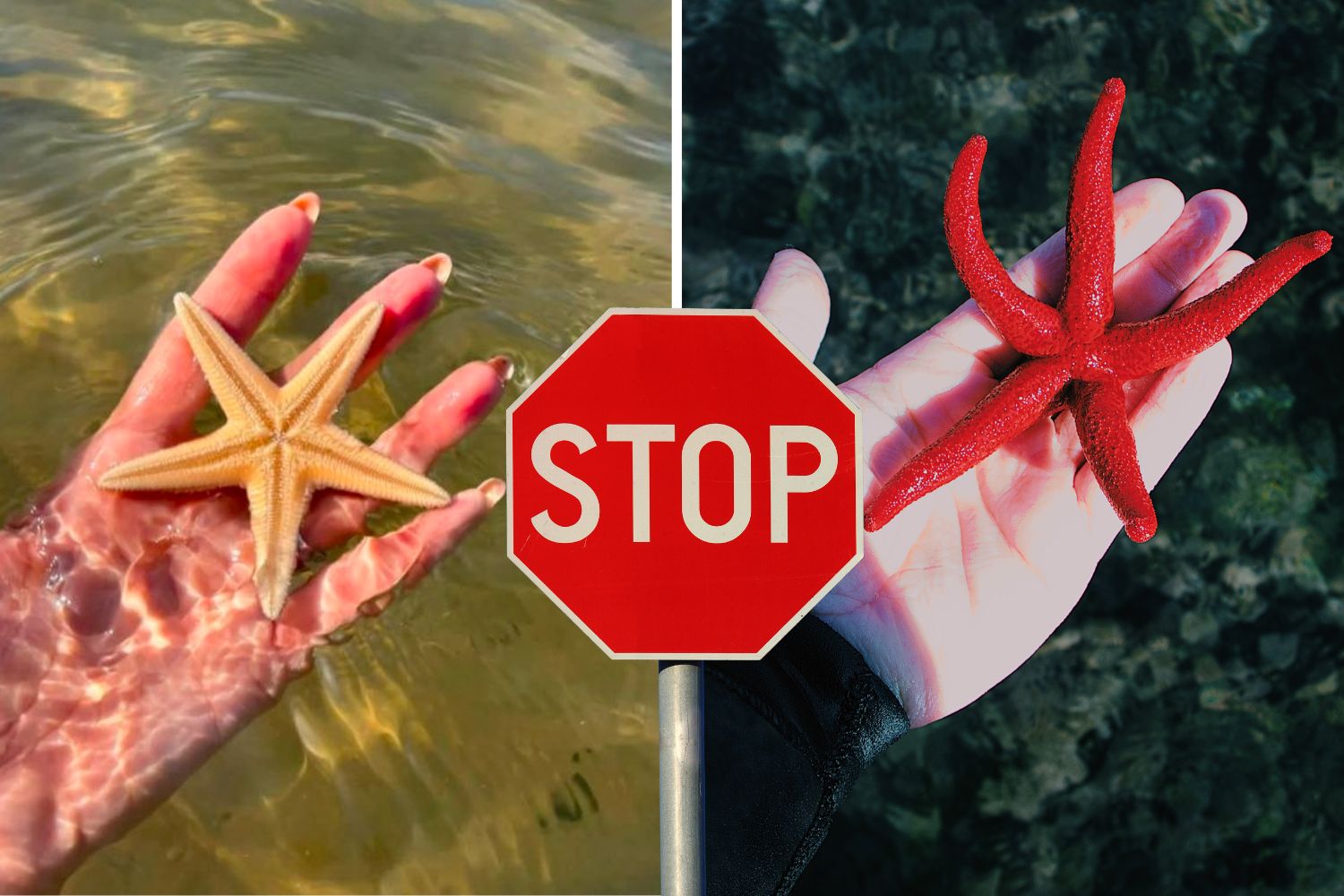
Punctual like the heat and the summer catchphrases, every summer the same scene comes back into fashion on social media: starfish raised from the water, held in the palm of the hand and shown as if they were souvenirs purchased on holiday and not living beings.
It’s not just children who are curious about marine life (often encouraged by their parents) who do this. Just scroll through Instagram or TikTok to come across photographs and videos of tourists, creators, influencers and even journalists touching these creatures and taking them from the sea with great ease.
@Irene Taurino/Facebbok
View this post on Instagram
View this post on Instagram
View this post on Instagram
The problem is that what may seem like a harmless souvenir photograph can turn into a source of severe stress and potential harm to the animal. And the fact that a starfish is put back into the water a few seconds later does not automatically mean that it has not suffered consequences.
We admire sea creatures, but with respect
Starfish are not decorative objects and, above all, they are not fish: they are echinoderms, relatives of sea urchins and cucumbers, with a physiology completely different from ours. Their body also functions thanks to a sophisticated aquifer or ambulacral system, an internal network full of water connected to small pedicels present especially on the lower surface. Through these structures, starfish are able to move, adhere to surfaces and carry out important physiological functions. Gas exchange also occurs through structures directly exposed to the aquatic environment, including ambulacral papules and pedicels. In other words, they are animals intimately adapted to life immersed in water.
And this is precisely why taking them out of their environment, manipulating them and leaving them exposed to the sun to take a photo can be harmful. What happens when we take a starfish in our hand? WWF Italy is categorical on this point: starfish must not be taken out of the water and should not be picked up. The association explains that exposure to air can interfere with the animal’s physiology and warns that the entry of air bubbles into the channels of its body can cause serious consequences. The WWF also draws attention to hand contact, which can alter the delicate surface coating of the animal and promote dehydration and overheating. And there is a detail that we often forget: our hands are not a “neutral” surface at all.
Sunscreen, oils, repellents, soaps, sweat and residues of other substances can come into contact with the animal’s surface. Added to this is the mechanical damage that clumsy handling can cause to extremely delicate structures. For this reason, the correct question should not be “how many seconds can I keep it out of the water?”, but rather: why should I do it? There is no need to lift a starfish to observe or photograph it. You can admire it exactly where it is.
It is also misleading to look for some sort of “safe time limit” – five seconds, ten seconds or thirty seconds – within which it would be possible to safely extract a starfish from the water. Conditions change based on the species, temperature, sun exposure, the condition of the animal and how it is handled. The truly risk-free solution is much simpler: leave it where it is.
Starfish, fish and crabs are not toys!
Every year on our beaches we see children (and not only) collecting starfish, crabs, small fish and other animals to transfer them into buckets on the beach. Filling them with sea water does not recreate the conditions of the natural environment at all. In a small container left in the sun the temperature can rise rapidly, while oxygen availability and water quality can deteriorate.
Starfish, crabs, fish and other small aquatic animals forced into buckets can experience thermal shock, hypoxia and death. And as the OIPA reminds us, this practice constitutes a crime based on art. 544 ter of the Criminal Code, which provides that “anyone who causes the death of an animal through cruelty or without necessity is punished with imprisonment from 6 months to 2 years and a fine from 5,000 to 30,000 euros”.
View this post on Instagram
A practice that too often is still offered to children as an educational game therefore risks teaching the exact opposite of what knowing nature should mean: not observing an animal in its habitat, but capturing it for our entertainment.
Influencer photos normalize bad behavior
Then there is another aspect that should not be underestimated: the imitation effect. A photograph published by a person with thousands or millions of followers does not remain simply a simple snapshot. It can transform harmful behavior into something seemingly normal, worth emulating. If we continually see starfish on tourists’ hands, we end up considering them a sort of natural holiday accessory: something to take, photograph and put back in their place. But animals are not props.
So if we encounter a starfish this summer, let’s photograph it. But let’s leave it under water, exactly where we found it.
Sources: OIPA/WWF
