
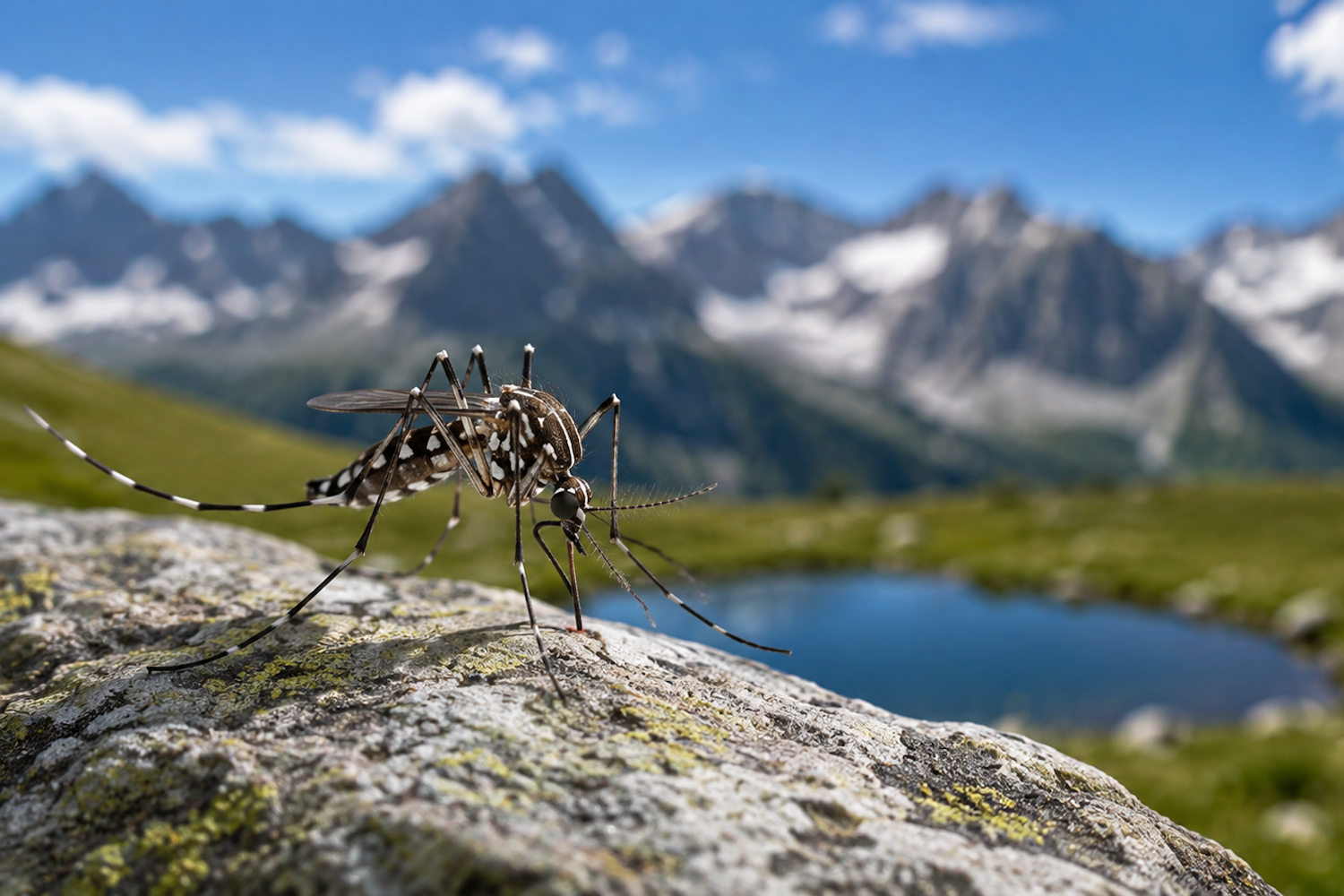
Twelve larvae and pupae inside a manhole, at 447 meters above sea level in the province of Belluno. Thus began the Italian story of the Korean mosquito at the end of May 2011, Aedes koreicus. The researchers raised the collected specimens and identified ten adults with morphological and genetic analyses. Surveillance was looking for the tiger mosquito; he found another Asian species, capable of settling right where the tiger begins to struggle. The study on the first Italian report confirmed already in the following months that the population had become established.
Fifteen years later that mosquito is still here and its range has expanded. A new one scoping review published on Acta Tropica sifted through the available research on Aedes koreicus: 334 works identified, 91 studies included in the analysis, supported by a workshop held in Trento on 10 February 2026 with 41 researchers and professionals from six European countries. Rather than announcing a new health emergency, the work puts something much less spectacular and quite useful on the table: we still know too little about an invasive mosquito which, in the meantime, continues to gain territory.
A mosquito that climbs where the tiger reaches with more difficulty
Its advantage begins in winter. Aedes koreicus it produces eggs capable of surviving the cold months in quiescence and tolerates lower temperatures than others Aedes albopictusour now very familiar tiger mosquito. Adults may also appear earlier in the season and remain active longer into autumn. In Valbelluna, in the first Italian investigations, the species was active approximately from the end of March to the end of October. The researchers found it between 173 and 1,250 meters above sea level, even above 800 meters where the tiger was absent or only appeared sporadically. The data collected in the Italian North-East already showed a mosquito decidedly unimpressed by the mountains.
To reproduce, then, it does not require tropical landscapes. Manholes, artificial containers, gardens, nurseries and small water collections may suffice. In the monitoring carried out between Veneto and Trentino, manholes represented almost half of the positive larval sites and artificial containers over 40%. It is a species adapted to anthropized environments, although it has also been found in woods.
Italian expansion now seems well consolidated. A genetic study published in PLOS Neglected Tropical Diseases analyzed 414 mosquitoes from 13 Italian and Slovenian populations. The results indicate stable colonization and support the expansion of a population originally introduced in the Belluno area westwards and towards Slovenia. In places such as Vicenza, Sondrio and Fonteno, evidence has also emerged of populations capable of surviving the winter on site.
The most recent ECDC photograph, updated to April 2026, adds another piece: compared to June 2025, there are four new European administrative units where the species is now considered established. Two are in Italy, one in France and one in Russia. The Korean mosquito isn’t just appearing in new spots on the map: it’s managing to stop in some areas.
Can it transmit dengue, Zika and chikungunya?
Here we need to distinguish the biological capacity observed in the laboratory from the risk we encounter outside our front door. Experiments have shown that Aedes koreicus it can become competent for some arboviruses, however the results change greatly with temperature, virus studied and mosquito population used.
In a study published in Virusesfor example, specimens from Germany were able to transmit chikungunya and Zika only under the warmest thermal conditions tested, with transmission efficiencies of 4.6% and 4.7%, respectively. In the same experiment, no transmission of West Nile virus was observed.
For dengue, a study on an Italian population also arrived in August 2026 Aedes koreicus. Laboratory-reared females were fed blood containing DENV-1 and maintained at 26 ± 1°C. Infectious virus was recovered in saliva 28 days after infection; in the most advanced stages of the experiment the authors report a transmission rate of 33.3% and an overall efficiency of 20%. It is a demonstration of vector competence in controlled conditions, accompanied however by low efficiency and rather long incubation times.
Outside the climatic chamber, many other things come into play: how many specimens are present, how long they live, how many times they bite humans, the actual temperatures, the presence of the virus and the probability that a mosquito encounters an infected person first and then a susceptible one. The studies available so far do not attribute to Aedes koreicus outbreaks of arbovirus in Europe. In Northern Italy it has also been found during investigations related to dengue, but the known native outbreaks have been supported by the tiger mosquito.
The same new revision of Acta Tropica therefore invites us to consider it today above all as an invasive and potentially annoying species, with a health role that needs to be studied better. Among the priorities identified there are new experiments on vectorial competence, longer data on populations, studies on competition with others Aedes and a surveillance capable of reaching quotas and seasons that are normally less frequented.
The problem is also being able to recognize it
To complicate the job there is a rather unpleasant detail: Aedes koreicus resembles other invasive white-striped mosquitoes. Even eggs collected in common egg traps can be difficult to distinguish from those of Aedes albopictus, Aedes japonicus and other species without resorting to more careful controls. The new review therefore calls for better identification protocols and surveillance that includes mountains, plains and longer periods of the year. A mosquito that changes its habitat and calendar makes it of little use to continue looking for it only in the places and months in which we were used to looking for the others.
For gardens and private spaces, however, the countermeasures have very little that is exotic. The Istituto Superiore di Sanità recommends for mosquitoes of this kind Aedes to regularly eliminate small stagnations, empty saucers, buckets and watering cans, keep gutters and channels free and cover water collections that cannot be eliminated. A few centimeters are enough for a forgotten container to become a much more productive farm than expected.
The Korean mosquito, therefore, arrived some time ago, learned to spend the winters in Northern Italy and continues to occupy territories where other invasive species find less comfortable conditions. For now, the most solid signal comes from its ability to expand, much more than from its track record as a vector of human diseases. And this is precisely the useful moment to follow it: when the mosquito is already on the map, while the health emergency is not yet.
