
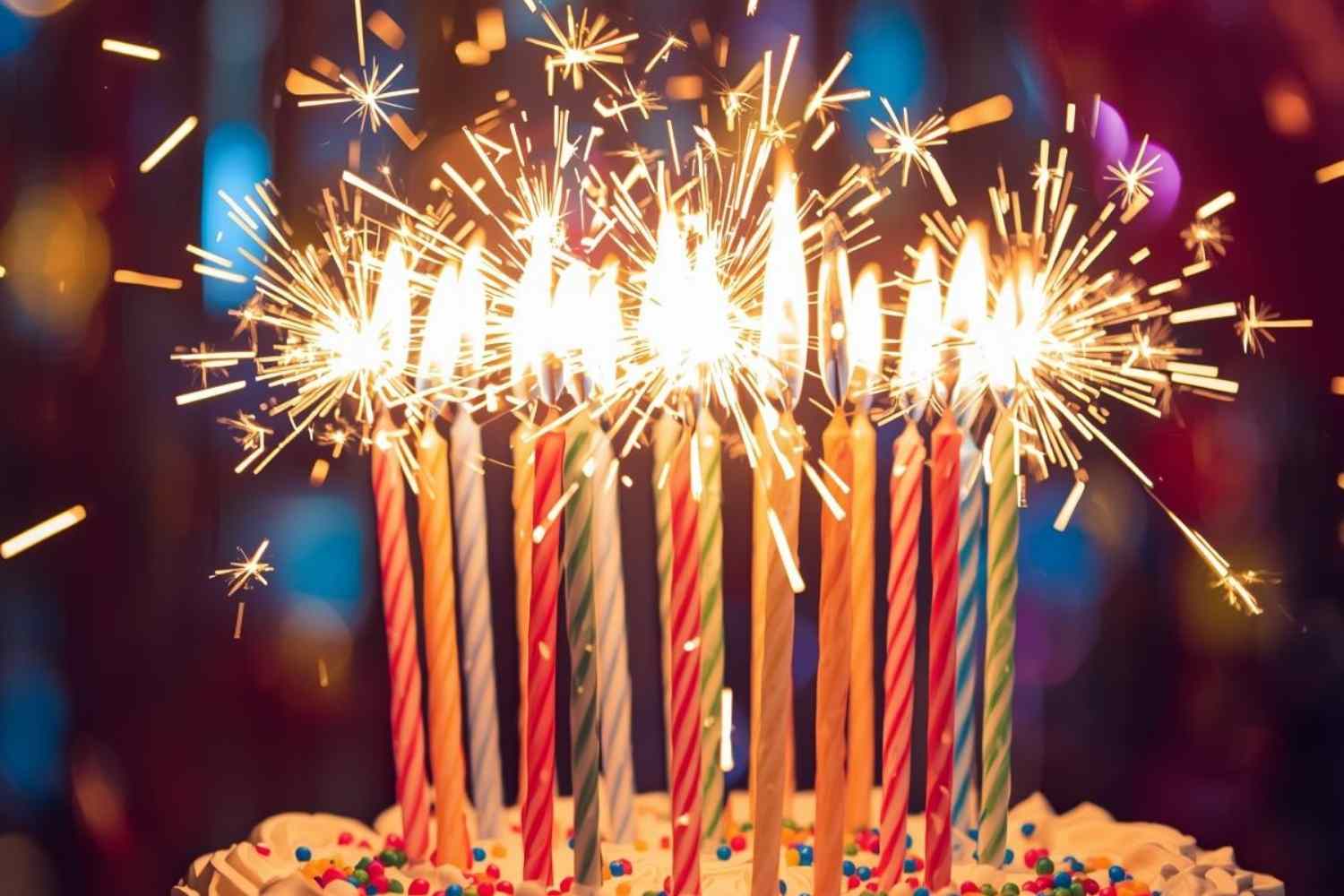
What happened on New Year’s Eve in Crans-Montana brought sparkling candles back into the spotlight, those small pyrotechnic displays – only apparently harmless – that illuminate cakes, desserts and even bottles of champagne during parties and celebrations. But in addition to the fire risk, dramatically demonstrated by the Swiss accident, these products also hide another little-known danger.
Studies on twinkling candles
Pyrotechnic candles are not simple decorations, they act like mini-fireworks. This is demonstrated by an Italian study carried out as part of the Davenpros project, coordinated by Professor Tiziano Pagliaroli of the Niccolò Cusano University, in collaboration with the Roma Tre University and the ENEA Research Center of Casaccia.
The team, originally developing sensors to measure the speed of particles in rocket engines, applied the same technology to pyrotechnic candles. The results are surprising: the metal particles emitted by combustion travel at speeds between 20 and 80 meters per second and practically all fall onto the surface of the cake, bringing with them metals such as aluminium, iron, magnesium, barium, copper and strontium.
As Pagliaroli explained to Repubblica, these spark plugs reproduce on a small scale some typical aspects of aerospace propulsion systems and are loaded with the same metals used in rockets as propellants. Their scenic effect is due precisely to the oxidation of these tiny metal particles which emit the characteristic colored sparks.
To confirm the fears in the use of these candles there is also a study published in the magazine Food Analytical Methods by Brazilian researchers, who analyzed the residues of the luminous fountains. The chemical analysis revealed microdoses of metals: barium (0.3%), copper (0.18%), strontium (0.06%), iron (0.03%) and aluminum (0.02%), with traces of cadmium and chromium on the exposed surfaces.
Apparently low percentages, but significant because these are substances that should not be found in foods, especially if intended for children or sensitive people. The authors point out that, although the quantities are minimal, repeated exposure can exceed the daily intake limits considered safe by international health agencies.
In summary, both studies highlight the same problem: pyrotechnic candles release metallic particles that can deposit on sweets when used for stage effect, turning seemingly harmless decorations into a potential health risk.
The fire risk
The Swiss tragedy then reminded us in the most dramatic way how dangerous fire risks can be. As explained by ballistics expert Raffaella Sorropago, who conducted an experiment, sparkling candles contain gunpowder and can reach temperatures of up to 600°C. Used near non-fireproof materials, such as paper, fabric or sound-absorbing panels, flames can start fires within seconds.
Sorropago underlines that, if used correctly, they do not generate dangers, but it is enough to bring them close to flammable materials for the risk to become immediate.
To reduce the risks, experts recommend using them in moderation, keeping them away from edible surfaces and considering safer decorative alternatives, even for sweets, especially if intended for children. Traditional candles or LED light decorations can offer the same scenic effect without risking either the safety or health of those celebrating.
Sources: Food Analytical Methods
