
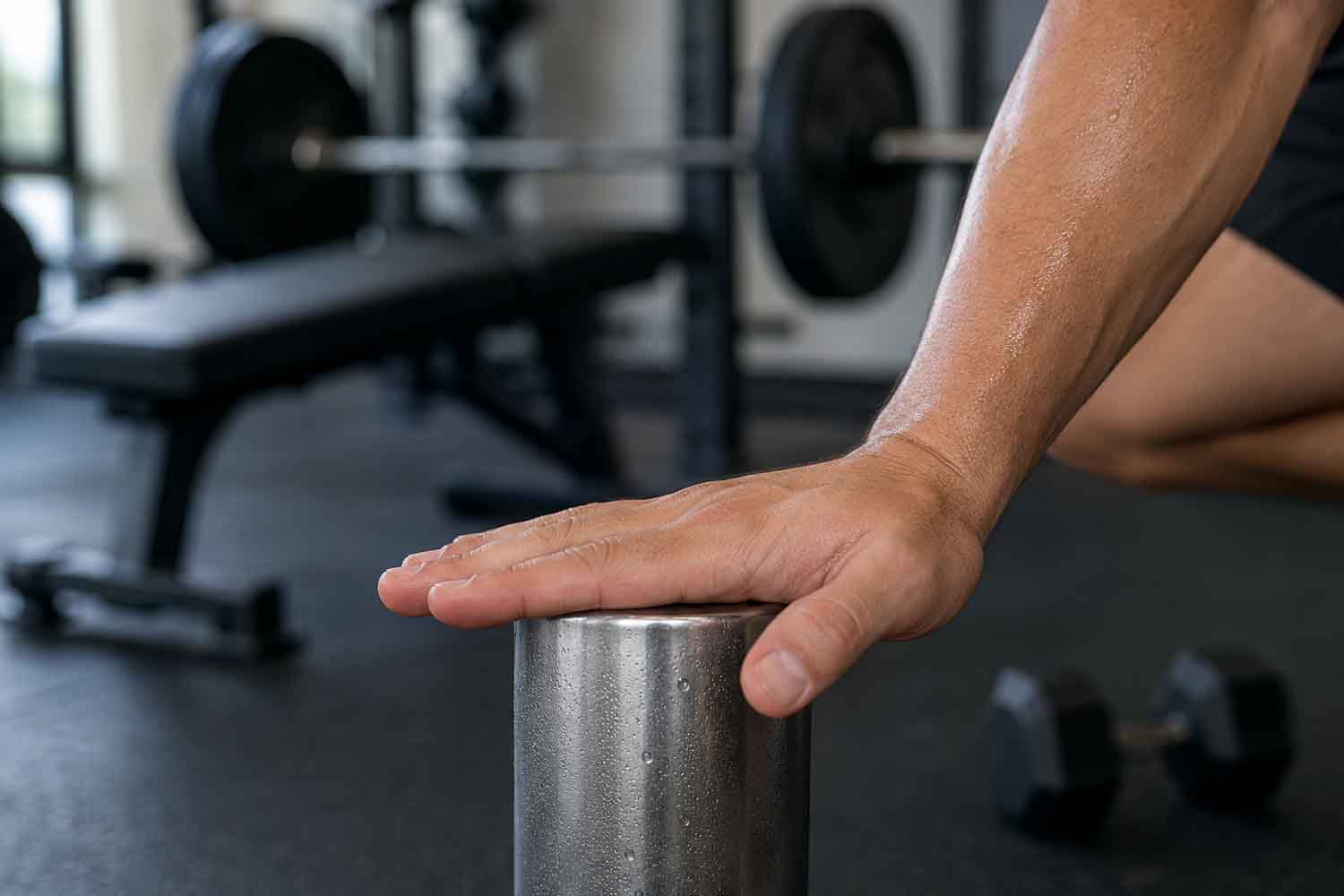
Between sets, the barbell returns to the stand and the palm ends up on a cool surface. Two or three minutes, then we start again. Palmar cooling promises to slow down fatigue and leave room for a few more repetitions, taking advantage of a real characteristic of our hands.
Studies, however, do not always return the same result. The technique seems to have more possibilities when the body has accumulated a lot of heat. During a normal session in an air-conditioned gym, the advantage can reduce and even disappear.
Why exactly the palms
The palms and soles of the feet are covered with hairless skin. Below the surface are numerous arteriovenous anastomoses, direct connections between arterioles and venules capable of rapidly transporting large quantities of blood. When the body temperature rises, the warm blood reaches the periphery, releases part of the heat outside and returns towards the center of the body. The hands therefore function like small radiators.
This feature makes handheld cooling plausible, without automatically turning it into a system for lifting more. Fatigue also depends on the load, the duration of the sets, energy reserves, muscle recruitment and the perception of effort. Cooling your hands only affects the thermal component.
Temperature matters too. An icy object can cause vasoconstriction and reduce blood flow to the palm. The hand becomes cold, while the heat exchange that was intended to be promoted can slow down. Serve fresh, not a freezer-proof test.
The study from which the famous 40% comes
The most cited data comes from a Stanford University study published in 2012. In one of the tests, eight participants performed exercise on the treadmill in a hot environment and then four sets of flat bench presses with a fixed load. With palm cooling, mean esophageal temperature dropped from 39 to 38.4°C and overall repetitions went from 36 to 42.
In a separate protocol, three minutes of cooling during each recovery was associated with a 40% increase in bench press volume over three weeks, versus 13% without treatment.
40% traveled much faster than the rest of the study. The sample consisted of eight people, the training period was short and equipment designed to extract heat from the palm was used. It is therefore not enough to squeeze a fresh bottle to add 40% of work to your card.
When the advantage disappears
In 2023, a study of weight-trained men compared palm cooling at 10°C, 15°C, and a thermoneutral condition during the bench press. Repetitions, volume lifted and physiological responses remained essentially the same.
The following year, researchers at the University of Leipzig tested the cooling of the palms and soles during tractions, bends and leg extensions. A total of 41 physically active adults were involved in the three protocols.
As reported by the study published on Sportsthe number of repetitions did not increase. In the pull-ups it even decreased, perhaps because the cold interfered with the grip. The radiator, in that case, also had to remain attached to the bar.
In July 2026, a work published on Journal of Sports Sciences brought the test closer to a normal gym session. Twenty-five trained people performed bench press, lat machine, leg press, curl and pushdown, cooling one hand between sets with water kept between 10 and 15°C.
Here too, no differences emerged in the number of repetitions, total volume, perceived fatigue, heart rate or lactate. In a hypertrophy-oriented session, without severe heat stress, palmar cooling added no work.
Feeling cooler doesn’t mean your body is cooling down
Another 2024 study published in the Journal of Thermal Biology involved ten men during physical activity at 33°C and 60% humidity.
Cooling the palms to 12°C or 0°C improved sensation and thermal comfort. Rectal temperature, sweating, heart rate and oxygen consumption, however, did not change.
Participants felt cooler, without showing a measurable reduction in core temperature. The relief can make the effort more tolerable, especially in the heat, but it doesn’t automatically equate to completing more reps.
How to try it during training
Temperatures between 10 and 15°C have often been used in strength protocols, applied for two to three minutes during recoveries. However, there is no ideal temperature valid for every person and for every exercise.
You can use a cool bottle, a gel pack wrapped in a thin cloth, or a cooled metal surface. The palm must adhere for a large part, without squeezing forcefully and without numbing the fingers.
Pain, burning and loss of sensation indicate that the temperature is too low. Ice applied directly to the skin adds risk and offers no proven benefits to justify the discomfort.
Palmar cooling can make sense during long workouts, repeated efforts and very hot days, when there is really a significant amount of heat to lose. In a cool gym, during a normal weight session, the cold bottle remains mostly a cold bottle.
