
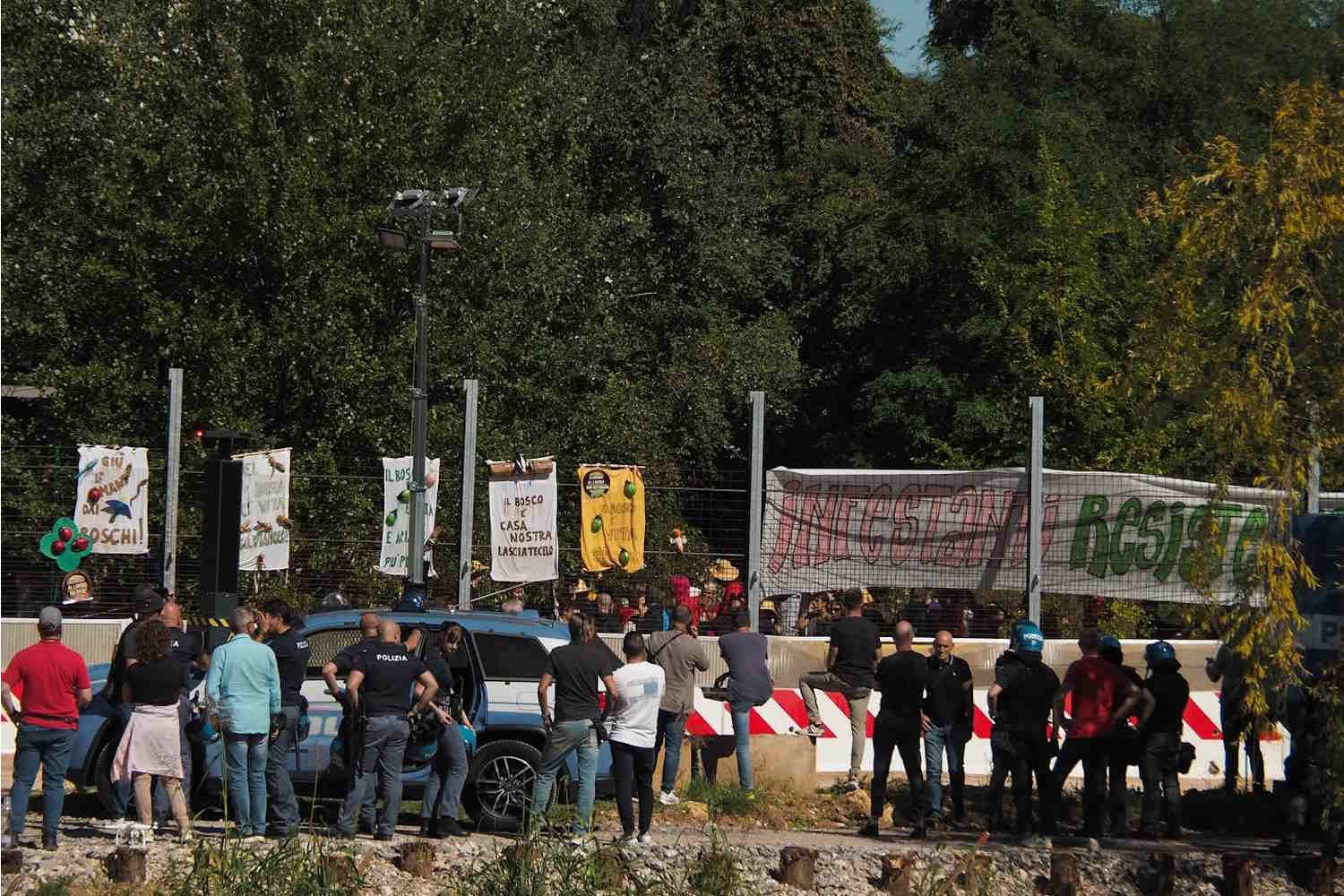
PFBA, TFA and other compounds of the PFAS family in the land affected by the high-speed construction sites in Vicenza. They were found by four independent samplings commissioned this summer by the assembly of de activists THE Woods that Resist to an accredited laboratory.
Two of the four samples would have returned values that activists define as “significant”: one was taken in the Ca’ Alte area, in the Ferrovieri district, where the TAV project involves the construction of a new railway overpass; the other under the Ferreto de’ Ferreti railway overpass, destined for demolition.
The data alone is not enough to establish either the extent of the contamination or its origin. And the committees themselves specify: independent sampling “does not replace an official characterization of the land”. But it is obvious that they are able to raise an issue that is difficult to ignore, especially here, in this territory that has coexisted with PFAS for years.
What was found in the samples
According to the results released by Boschi che Resistono, the following were found in the soil taken from Ferreto de’ Ferreti:
In the Ca’ Alte sample, however:
These are data to be verified through institutional sampling, of course, but which according to the committees highlight a gap: in the controls envisaged on the excavated earth and rocks of the Tav project, they claim, PFAS would not have been looked for.
The precedent of the Pedemontana
In the Vicenza area, already during the works on the Pedemontana Veneta highway, ARPAV had identified PFBA in the waste water from the Malo tunnel construction site. In an official response from 2021, the Veneto Region explained that the evidence collected by ARPAV did not allow it to exclude a correlation between construction site activities and the high concentrations of PFBA detected. Further investigations and interventions on the water purification system were therefore requested.
We talked about it here: PFAS in the aquifers along the Pedemontana Veneta: 12 investigated for pollution
Furthermore, as regards the presence of PFAS in the groundwater of the area affected by the railway works, in 2025 a monitoring before construction in the area of the Vicenza station it had already detected several fluorinated compounds in the first aquifer, including PFOA and GenX.
Now, according to Boschi che Resistono, the TAV project involves the movement of over 1.5 million cubic meters of soil, a part of which is intended for reuse even outside the construction site areas. If the presence of PFAS were confirmed on larger portions of the land, there would be an urgent need to prevent excavation, transport and reuse from becoming a further vector of dispersion.
Hence the request from the TAV Environment and Health Coordination for a more extensive characterization of excavated soil and rocks and the introduction of “PFAS-free” declarations for products used on construction sites.
In an area already marked by the Miteni case and the controversies over PFAS in the Pedemontana, moving millions of cubic meters of soil without knowing in sufficient detail what they contain would be imprudent to say the least. And here the precautionary principle is not an environmentalist slogan: it simply means knowing before digging.
Independent analyzes therefore open up a big question. Now it is up to the institutions to verify those data and say, with public and transparent sampling, what is really under the construction sites of the TAV in Vicenza.
