
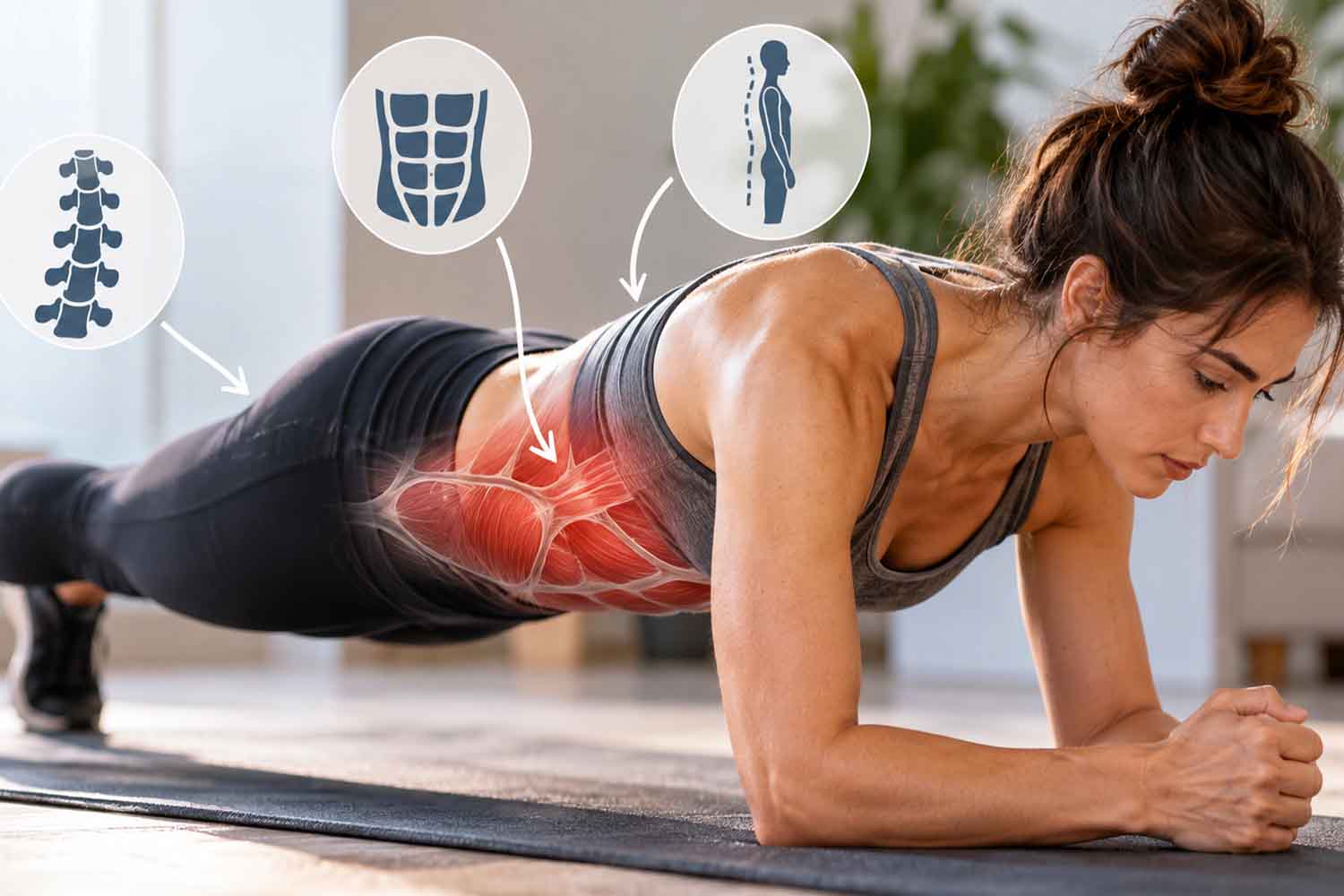
Thirty young adults, half trained and half untrained, held a plank until voluntary failure. In the less trained participants, the researchers recorded greater activation of the erector spinae and multifidus, two muscle groups of the back. Those who trained regularly, however, showed different and more efficient muscle recruitment during exercise.
This is what emerged from a study published in 2026 in the Journal of Electromyography and Kinesiology, conducted on 30 healthy people. The sample is small, young and the study measured muscle activity, not any injuries: it would therefore be incorrect to conclude that the plank is dangerous for beginners. However, the authors indicate something much more useful: the same plank does not weigh the same on a trained body and on one that is not.
Plank, how long do you need to hold the position before seeing results?
Which makes the domestic competition to see who can last the longest while staring at the floor a lot less meaningful.
What the plank really trains
The plank is an isometric exercise: muscles work to maintain a position without producing the obvious movement of a crunch or squat. Abdominals, obliques, deep trunk muscles, spinal stabilizers, shoulders and glutes participate to a different extent depending on the variant and position adopted.
Even a few centimeters make a difference. In an electromyographic experiment on 19 participants, moving the levers and associating a retroversion of the pelvis significantly increased the activation of the rectus abdominis, external obliques and deep stabilizers compared to the traditional plank.
This explains why technique comes before the stopwatch. Elbows under the shoulders, stable trunk, active abdomen and buttocks, neck in continuity with the spine and regular breathing are indications that also occur in the instructions of the American Council on Exercise. When the pelvis begins to fall towards the floor and the lumbar area arches, another ten seconds are mainly used to win an imaginary argument with oneself.
The 30 day plank challenge, to tone your body and strengthen your muscles. Part 3, with the last 10 exercises
A flat stomach is another matter
Training your abs can make them stronger and more resilient. The amount of fat that covers them follows much less cooperative rules.
A 2011 randomized study involved 24 sedentary people between 18 and 40 years old. For six weeks the experimental group performed seven abdominal exercises, five days a week. Muscle endurance improved, while weight, body fat percentage, abdominal circumference and belly fat measurements did not significantly change.
The issue of the so-called localized fat reduction, however, is not completely resolved. A small randomized trial published in 2023 found greater reductions in midsection fat in 16 overweight men who underwent a specific program of endurance abdominal exercises combined with running for ten weeks.
The detail matters a lot: there were four workouts a week, with a long and demanding protocol, compared with another aerobic program with similar energy consumption. It doesn’t prove that a few sets of planks can pick out your belly fat and gently usher it out.
To obtain more visible abs, overall training, body composition, nutrition and individual characteristics come into play. The plank can build what lies beneath. For what is above, unfortunately, it does not have an eraser.
Posture and back, without turning it into a universal cure
A trained core participates in trunk stability and movement control. This is where the frequent association between plank and better posture comes from. Here too it is best to remove some layers of advertising.
The studies often involve comprehensive core stability programs, not the plank performed alone. In a randomized trial of 34 young adults with chronic low back pain, eight weeks of core stability exercises — including front and side plank, bridge and bird dog — improved pain, disability and some measures of postural control. A different program specifically dedicated to posture control achieved comparable results.
Therefore, work on the core can have a useful function in stability and, within suitable programs, also in the management of low back pain. From here to promising an immediately straighter back, an elegant posture and clothes that fit better, some scientific steps are missing.
How long should you hold the plank
There is no universal scientific table that automatically assigns 15 seconds to a beginner, 60 to those who are trained and a different time simply because they are over 40 or 50 years old.
If anything, the new 2026 study suggests looking at the level of training and the ability to maintain the position correctly. The practical indications of the American Council on Exercise also use progressive intervals: in the initial phases it suggests relatively short holds and a gradual increase in load. They are training indications, not biological thresholds beyond which the plank suddenly acquires superpowers.
For those starting from scratch it may make sense to reduce the leverage by resting the knees or use a raised stand, then gradually increase the difficulty. When the position deteriorates, the series is already essentially over even if the timer has other ambitions.
Lower back pain during exercise, known spinal pathologies or other musculoskeletal conditions deserve an individual evaluation with a healthcare professional. The plank can also be included in programs for those suffering from back pain, as clinical studies show, as long as it is chosen and dosed for that person.
At 61 years old she stays in plank for 5 consecutive hours: DonnaJean Wilde breaks the world record (set by herself)
It’s still a surprisingly honest exercise: it trains your core well, requires zero equipment, and gets harder as you do it really well. For the complete transformation of the silhouette in three minutes a day, you will still have to wait. Possibly without remaining supported on your elbows in the meantime.
