
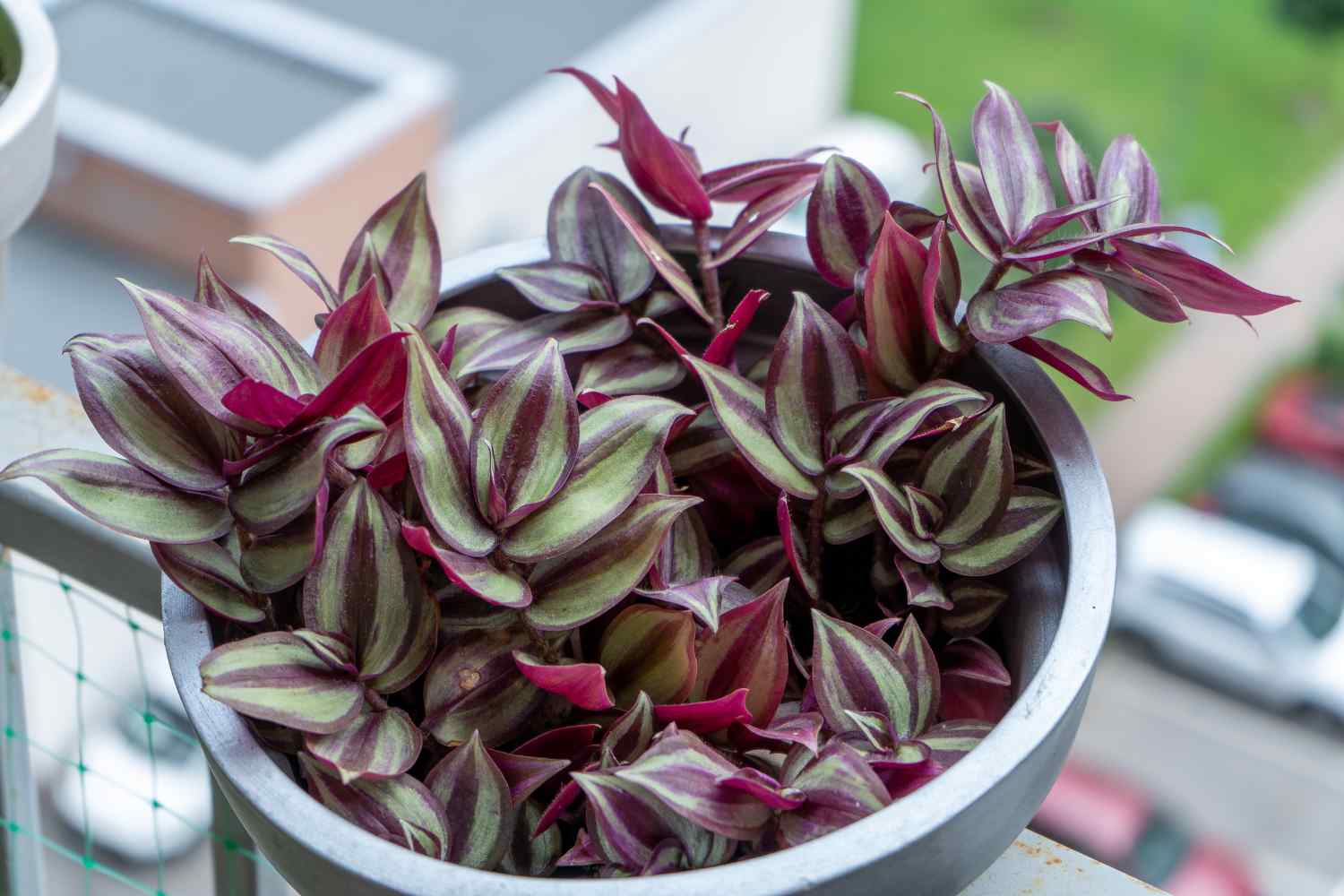
Grass misery, also known as “misery plant” and known with the scientific name of Tradescantia Ruppiusappeal to the family of Comelinaceae And it is originally from the tropical regions of Central America and the South.
We are talking about a perennial plant highly appreciated in different aspects: because of the decorative leaves, for the good resistance and for the natural ability to adapt to different environments, equipped with great beauty and also known for the benefits it can bring.
Description of the Plan Misery
The misery grass stands out for long and pointed leaves, characterized by a fascinating mix of dark green and purple streaks. The leaves are arranged in compact rosettes, creating a visual effect that adds depth and color to the internal and external spaces. Despite being a perennial plant, it is relatively easy to cultivate and maintain, therefore perfect for the less expert in gardening or for those who want an undemanding plant.
The varieties of tradescantia
Tradescantia includes different varieties, each with unique characteristics that can meet different decorative needs. Here are some of the most common:
Where to place the plant plant
The misery grass is extremely versatile and can be grown both inside and outside. Inside the house, place it in bright areas, which are not directly exposed to intense sunlight: indirect light is the one that serves the plant to maintain vivid colors and to prevent drying of the leaves.
Outside, it prefers places with filtered light or in partial shadow. In areas with mild climates, it can also be grown outdoors throughout the year, while in areas with cold winters it is advisable to bring it inside to protect it from low temperatures.
What ground to use for the plant plant
The misery grass prefers well -drained soils, therefore a mix of universal soil, enriched with pumice, sand or clay, is a good composition, which can improve drainage and prevent stagnation of water, the usual threat lurking for the entire radical apparatus. Be sure that the vase has drainage holes to avoid the accumulation of humidity, which could lead to radical rot.
If grown in the garden, misery easily adapts to various types of soil, provided it is not too heavy or compact, and in the hottest climates it can be planted directly on the ground.
How to cultivate tradescantia in pots
Misery adapts well to pot cultivation. Make sure to choose a container large enough to allow the roots to expand, since a too small vase could limit the growth of the plant.
Place the vase in a bright place, but far from direct sunlight. During the summer, you can move the vase outside, to a shaded or semi-umbrented area, but remember to bring the plant back inside when the temperatures begin to drop below 10 ° C.

How to irrigate the plant misery
The irrigation of the misery plant must be moderate. You will have to water it only when the soil is dry to the touch, and prevent water stagnation from the saucer. Remember that excessive irrigation could cause radical rot, one of the main causes of death for this type of plant. During the winter months, the irrigation can be reduced, because the plant will enter the rest phase.
How to ferty the plant misery
During the growth season, ranging from spring to summer, grass misery should benefit from regular fertilization. A specific liquid fertilizer for green plants, applied every 15-20 days, will be able to encourage lush growth and more intense colors. In autumn and winter, you can reduce the frequency of fertilizations, since the plant will slow down the growth cycle.
When the misery grass blooms
Tradescantia produces small white or pink flowers, which generally appear during the summer season. Although flowers are not the main element of attraction of the plant, they contribute to making its appearance even more fascinating, even if it is above all for the color of the leaves that misery is appreciated as a decorative element.
Common diseases and parasites of the Plan Misery
The misery grass is generally a robust plant and not subject to insect attacks. Only aphids can sometimes hit it, but not particularly seriously. As for diseases, the main signals come from the leaves: when they darken, they dry out or fall, often the cause is the lack of humidity or a soil too dry. In these cases it is better to immerse the vase in the water and increase the frequency of the watering. If, on the other hand, the ends of the leaves become dry, the plant is likely to be exposed to excessive direct light. The sudden fall of the leaves from the branches can indicate deficiency of light, while the formation of too many green sprouts is often linked to an excess of fertilizer or a lack of brightness.
To prevent infestations, regularly check the leaves and, in the event of the presence of parasites, intervene with specific products or natural remedies such as Marseille soap diluted in the water.
As already observed, another common problem is the radical rot, caused by excessive irrigation or by insufficient drainage: to avoid it, make sure not to overdo the water and use a well -draining soil.
Symbolic meaning of the grass misery
The vulgar name “grass misery” contributed to spreading the belief that tradescantia was a plant bearer of bad luck. The negative fame of which it was cloaked suggested that nor gave or stolen, since its possession, if not acquired correctly, could have caused problems. In addition, the tradition advised to place it outside the door of the house together with a thorny plant, such as Aloe: in this way, with the combination that came to create, it would have been possible to keep absent -minded people away, who would find themselves “trapped” in the thorns of the Aloe plant.
Another popular belief predicts that tradescantia is placed on the roofs of homes. In this way, it is believed that the plant can capture and imprison the evil spirits, avoiding that they enter the home and thus protecting the inhabitants. The ritual use of the plant connects to an ancient conviction that saw in its luxuriant growth a force capable of retaining negative energies: as a result, a different combination of symbols related to bad luck and protection make tradescantia a symbol of ambivalence, capable of chasing the evil if used with due precautions.
Despite the superstitions related to the name “Erba Miseria”, in various countries of South America, tradescantia is often given as a sign of prosperity and continuity. It is considered a resistant plant, capable of growing even in difficult conditions, and precisely this tenacity is interpreted as a wish for strength and long life to those who receive it. It is not uncommon to find it in homes as a good hopeful gift, unlike what the most wary European popular tradition suggests.
Its symbolic meaning varies very much from culture to culture. In some traditions it is a plant that attracts positive energies and brings luck, a green talisman that promotes harmony and abundance. In others, on the other hand, he maintains the fame of “guardian” against negativity: not so much a bearer of bad luck, but a barrier that absorbs and retains what is harmful, protecting those who live in the house.
Benefits of misery
In some cultures, tradescantia is used in popular medicine to treat wounds and inflammation of the skin: the leaves are used for soothing and refreshing properties, even if certain uses are not widely supported by in -depth scientific studies.
