
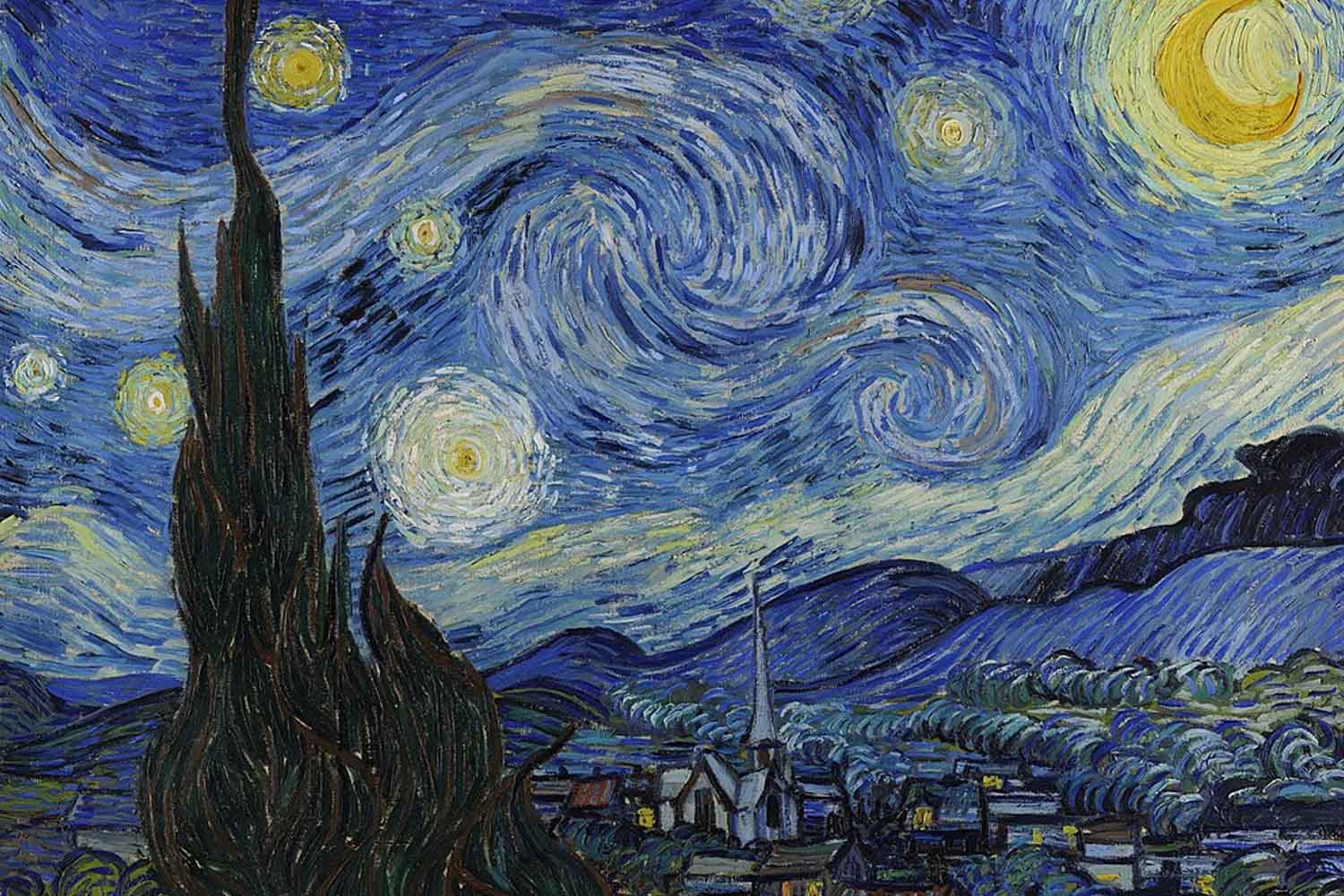
The turbulent sky of the “Starry night” Vincent Van Gogh made dreams dream, but today he also fascinates physics. Those spirals of color and the large crescent moon surprisingly remember a phenomenon that has just been observed for the first time in the laboratory: theInstability of Kelvin – Helmholtz in a quantum fluid.
A group of researchers fromOsaka Metropolitan University and of the Korea Advanced Institute of Science and Technology has captured images of tiny vortices with an unusual shape, called Skyrmion fractional eccentric. Their curvature recalls so much the moon painted by Van Gogh that one of the scientists has put them compared to direct comparison.
From the stormy sea to ultrafreddi gases: how the phenomenon is born
If you think of the wind that impaired the surface of the sea, you will have an intuitive image of Kelvin – Helmholtz’s instability. In classic fluidinamics, this phenomenon appears when two layers of fluid flow at different speeds, generating waves and vortices. The same happens in the clouds that bend and roll up in the sky or when the milk and foam of the cappuccino mix creating small spirals.
In the laboratory, however, there were neither water nor air. The researchers cooled lithium gas up to very few billionths of grade above the absolute zero, giving life to a Condensive of Bose -Einstein Multicomponentthat is, to a quantum superfluid. Here, two particles flows flowed at different speeds, forming an wavy motif similar to what we see on the waves of the sea. But instead of stopping at this, quantum mechanics took over, transforming the waves into vortices regulated by topological laws and generating structures never seen before.
The Skyrmion are already known to be small stable structures present in certain magnetic materials, designed for applications in spintronics and in magnetic memories. The novelty is that a version never observed emerged in this experiment: the Skyrmion fractional eccentricor efs.
To imagine them, think of a thin slice of orange: their curved shape recalls a small wedge. Inside, as if it were a thread of fabric with a knot, they contain breakage points that break the regularity of their internal order. They move in an unusual way, a bit like leaves transported by water currents that change direction suddenly.
Second Hiromitsu Takeuchione of the authors of the study, the similarity with art is clear:
The large crescent moon in the upper right part of the starry night is identical to an efs.
Because this discovery is also important for the future
This observation is not just a curiosity for physics enthusiasts. Understanding how EFS behave could improve our knowledge of complex quantum systems and lead to new technological applications. The team hopes to carry out even more precise measures to verify predictions already made in the nineteenth century on the wavelength and the frequency of the waves generated by the instability of Kelvin – Helmholtz.
In addition, the presence of internal singularity in the EFS could question the current classifications of topological defects and open the way to discover similar structures in other multi-component systems or in more size contexts.
