
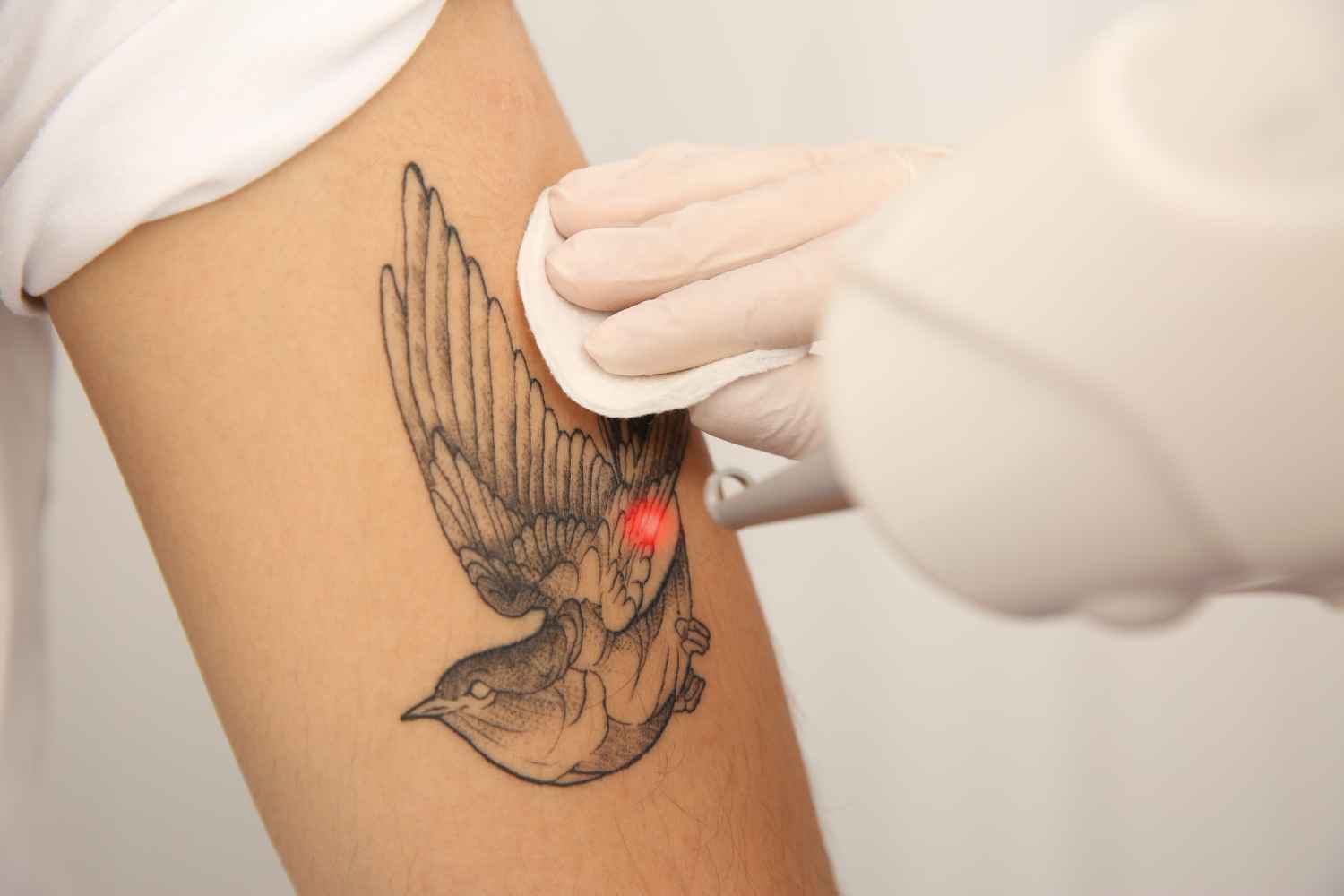
A tattoo that no longer represents us, a drawing made on impulse or a name that we would rather forget. There can be many reasons for wanting to erase a tattoo, but getting rid of it isn’t as simple as doing it. Removal often requires numerous sessions, can last years and involves an expense which, in some cases, reaches several thousand euros. Not to mention the possible side effects, from changes in skin color to scars.
An investigation by 60 Millions de Consumers. The French magazine collected the testimonies of dermatologists and other specialists, highlighting above all the risks of some alternative techniques to lasers, proposed as cheaper and quicker solutions, but potentially very harmful.
Laser removal, how many sessions are needed and how much it costs
Laser is today the most used technique for removing tattoos. The treatment acts on the pigments, fragmenting them into smaller particles that the body can progressively eliminate through its defense mechanisms.
As Jean-Michel Mazer, a dermatologist specializing in laser therapy and one of the founders of the French Society of Dermatological Laser Therapy, explains, it is not possible to establish precisely from the beginning how many sessions will be necessary. The answer depends on several characteristics of the tattoo, some of which are difficult to evaluate before starting.
For example, the quantity and depth of the ink, as well as the size of the pigment particles, matter. Color also makes a difference: black is generally easier to treat, while some shades, such as yellow and pale green, can be more resistant. Designs that combine numerous colors are often more complex, because they may require lasers with different wavelengths.
According to specialists interviewed by 60 Millions de Consumersyou can reach more than 20 sessions. Generally several weeks, often one or two months, must pass between treatments to allow the skin to recover. Complete removal is not always possible and the process can take years.
Pain and costs are also things to consider. To give an idea of the figures reported in the French survey, a session can cost between 100 and 500 euros, depending on the size of the tattoo, the colors, the complexity of the treatment and the professional chosen. The magazine cites the case of a YouTuber who spent 5,250 euros for 21 sessions spread over three years.
Doctor Mazer’s advice is however clear: before starting, it is important to evaluate the overall cost of the process, without stopping at the price of the single session. In fact, once removal has begun, the tattoo may be damaged and it is not certain that it will be possible to interrupt the treatment and obtain a satisfactory result.
The risks of lasers and the centers to be wary of
The investigation highlights another problem: the presence of centers that offer treatments at particularly low prices, sometimes using ineffective equipment or entrusting the laser to personnel without the necessary skills.
Mazer says he has received reports of situations in which assistants, rather than doctors, would actually carry out the treatment. According to the dermatologist, incorrect settings and inappropriate equipment can cause burns, permanent pigmentation changes and other skin damage.
It is therefore not enough to choose a center based on price. It is important to know who will perform the procedure, what experience they have in tattoo removal, and how the laser parameters will be adjusted based on the pattern and characteristics of the skin.
Furthermore, the treatment is not without risks even when performed correctly. The Istituto Superiore di Sanità reports the appearance of crusts and vesicles, pigmentation changes and hypersensitivity reactions among the possible complications. In some cases the color of the tattoo may even darken rather than disappear.
For this reason it is advisable to contact a doctor with specific experience in tattoo removal. The dermatologist, in particular, can evaluate the condition of the skin and recognize any complications, including abnormal scars.
Chemical removal, the risk of permanent scarring
The most worrying part of the investigation concerns an alternative technique to laser that some beauty centers and tattoo artists propose as a quicker and cheaper solution: chemical removal by injecting lactic acid into the dermis, the layer of the skin where the pigment is found.
The method is presented by some operators as a system to bring out the ink through the skin, rather than fragmenting it as happens with laser. But, according to specialists interviewed by the French magazine, the price to pay can be very high.
Nicolas Kluger, dermatologist expert in complications related to tattoos and head of a dedicated consultancy service at the Bichat-Claude-Bernard hospital in Paris, explains that this procedure causes a destructive reaction of the tissues. The skin may undergo necrosis, become dark and crusted, as pigment is expelled through the wound.
The result can be a permanent scar. Aesthetic doctor Arnaud Lambert reports having followed several patients with hypertrophic scars, i.e. thickened and raised scars, which cannot be completely eliminated even with further treatments.
Lactic acid is also known for its use in cosmetics, but this does not mean that it is harmless when injected deep into the skin. According to Kluger, in this context it can damage cells and collagen, contributing to the formation of scars that are difficult to correct.
Sandra Dos Santos, a tattoo artist from Bordeaux who specializes in working on scars, also tells the magazine that she tattooed a client who wanted to cover the marks left by an attempted chemical removal that extended to her lower back.
Second 60 Millions de Consumersthe use of these injections continues also due to regulatory ambiguity. Some operators present the products used as cosmetics, a classification which, according to what was reported in the investigation, does not adequately clarify the rules applicable to their use to remove tattoos.
The specialists interviewed by the magazine ask for urgent intervention. Lambert considers it unacceptable that we continue to practice a procedure capable of causing permanent damage, while Kluger draws attention to the need to evaluate the safety of these methods more rigorously.
Creams to erase tattoos
Among the solutions to avoid, the investigation also mentions creams and gels sold online with the promise of eliminating tattoos for just a few euros. Some products identified by the magazine on e-commerce platforms cost less than 10 euros and are advertised as simple alternatives to laser treatment.
The problem is that most of these creams work on the surface layers of the skin, while tattoo ink is located in the dermis. For this reason, according to Lambert, these are generally exfoliating products that are unable to effectively reach and remove the pigment.
The magazine also reports some imported products without a list of ingredients. In these cases it is not possible to verify with sufficient transparency what they contain, one more reason not to rely on commercial promises not supported by evidence.
Also beware of cheap devices sold online such as tattoo removal pens or laser pointers. According to specialists cited in the investigation, some are not real lasers and can be ineffective or damage the skin if used improperly.
Can the pigments reach the lymph nodes?
Finally, the investigation addresses a scientific question that is still open: the fate of pigments after laser removal.
Thierry Rabilloud, research director at the CNRS, the French national center for scientific research, explains that some tattoo ink can migrate from the skin to the lymph nodes. The phenomenon has also been observed in studies of organic pigments, metals and titanium dioxide.
According to the researcher, the laser can promote the diffusion of particles by fragmenting the pigment and freeing it from the cells that hold it. A portion can then be transported through the lymph.
This does not mean, however, that it is already possible to precisely quantify the health risks of those undergoing treatment. Rabilloud points out that the short- and long-term effects of tattoo removal are still poorly studied, especially compared to other aspects of the practice.
The most important fact, in the end, is the need not to consider removal a simple aesthetic treatment without consequences. Before starting, it is best to ask for a medical evaluation, find out about the number of sessions and possible side effects and be wary of solutions that promise quick, cheap and scar-free results.
As Lambert points out, erasing a tattoo often takes much longer than making it. Taking the time to evaluate the alternatives can avoid turning a design you no longer want into a skin problem that is even more difficult to resolve.
