
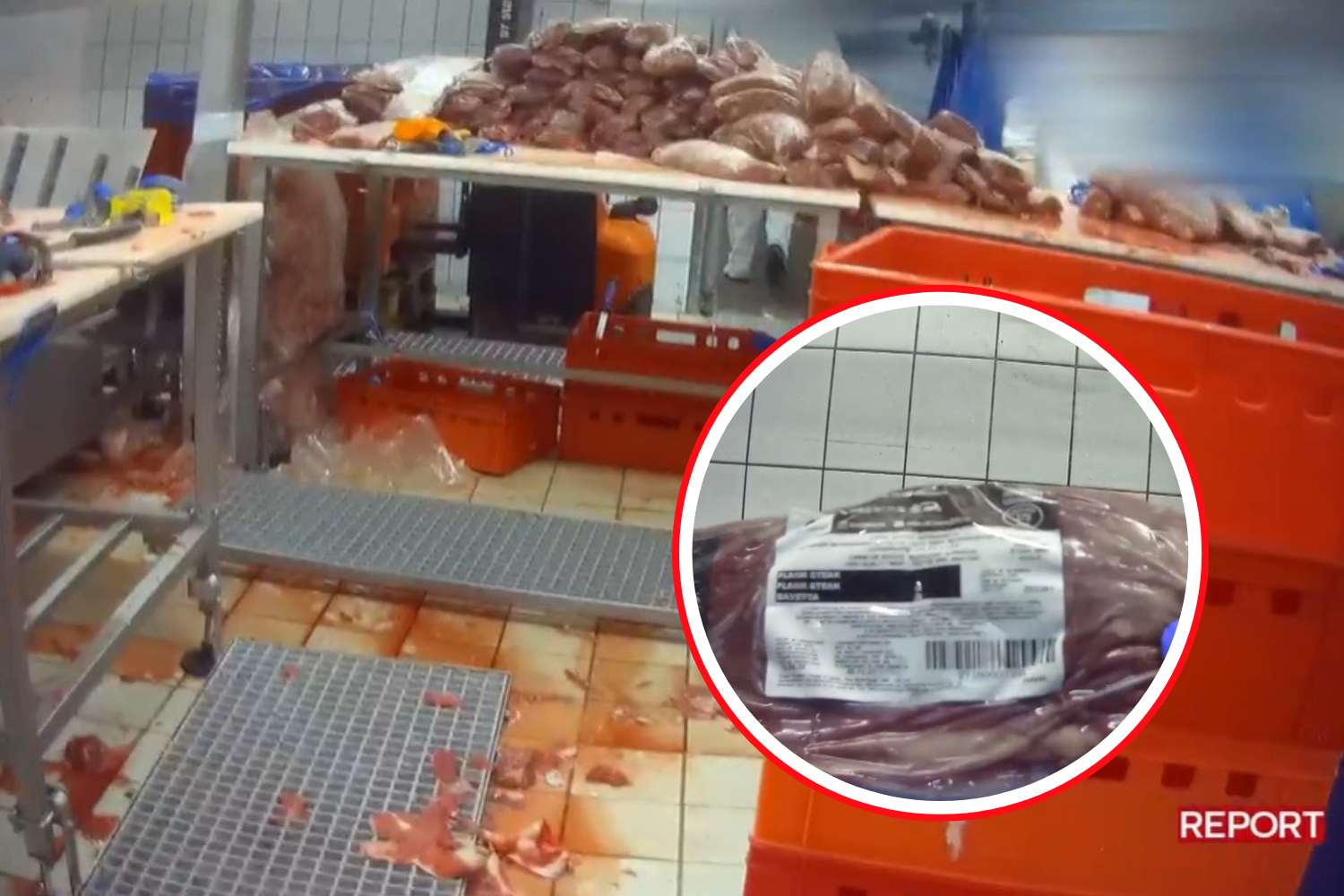
We thought we had already seen the worst. But no. After last week’s shock investigation, Report returned yesterday, November 30, to update on the story of the alleged expired meat processed in the Bervini slaughterhouse, in the Mantua area. And what emerged is even more disturbing.
But let’s recap for a moment what happened. Giulia Innocenzi’s investigation, with the eloquent title “Nothing is thrown away“, shows the inside of the Bervini factory in Pietole, in the province of Mantua, on an ordinary day of meat processing. We are talking about a historic company in the area that manages around 200 million euros of imported meat every year.
Already last week a serious accusation had been made: years-old meat – coming from Uruguay, New Zealand, other countries and even from Egyptian military reserves – thawed, “cleaned” by eliminating the most deteriorated part, repackaged with new labels and refrozen to be put back on the market. A practice, confirmed by the images shot undercover and by the statements of some employees, which may have continued for years.
But in yesterday’s episode, Report revealed a further detail. Not just meat that has expired for two, three, five years, “cleaned” and resold as if nothing had happened. Not just modified labels and meat imported from the other side of the world, preserved beyond all limits and then “brought back to new life” with a stroke of the knife. Now a worse hypothesis also arises: pieces of meat that would have undergone double processing, expired for the first time, put back on the market, expired again and put back on the market for the second time.
Where did this meat go?
Yesterday Report also revealed the information everyone was waiting for, namely where the expired meat presumably ended up. According to an interviewed worker, the high-level “cleaned” meat would be destined for large-scale distribution and restaurants in Milan, while the “carnetta”, the one portioned into small pieces and considered of poor quality, would go to the cooking room of another plant, also owned by Bervini.
But then who bought it? Who cooked it? Who ate it? The answer in theory is simple: just track the lot numbers. And in fact Giulia Innocenzi handed everything over to ATS Valpadana. It’s a shame that – as revealed last night – the company was late in providing the data, citing IT problems. In fact, therefore, we do not know.
The double refreezing hypothesis is possible
But returning to the hypothesis of double refreezing, the director of the ATS contacted by Innocenzi did not rule out anything:
It could well be, but to be sure we would need the information that the operator has to give us regarding the traceability of the product.
In short: until the company fully cooperates, expired meat could be everywhere. On the expensive plate of a Milanese restaurant, on the refrigerated shelves of a supermarket or elsewhere.
We really hope that, after the fuss raised by Report’s investigation, the authorities will finally clarify what is happening inside this plant, reconstructing every batch, every step, every possible responsibility. Because citizens have the right to know what arrives on their plates.
The company’s response
When asked by Report, the Bervini company firmly rejected all accusations.
This is the full reply:
Bervini Primo Srl, in reference to the request received from the “Report” broadcast, firmly rejects any accusation of reselling expired meat.
The meat we market has never, under any circumstances, reached its date deadline, let alone exceeded it, as the Bervini company has always applied punctually comply with community and national laws and ministerial provisions.
The regulations and ministerial provisions allow the freezing to proceed of fresh refrigerated meat, vacuum-packed, before it is reached the expiry date assigned by the manufacturer.
This operation does not change the status of the fresh meat which changes from “fresh meat”. refrigerated” to “fresh frozen meat”.
Operations are carried out according to strictly controlled procedures, which guarantee the full healthiness of the product.
Proof of this is that in all these years of activity there have been no safety problems food and no food alert has ever been generated by the processing of Bervini company.
Our factories are constantly subjected to checks by the State authority.The Community and National regulations that support these operations are:– EC Regulation 853/2004
– Law 25/2022
– Ministry of Health note dated 4 April 2022.It is mandatory on original packages that are subjected to freezing indicate, in accordance with the law, only the freezing date. Such frozen meats may be intended for processing by others food sector operators.
