
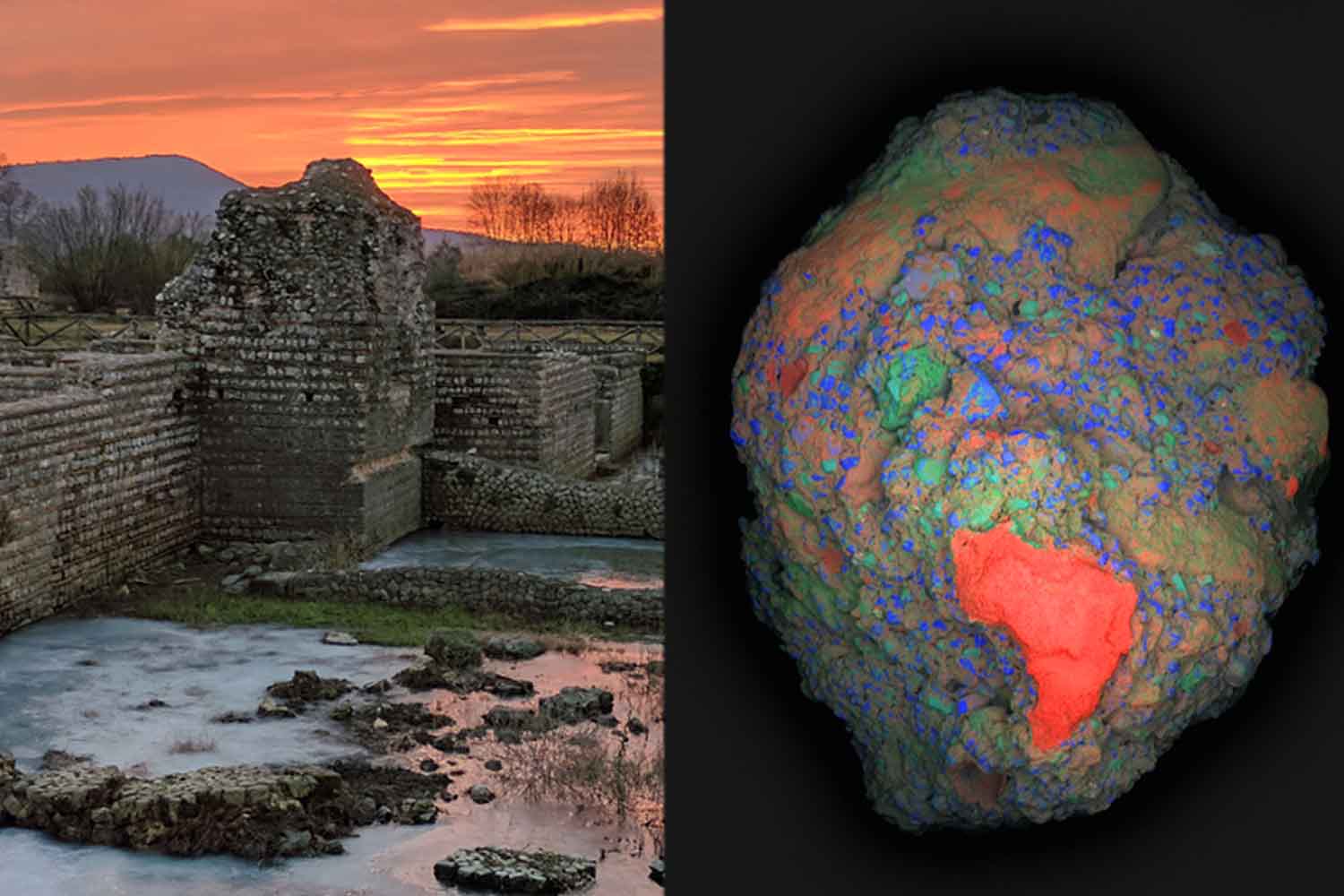
We have already reported the discovery: Roman concrete was not only resistant, it was capable of self-repairing. Fragments of quicklime trapped in the mixture, reactive volcanic ash, a “hot-mixing” process that generated heat and transformed the cement into a dynamic material, capable of sealing cracks over time.
Now, however, the story takes a further leap. Because that discovery didn’t stay locked in a laboratory. It has become a business. It has become business. And this is where things get really interesting.
From the MIT laboratory to the global market
The protagonist of this new phase is Admir Masic, associate professor at MIT, who in 2023 published the study destined to rewrite what we knew about the longevity of Roman concrete. After demonstrating that the Romans used a hot mixture capable of trapping reactive fragments of lime – real self-repair “triggers” – Masic decided not to stop at the theory.
Three years after that publication, he founded a company, DMAT, with a specific objective: to bring back to the market a cement inspired by the principles of ancient Rome. Not a romantic copy of the past, but a contemporary material built to last much longer than current standards.
To understand the economic significance of this choice, we must start from a simple fact: cement is the most used material in the world after water. Every infrastructure – bridges, viaducts, schools, hospitals, buildings – depends on him. Yet, modern concrete degrades. It cracks. Requires constant maintenance. Expensive structural interventions. Endless construction sites.
Roman concrete, on the other hand, has resisted earthquakes, eruptions, marine immersions and atmospheric agents for two thousand years. It’s not just a question of archaeological nostalgia. It’s a gigantic economic problem. If a material can self-heal when microfractures form, it means less repairs, less demolitions, less reconstructions. It means less consumption of raw materials, less transport, fewer emissions and, therefore, less costs.
Less emissions, maintenance and waste in contemporary construction
This is where the real green issue comes into play. The cement sector is responsible for a significant share of global CO₂ emissions. Every ton produced has a heavy environmental impact. However, if a structure lasts double or triple as long, the balance changes radically. It’s not just about building better, but about building less over time.
The model studied by Admir Masic starts from the observation of what happens inside the Roman concrete: when water penetrates the cracks, the fragments of quicklime dissolve and recrystallize, filling the fractures. At the same time, volcanic ash – like that which buried Pompeii in 79 AD – reacts chemically over time, creating new minerals that strengthen the structure. A real system that evolves.
Translating this principle into modern concrete means imagining longer-lasting infrastructures and cities less dependent on continuous construction sites. Let’s think about the Italian bridges that collapse or are closed for maintenance. Let’s think about the neighborhoods built in the 1960s that today require massive interventions. How much do these works cost, economically and environmentally?
The Roman concrete business is a proposal for systemic change. Of course, challenges remain. Replicating an ancient process on a large scale is not immediate. The raw materials are different, the regulations are stringent, the cement supply chain is among the most consolidated in the world. But the point is not to go back in time. It is learning from the past to correct the mistakes of the present.
You might also be interested in:
