
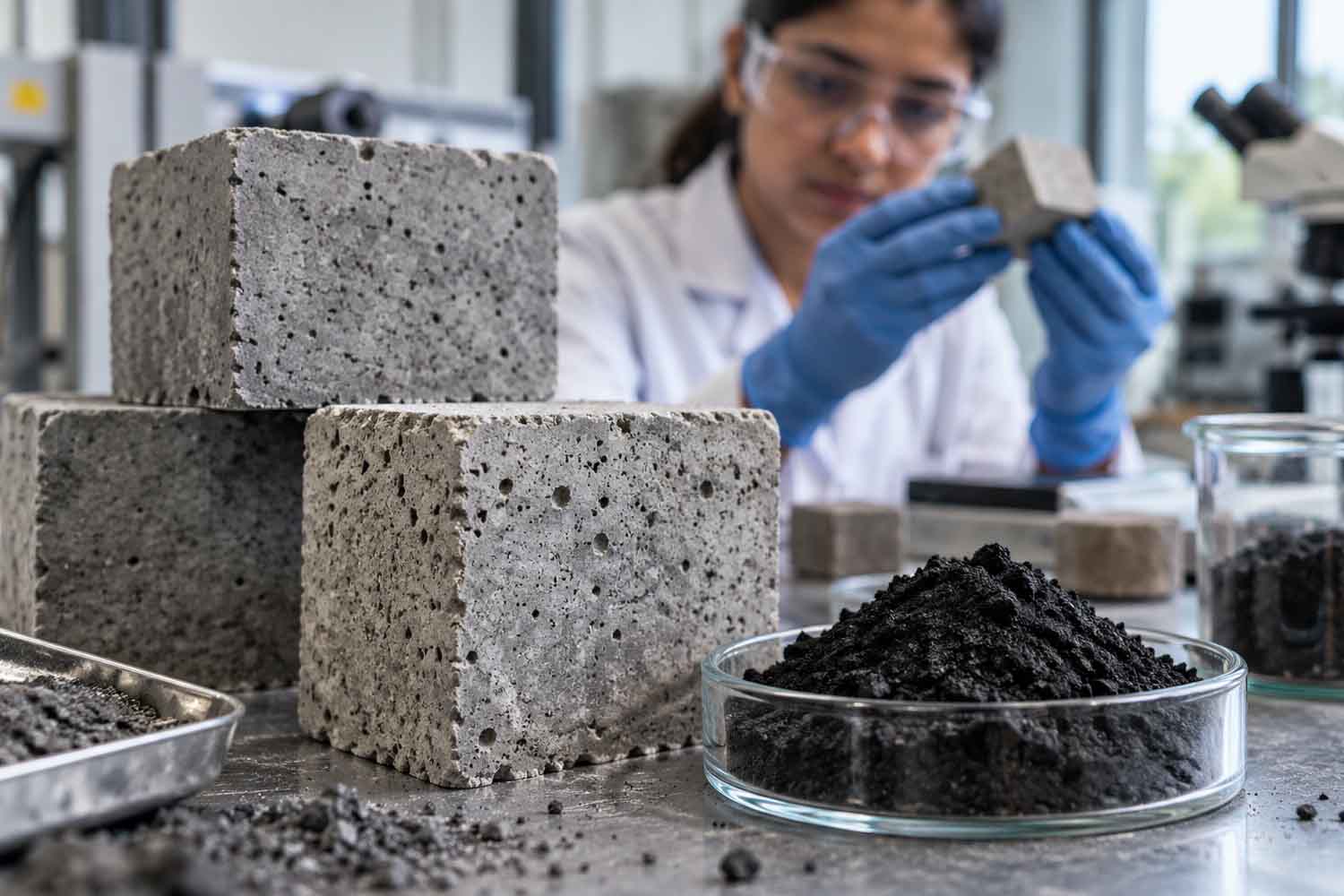
They take fecal sludge, turn it into a carbon-rich powder and use it to replace some of the concrete. After 91 days, the concrete containing 10% resists 21% more compression and 42% more resistance to bending than the conventional mix. The raw material is not exactly what we would expect to find in a building material. The results, however, deserve attention.
This mixture was obtained by a group of researchers from Manipal University Jaipur, India, and Louisiana Tech University, in the United States. The study, published on Scientific Reports on 5 September 2026, starts from the sludge collected in waste treatment plants from septic tanks and other sanitary systems.
First clarification, which avoids imagining construction sites much more picturesque than necessary: the excrement is not inserted directly into the concrete. The sludge is treated and transformed into biochar, a carbonaceous material obtained through pyrolysis, i.e. the heating of organic matter in conditions of low oxygen.
With 10% biochar the best result arrives after 91 days
The researchers tried replacing part of the cement with different amounts of biochar derived from fecal sludge: 5%, 10% and 15%. They then measured strength, water absorption, porosity, shrinkage during drying and microstructure characteristics.
The most interesting mixture is the one with 10%. After 91 days of curing it achieved a 21% increase in compressive strength and 42% increase in flexural strength compared to the control concrete. That 42%, therefore, does not mean that it has become generically “more resistant than 42%”: it concerns a precise property, that is, the ability of the material to withstand the stresses that tend to bend it.
5% also improved performance, while going up to 15% did not produce as clear an advantage. In short, more sludge transformed into biochar does not automatically mean better concrete. The band that seems to work best in the study remains between 5 and 10%.
Behavior over time is another interesting detail. After 120 days, the shrinkage of the mortar containing 10% biochar was similar to that of mortar made with ordinary Portland cement. Water absorption and porosity of the 15% mixture, after 28 days, were also comparable to those of the conventional sample.
Because such a porous material can help concrete
The structure of the biochar appears to play an important part in the outcome. Its pores can retain water and make it available more slowly during curing, favoring the reactions that cause the concrete to harden. Its mineral composition also contributes to the formation of compounds that give resistance to the cement matrix.
Then there is a less flashy step of 42%, but decidedly important when the raw material comes from fecal sludge: heavy metals. The authors detected a reduction in their concentration in the samples as the amount of biochar increased and indicate the possibility that the material contributes to retaining them within the concrete matrix, limiting their release. It is a result that needs to be explored further, especially because the composition of the sludge can change a lot depending on its origin.
And it is one of the reasons why we are still faced with experimental material. Before thinking about beams, pillars and condominiums, longer tests and much less comfortable conditions than those in the laboratory will be needed: frost, heat, salinity, repeated cycles of humidity and drying and, above all, controls on environmental behavior over time.
Less cement, one less waste to manage
The work is also of interest for what biochar replaces. Producing cement means consuming a lot of energy and releasing CO2 both for the fuels necessary to reach high temperatures and during the chemical transformation of limestone into clinker. In fact, the International Energy Agency indicates among the ways necessary to reduce the impact of the sector a greater use of additional cementitious materials, so as to reduce the quantity of clinker required.
Here the potential advantage comes from both ends: a problematic residue of the sanitation systems is recovered and a part of the necessary cement is reduced. The study, however, does not calculate the entire climate budget of the solution. To know how many emissions could really be avoided, it will also be necessary to take into account sludge treatment, biochar production, necessary energy and transport.
So, no “concrete made from poop” ready to invade construction sites. There is something more interesting: a treated human waste that, by replacing just a part of the cement, improved some properties of the concrete instead of worsening them. For a material born from what we normally want to disappear down the drain, that’s already quite a remarkable career.
