
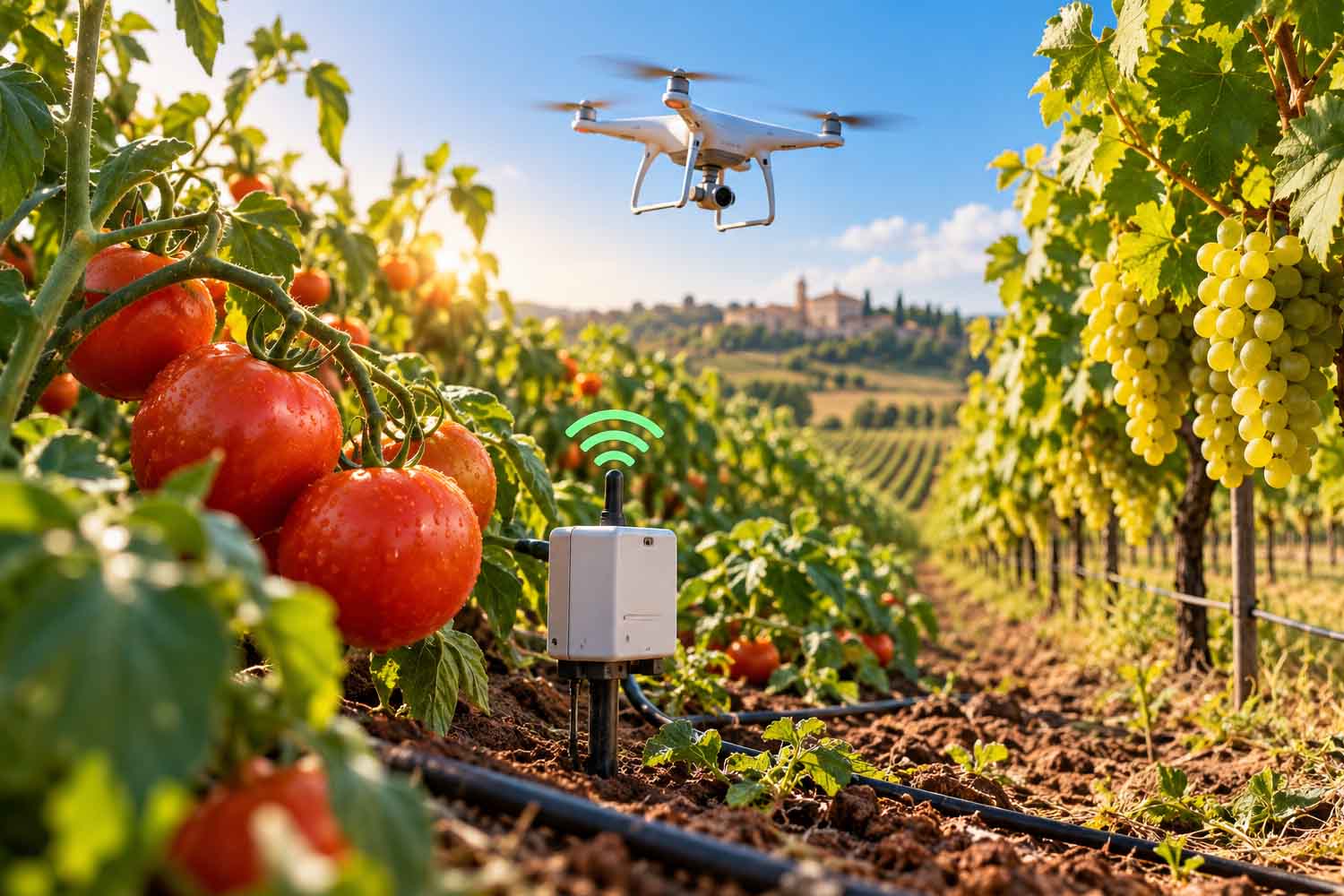
In Torremaggiore, in the Foggia area, some of the tomatoes received water when sensors in the soil said it was time to irrigate. In 2023, 350 millimeters of water were enough against 410 of the plots managed according to the farmer’s usual practice. In 2024, 400 versus 470. About 15% less in both seasons.
Except the water saved is half the story. Tomatoes grown with precision farming techniques reached an overall average yield of 138.6 tonnes per hectare, against 102.9, while the marketable yield reached 111.2 tonnes per hectare against 72.7. Less irrigation, therefore, and more usable product.
This is what researchers from the University of Bari Aldo Moro achieved in the study Precision agriculture for water saving: The case of processing tomato and table grapepublished September 23 on Plants, People, Planet. For two years, in 2023 and 2024, the group brought sensors, drones and optical instruments directly to the Apulian fields, working on industrial tomatoes of the Taylor variety and Allison table grapes.
The sensors wait for the soil to ask for water
The principle is simple: water when you really need it. In the Rutigliano vineyard, in the province of Bari, researchers have installed sensors capable of monitoring the water potential of the soil in real time. The data was recorded every ten minutes and, once a certain threshold was reached, irrigation started; once the expected level was re-established, the valve was closed. Farmers could also receive alerts via an app.
With this system, in 2023 the grapes required 14.5% less water and in 2024 8.2% less than with traditional management. In the first year the yield showed no significant differences; in the second, the vines managed with precision agriculture produced more. Water use efficiency improved in both seasons.
On the tomato the mechanism was similar. The sensors were placed 30 centimeters deep and continuously monitored the available water in the soil. Here too the data arrived every ten minutes and guided the opening and closing of the irrigation.
The good thing is that the researchers didn’t have two photocopied years. In 2023 the spring was unusually rainy, then between mid-July and early August temperatures exceeded 40°C. In 2024, almost the opposite happened: dry winter and spring, above-normal heat already between May and June and less water available for irrigation. The system therefore found itself working in very different conditions.
Drones also flew over the tomatoes
The drones didn’t decide when to turn on the water. They had another job: to look at the plants from above and understand how they were doing. In the tomato field, thermal imaging and vegetation indices were used to track plant vigor, temperature and stress throughout the season.
At the beginning, those irrigated according to traditional management appeared even more vigorous, probably due to the greater quantity of water received. Later, however, that vegetation first entered senescence. The plots managed with the sensors maintained a more uniform trend and conditions compatible with less water stress.
The thermal images told the same thing from another perspective: in the hottest moments the foliage of tomatoes managed with precision agriculture were fresher and less variable, a sign of a better physiological response to high temperatures. In practice, there wasn’t just a water meter to say that the system was consuming less. There were also plants.
A sensor monitors the fruit without destroying it
The researchers also used a portable near-infrared sensor, the SCiO, to try to measure ripeness and quality characteristics directly on the fruit, without having to cut or squeeze it every time to analyze it. On grapes, the models to estimate the sugar content worked well in the two seasons, with R² coefficients of 0.77 and 0.80 respectively.
For tomatoes, the prediction of dry matter, a particularly important parameter for industrial processing, has given good results. The estimate of the Brix degrees of tomatoes, however, was much less precise. However, three of the four models developed showed performances considered by the authors suitable for future practical applications.
In practice, a farmer could carry out much quicker checks directly in the field: understand when to harvest, check the quality of the product without continually sacrificing samples and put together the information on the fruit with that coming from the soil and plants.
The problem now is getting these tools to even the smallest companies
The study was born as part of AgriPuglia, a project financed by the Puglia Region specifically to experiment and transfer precision agriculture technologies to companies. The Region had already organized demonstrations directly in the tomato fields and the project ended after two years of applied research.
The authors see sensors, automated irrigation, drones and optical instruments as pieces of the same system, and point to public incentives and training among the tools needed to make them accessible to even the smallest farms. Initial costs exist, especially for sensors and software, but in the study they are related to water and energy savings, greater stability of yields and the reduction of rejected product.
15% is naturally not a percentage to be applied to any Italian soil: the study concerns two crops, two Apulian locations and two seasons. But here the technology did not remain on a monitor in the laboratory. She actually ended up between rows and tomatoes, she waited until the soil needed water and, when it didn’t need it, she simply left the tap closed.
