
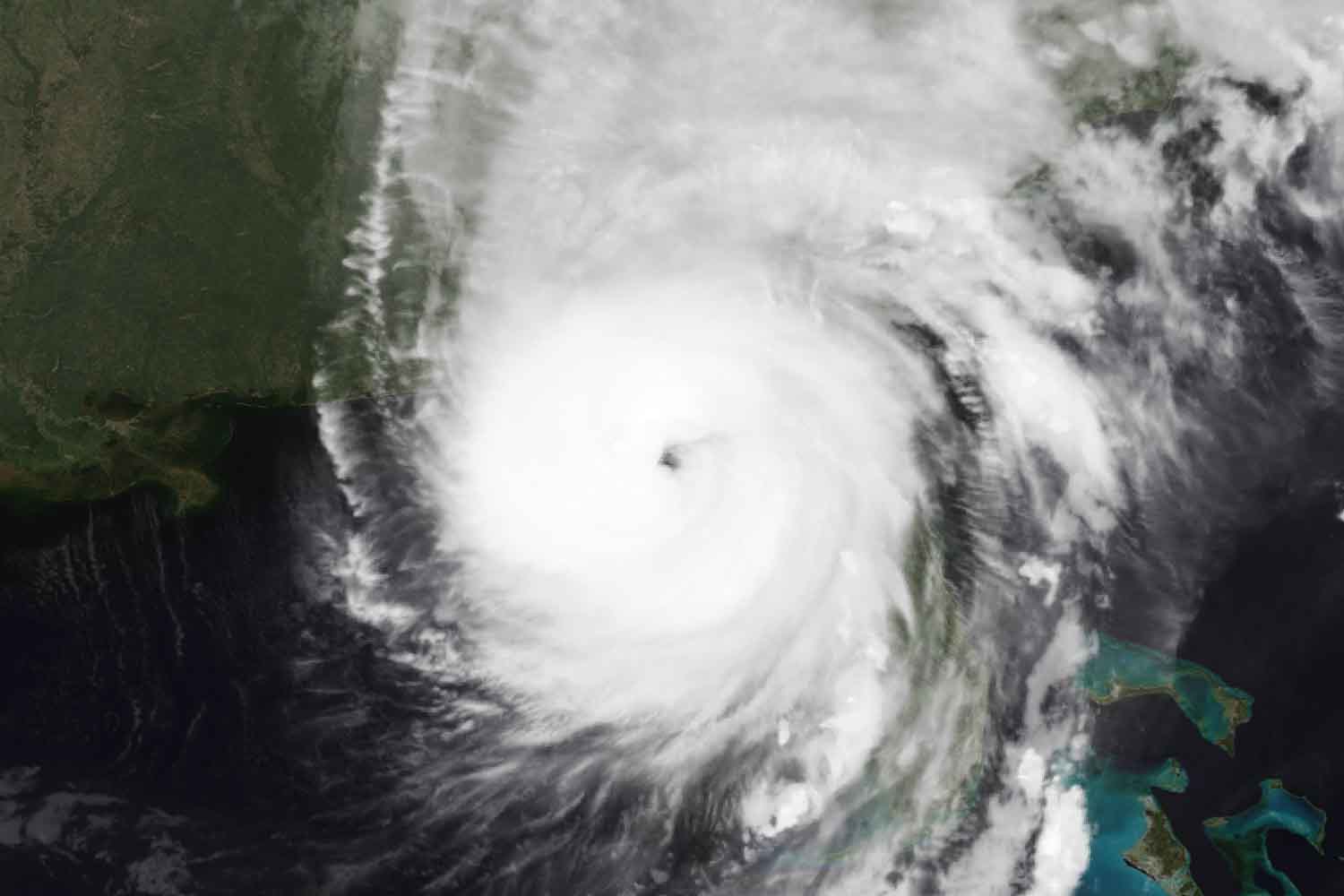
In two days, Hurricane Helene left a quantity of microplastics equal to 18.8% of all the deposits measured during the year at the Highlands Biological Station, in the mountains of North Carolina. On the same days, the rate at which these particles fell from the atmosphere rose to 22.7 times compared to previous levels. And the site is located at almost 1,200 meters above sea level, in the middle of the southern Appalachians.
Helene had reached category 4 before touching down in Florida on September 26, 2024, and then pushed northward and caused catastrophic rainfall and flooding in the Appalachians, as reconstructed in the official report from the National Hurricane Center. When the storm arrived in western North Carolina, however, three instruments had already been there for months, collecting what fell from the sky. A very scientifically useful coincidence.
Researchers from Virginia Tech, Western Carolina University and other institutions were thus able to compare the previous period, the days of the hurricane and the following weeks. The study published on Integrated Environmental Assessment and Management is, according to the authors, the first in the United States to track atmospheric deposition of microplastics in multiple locations before, during and after a hurricane.
In two days, almost a fifth of the annual total
The three monitoring locations were Iron Duff, Coweeta Hydrologic Laboratory and Highlands Biological Station, all in the Blue Ridge Mountains area. During Helene, the average rate of microplastic deposition was 8.1 times higher in Iron Duff, 3.4 times higher in Coweeta and 22.7 times higher in Highlands compared to levels recorded before the storm.
In Highlands, the wettest site, between about 1,779 and 2,743 particles per square meter per day fell during the hurricane. Compared to the entire observation period, those transported during Helene’s days represent 18.8% of the annual total. In Iron Duff the share was 4.2%, in Coweeta 4.6%.
These are percentages measured at just three sites and do not describe everything that happened along the hurricane’s path. However, they show how quickly an extreme weather event can change plastic deposition even in mountain landscapes far from the densest urban areas.
The researchers found mostly fibers. After Helene they made up 88.5% of the particles at Iron Duff, 94.4% at Coweeta and 100% of those identified at Highlands. On a subset of 258 particles analyzed with Raman spectroscopy, more than 30 types of polymers were recognized, including polyamide or nylon, polystyrene, PET, polypropylene and polyethylene.
Rain and wind have changed the journey of plastic
Microplastics do not necessarily have to be near where they are collected. They can be lifted, carried by the air and fall much further. The models used in the study show that the path of air masses heading towards the three sites had also changed during Helene.
Before and after the hurricane, the air at lower altitudes generally came from the northeast, passing over the Atlantic near Nova Scotia. During the storm it instead came from the Gulf of Mexico and Caribbean area. This does not allow us to attribute a single fiber to a specific place: it reconstructs the trajectory of the air, not the birth certificate of each piece of plastic.
Rain and wind seem to have worked in tandem. In statistical models, precipitation is the main factor for wet deposition, while wind speed weighs mainly on dry deposition. The water intercepts the suspended particles and brings them to the ground; the wind can lift them off the surfaces again and keep them circulating.
The consequence is particularly delicate in the source areas. Particles deposited on soil, vegetation and small mountain streams can enter river systems and continue downstream. In short, the distance from roads and large cities offers much less isolation than the landscape suggests.
Plastic continued to fall even after Helene
One of the most curious observations came when the hurricane was already gone. Between September 30 and October 30, 2024, average microplastic deposition remained 3.8 times above previous levels in Highlands and 4.4 times in Coweeta. At Iron Duff, however, it fell.
The difference could have ended up in the trees, literally. Coweeta had approximately 90.8% tree cover in the area around the sampler and Highlands 52.7%; Iron Duff just 14.7%. The authors hypothesize that part of the microplastics transported by the storm may have stopped on the leaves and then been set in motion by the wind in the following days.
For now it remains a hypothesis. The researchers did not directly measure the microplastics on the leaves and indicate this step among the things to be verified in future studies. Even the geographical extension of the work requires caution: there were three sites and the regional extrapolation constructed by the models is defined by the authors themselves as an order of magnitude estimate, not a precise count.
Then there is an even more material limit. The instruments used were not able to intercept all the smaller particles: the deposit estimates are therefore considered conservative. The study also measures where and how much plastic has fallen; it does not establish what effects it has had on wildlife, ecosystems or human health.
Helene crossed the Appalachians in just a few days. Collectors that were already turned on recorded a sharp surge in plastic fibers and fragments over the same interval. Even smaller ones, however, were left out of the account.
