
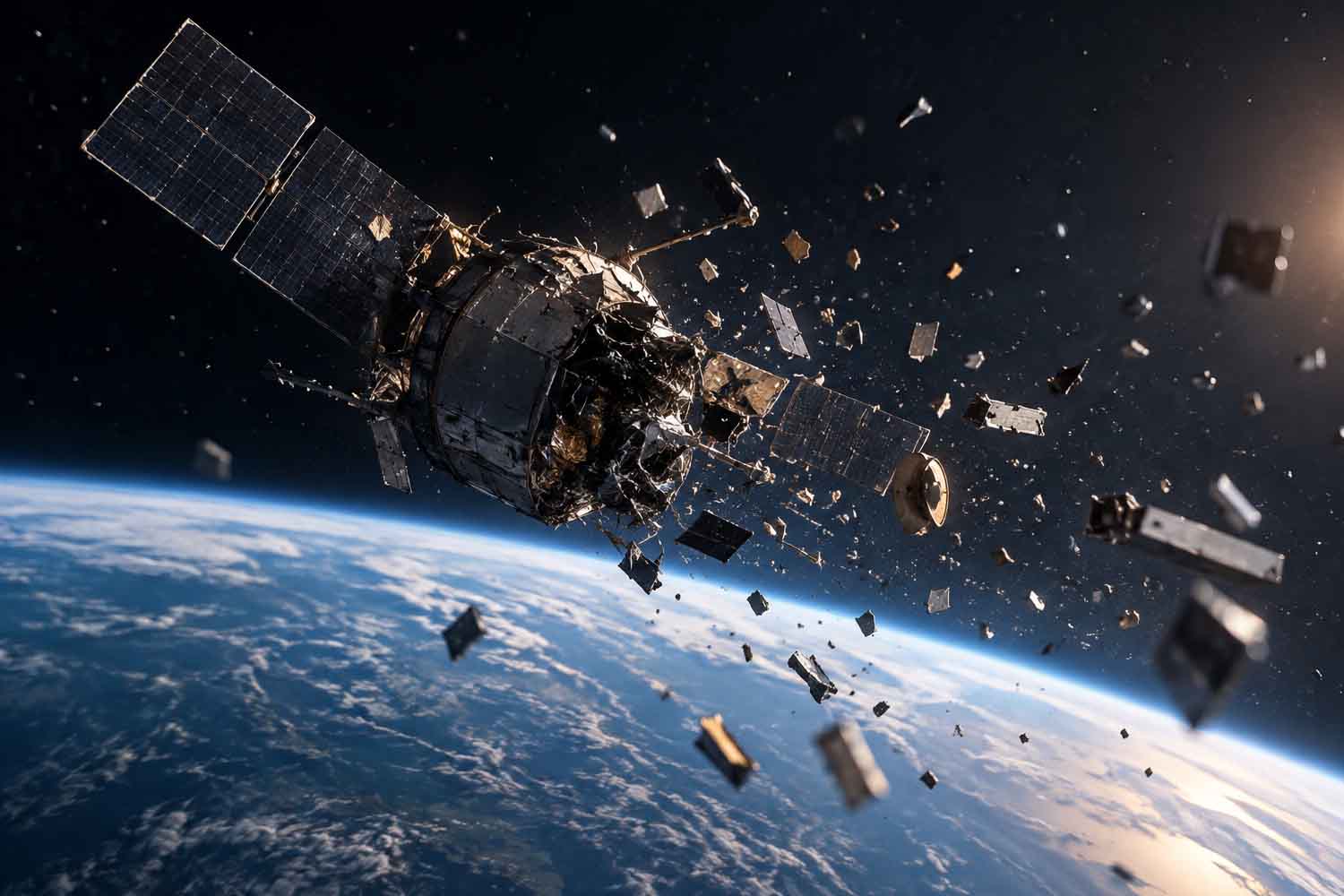
For 38 years it circled the Earth at an altitude of about 775 kilometers. On September 13th, however, something happened: USA 32, an old US spy satellite used during the Cold War, has fragmented in low Earth orbitleaving behind a cloud of debris that will now have to be identified and followed.
US Space Forces–Space confirmed that the event occurred around 9.13pm UTC, 11.13pm in Italy. The good news is that, at the moment: the tracked fragments are progressively inserted into the systems used to calculate possible close encounters with other satellites.
The less good one is that USA 32 was in an orbital belt that was already quite crowded and high enough for the atmosphere to be able to get rid of it quickly. Translated: some of those pieces could remain up there for many years.
USA 32 spied on Soviet radars
USA 32, NORAD catalog number 19460, was launched on September 5, 1988 from Vandenberg Base, California, aboard a Titan II rocket.
Behind the rather anonymous name he hid FARRAH IIIa satellite belonging to a secret US electronic intelligence program. As INAF reconstructs, its task was above all to intercept the signals emitted by the Soviet Union’s radars, locate them and study their characteristics. It was, in short, a piece of the Cold War that remained over our heads much longer than the Cold War itself.
The shape was not exactly what we would expect from a sophisticated spy satellite: large and flat, in the technical descriptions it was compared to a big can of tuna. It rotated about 50 times a minute, allowing the antennas to pick up signals coming from different areas of the Earth’s surface.
Even the name FARRAH was not accidental: it was a reference to the actress Farrah Fawcett. Other American satellites for collecting electronic signals were named after famous actresses. Espionage, evidently, also had its conventions for choosing code names.
Why did it fragment?
For now we don’t know: the cause of the fragmentation. There are no elements that allow us to talk about an anti-satellite attack, an impact or some other more spectacular scenario. However, there are much more ordinary explanations.
An old satellite can keep inside itself degraded batteries, residual propellant, pressurized gases and other forms of energy. After decades of severe temperature changes and deterioration of materials, a battery can experience a short circuit, a tank can fail or a component can simply break.
In the case of USA 32 these are all possibilities, just as impact with a small undetected object remains possible. At the moment, however, none of these hypotheses have been confirmed. And it is precisely to prevent a now unused satellite from deciding to produce new space waste thirty years later that today there is a lot of talk about passivation.
What does it mean to “passivate” a satellite
When a mission ends, shutting down the satellite isn’t enough. Current guidelines on space debris mitigation require that, when possible, energy sources remaining on board be eliminated: discharge and isolate batteries, depressurize tanks, consume or disperse residual propellant and secure other systems that could accumulate energy.
These operations must be carried out when the satellite is still controllable from Earth. USA 32, however, was designed in the 1980s, when current practices for reducing space waste were not yet consolidated. We don’t even know if it had been passivated and in what condition its systems remained.
Because 775 kilometers is an uncomfortable altitude
When a satellite breaks, the problem is not just that you have lost a satellite. From a single object tens or hundreds of new objects can be borndepending on the violence and characteristics of the fragmentation.
Those large enough can be spotted by surveillance systems and their orbits calculated. The smaller ones are harder to track, but they still move at speeds of several kilometers per second and can therefore seriously damage another spacecraft.
At around 775 kilometers the atmosphere is also extremely thin. The friction that slowly causes satellites and debris to lose altitude is therefore very weak and ESA explains that, above about 800 kilometres, objects can generally remain in orbit for many decades. USA 32 was practically on the doorstep of that range. And above all between 600 and 1,100 kilometers there is already a large amount of old debris accumulated over decades of space activity.
And this is where Kessler Syndrome comes into play
The fragmentation of USA 32. The problem is broader. Kessler Syndrome describes a scenario in which the quantity of objects in orbit becomes such that collisions produce new fragments, which in turn increase the probability of other collisions. A mechanism capable, in the long term, of making some orbital regions increasingly difficult to use. And it is no longer a problem that concerns only the very distant future.
In its Space Environment Report 2026, ESA highlights that Even if we completely stopped launching new satellites, the number of debris would continue to increase in some simulations because fragmentations can produce them faster than the atmosphere can remove them.
In 2025 alone, more than 4,000 new payloadswhile the great constellations continue to grow. The consequence is that avoiding new waste is no longer enough: according to the European Space Agency it will also be necessary to actively remove part of the waste already present.
That 2.5 day “countdown” doesn’t mean we will lose all satellites
Then there is a fact that explains quite well how crowded space near the Earth has become, but which must be read carefully. A study published in Acta Astronautica introduced the CRASH Clockan indicator that tries to answer a hypothetical question: How long would it be before a catastrophic collision if satellites in low orbit suddenly stopped performing collision avoidance maneuvers?
In 2018 the estimate was 164 days. By 2025 it had dropped to 5.5 days. For 2026 the value indicated by the authors has reached approximately 2.5 days. This, however, . This is not a countdown to the collapse of the satellite network.
The CRASH Clock measures how much the current system depends on continuous monitoring and maneuvers carried out by operators to avoid dangerous encounters. In essence: we have many more objects crossing each other and much less margin for error than just a few years ago.
And USA 32 also shows the other side of the problem. What we send into space doesn’t disappear when we stop using it. A satellite launched when the Soviet Union still existed can remain in orbit for almost forty years and then, one day, become a new cloud of debris to follow. Except that in the meantime, up there, we continued to fill the parking lot.
