
They extend the torso just a little, on average about nine degrees, and the leg goes from weight-bearing extension to the flexion needed to move forward. This is how four people with a chronic and functionally complete thoracic spinal cord injury were able to stand and walk with a walker, after the implantation of an epidural stimulator and four months of intensive rehabilitation.
The result comes from a study published in the journal Medsigned by researchers from the MINE laboratory, Modular Implantable Neuroprosthesesborn from the collaboration between Vita-Salute San Raffaele University, IRCCS San Raffaele Hospital in Milan and Scuola Superiore Sant’Anna in Pisa. The interesting part is also what is missing: no brain implant, no external sensor to decide when to take the step and no algorithm called upon to decode a brain signal.
The trunk becomes the stimulator’s command
Epidural electrical stimulation of the spinal cord can evoke different motor responses depending on how much stimulation reaches the nerve structures. At a certain level, the extension of the leg prevails, useful for remaining standing; by increasing the effect of the stimulation, coordinated flexion of the hip, knee and ankle appears which allows the limb to be brought forward.
The researchers discovered that the same transition can be caused by the patient through a slight voluntary extension of the trunk, without changing the stimulator settings each time. They called the mechanism trunk-mediated controltrunk-mediated control.
The hypothesis is quite concrete: moving the torso slightly temporarily changes the relative position between the nervous structures and the electrodes, thus modifying the effect of the current. The trunk becomes a kind of biological lever between intention and stimulation. As bioengineer Silvestro Micera summarized,
The body itself becomes part of the control interface.
The device used, moreover, is a spinal cord stimulator already available on the market. The novelty lies above all in the way in which it is exploited and in the rehabilitation process built around the stimulation. Relatively ordinary hardware, decidedly less ordinary usage.
One of the participants traveled 132 meters without stopping
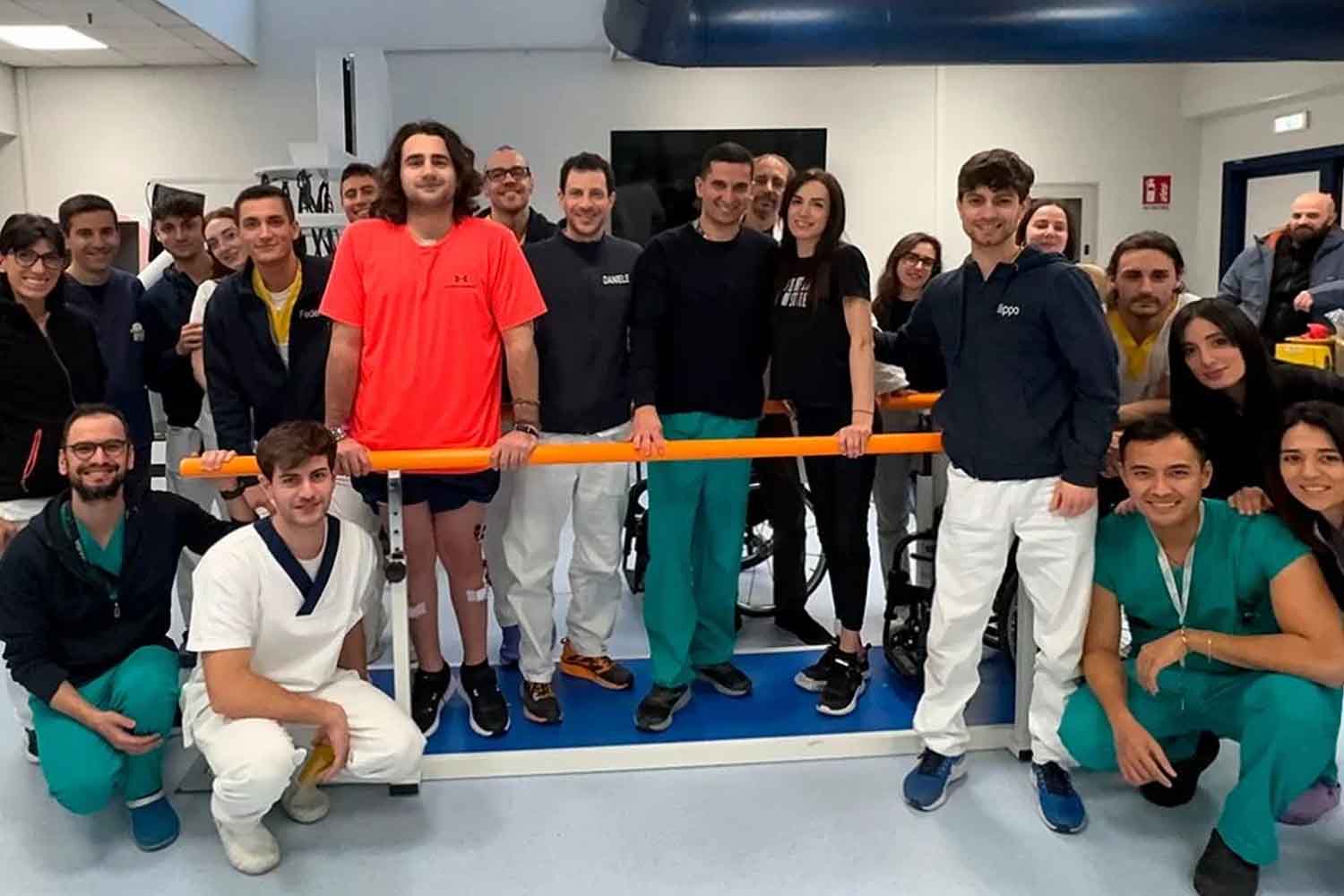
After four months of intensive rehabilitation, all four participants were able to walk with a walker without manual assistance or body weight support systems. The WISCI II score, a scale used to evaluate walking ability in people with spinal cord injury, went from 0 to 9 for everyone.
One of the four covered 132 meters in 42 minutes of continuous walking. Everyone managed to move even while dealing with curves, slopes and irregular external surfaces. Three participants also achieved the ability to stand while leaning on the walker with only one hand, leaving the other free for some daily activities.
They are much more concrete results than some steps obtained in the laboratory. Behind, however, there are months of work. As Sandro Iannaccone, director of the Department of Cognitive-Motor Neurological Disorders Rehabilitation at San Raffaele, points out, the stimulation was accompanied by an “intensive, progressive and individualized” program, designed to transform the responses evoked by the device into skills that can be used in real life.
Walking still depends on stimulation
An important distinction is needed here. None of the four participants recovered the ability to voluntarily contract their leg muscles during the trial. The lesions were traumatic, located between T4 and T7 and classified AIS A or B, therefore functionally complete on a motor level: at the time of implantation no voluntary contraction of the lower limbs was visible.
Electrical stimulation continues to produce movement. The patient instead uses a voluntary function that remains available – the movement of the trunk – to modulate that stimulation and directly contribute to the construction of the step.
It’s also what distinguishes this work from previous findings by the same group. Since 2023, the MINE Lab had already studied epidural stimulation in people with incomplete spinal cord injuries, in whom some voluntary motor skills remained. In the four patients described now that possibility was absent in the lower limbs.
Four patients, and a result that is worth much more than the number
There are four people, so larger studies will be needed to understand how much this technique can be extended to other patients. The size of the sample, however, does not deflate what happened: all four started from a chronic and functionally complete thoracic spinal cord injury, without any ability to voluntarily contract their leg muscles. After the implant and four months of intensive rehabilitation, all were able to stand and walk with a walker.
There is also a detail that makes this road particularly interesting. The stimulator used already exists on the market and the system does not require implants in the brain, external sensors or algorithms that decode brain activity. The command comes from a movement that patients can still perform voluntarily: a slight extension of the trunk. The body, literally, enters the circuit.
The technique is still experimental and requires surgery, stimulator programming and a very intense rehabilitation process. It’s the next step in research, not a reason to put the handbrake on the news. For four people who did not voluntarily control their lower limbs, that small movement of the torso became the way to get back to building a step.
