
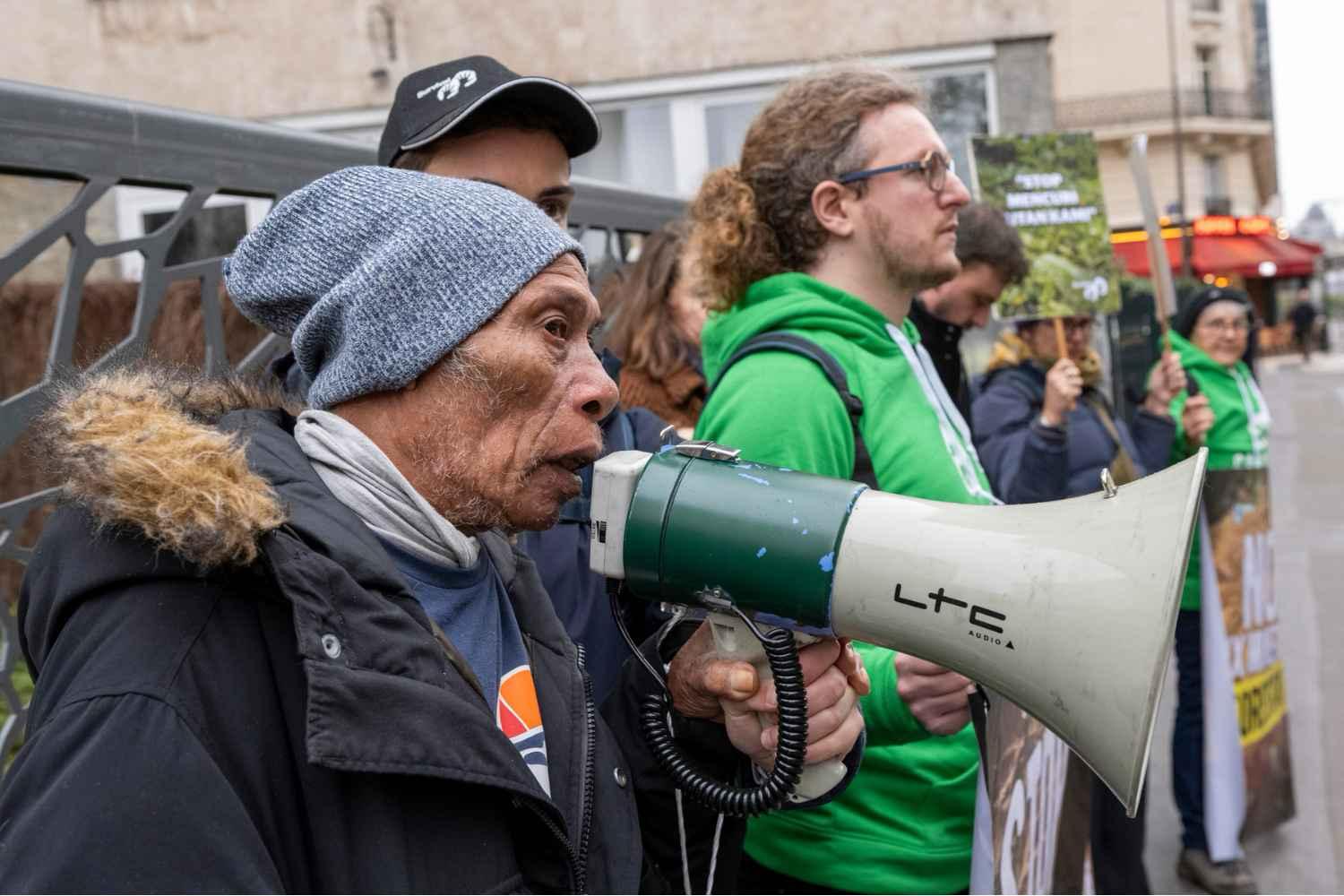
For the first time in his life, Ngigoro left the Halmahera rainforest to cross thousands of kilometers to reach Paris. It was not a journey of discovery or curiosity. It was a cry of alarm brought directly to the headquarters of Eramet, the French mining giant that operates the largest nickel mine in the world right on the lands of its people, the Hongana Manyawa.
Ngigoro was born uncontacted, raised in the forest that is now being devoured by bulldozers. Around 500 of his people still live in isolation, desperately fleeing the advance of mining. Together with protesters from Survival International and Canopée, today he gave his testimony to those responsible for what he defines as an announced catastrophe.
I came all the way here, to France, to tell Eramet and the French government that mining activities in the Hongana Manyawa forest must stop” declared Ngigoro outside the headquarters of the multinational.
If mining is not stopped, my uncontacted relatives will die. Corporations are getting rich off our deaths. When the world finds out that they are stealing our land, these companies will be ashamed.
Weda Bay Nickel, a company of which Eramet is co-owner, owns a concession that covers a large part of the island: over three-quarters of this area overlaps with the territories of the uncontacted Hongana Manyawa. The extracted nickel is intended for the production of electric car batteries, part of a larger project by the Indonesian government. A bitter paradox: destroying a forest and condemning a people in the name of environmental sustainability.
Yet Eramet has publicly denied the existence of the Hongana Manyawa within its concession, despite leaked reports commissioned by the company itself revealing that the company has been aware of their presence since at least 2013.
It may seem like an exciting and profitable venture to Eramet, but for the Hongana Manyawa people it means the destruction of their ancestral forest and a death sentence for those living uncontacted, said Caroline Pearce, Director General of Survival International.
This is why Ngigoro traveled thousands of kilometers, from his island to Europe: to tell Eramet that the catastrophe his people are facing is much more important than their profits.
Like many indigenous peoples, the Hongana Manyawa have been custodians of the forest for thousands of years. Today that same forest is being razed to the ground to fuel an industry that defines itself as green, in one of the most tragic contradictions of our time. According to Survival International’s new report ‘Uncontacted Indigenous Peoples: Frontiers of Resistance’, if governments and corporations do not act immediately, half of all the world’s uncontacted peoples could be wiped out within the next ten years.
Ngigoro’s journey from Halmahera to Paris is not just the story of a man crossing the world. It is the extreme attempt to stop a genocide disguised as progress.
