
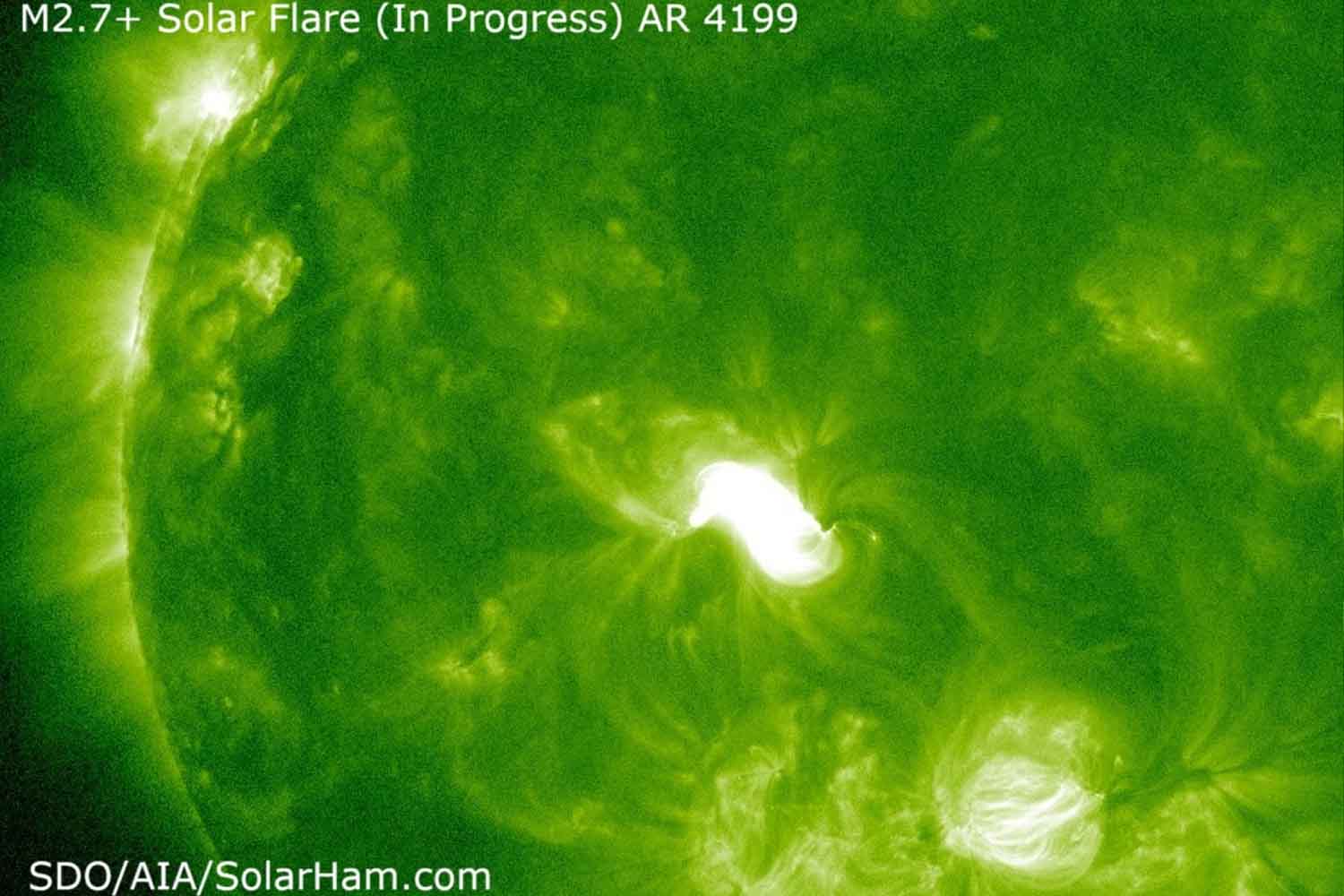
A strong sun storm It is directed towards the earth and could hit our magnetic field between Monday 1 and Tuesday 2 September 2025. The experts of the Space Weather Prediction Center from the Noaathe US agency that monitors the space weather. According to the analyzes, the phenomenon was caused by one CME – Expulsion of Coronal Massa – Very violent, thrown by the sun in the past few hours.
The most immediate consequence will be one G2-G3 class geomagnetic stormwith the concrete possibility that the incoming energy is even more intense than expected. A level G4 storm may occuramong the strongest, as already happened in the past with similar events. And in such cases, the Boreal Aurores can also become visible in countries like Italy.
The boreal aurora visible from Italy?
In recent months Solar activities have increasedand between 2024 and 2025 there have already been moments in which the Italian sky has given rare surprises. This time, The recorded CME could be powerful enough to trigger lights visible from us tooparticularly in northern Italy.
The phenomenon was caused by a Solar shine of class M 2.7started from the sunscreen AR 4199a very active region of the sun facing right towards the earth. The eruption took place on Saturday 30 August at 23:48 Italian time. Since the solar wind it uses on average between 48 and 72 hours to get to usthe crucial moment will be among the night of September 1 and the early hours of 2.
The peak phase of the storm, according to the app Aurora Nowis scheduled for 08:00 on 2 September (Italian time). If the activity intensifies before that time, there is the possibility that The aurores become visible also in Italyalbeit for a few moments and only in ideal conditions.
Long Duration Solar Flare (M2.7) in Progress Around AR 4199 More to Follow. https://t.co/aqk4q6xday pic.twitter.com/ywabjpuwll
– Solarham (@solarham) August 30, 2025
Solar storm: possible effects and how to follow evolution in real time
The geomagnetic storms they happen when The solar wind interacts with the earth’s magnetic field. This causes a visible reaction in polar areas, where the auror lights up. When the intensity of the wind is particularly high, The aurore can go to lower latitudes of usual, also touching central and southern Europe.
The arrival storm could also give rise to Sarless well -known but fascinating red auroral structures, which extend further south than the classic green aurore.
There is no extreme event (class G5), therefore, even if it is always good to monitor developments. The tools used by scientistslike coronographers, it on board the satellite Soin and the Ccor-1 on Goes-19have already made it possible to observe the CME in detail.
To try to see The boreal aurora in Italya dark place is needed, away from artificial lights and with a free view to the north. The northern regions They have some more possibilities (such as Piedmont, Lombardy, Veneto and Friuli), but with a little luck The phenomenon could also extend to the south.
The KP index – which measures geomagnetic intensity – is currently estimated just below level 7threshold beyond which the aurore are also visible from our latitudes. However, it is estimates that can change suddenlyespecially when the solar wind accelerates or becomes unstable.
