
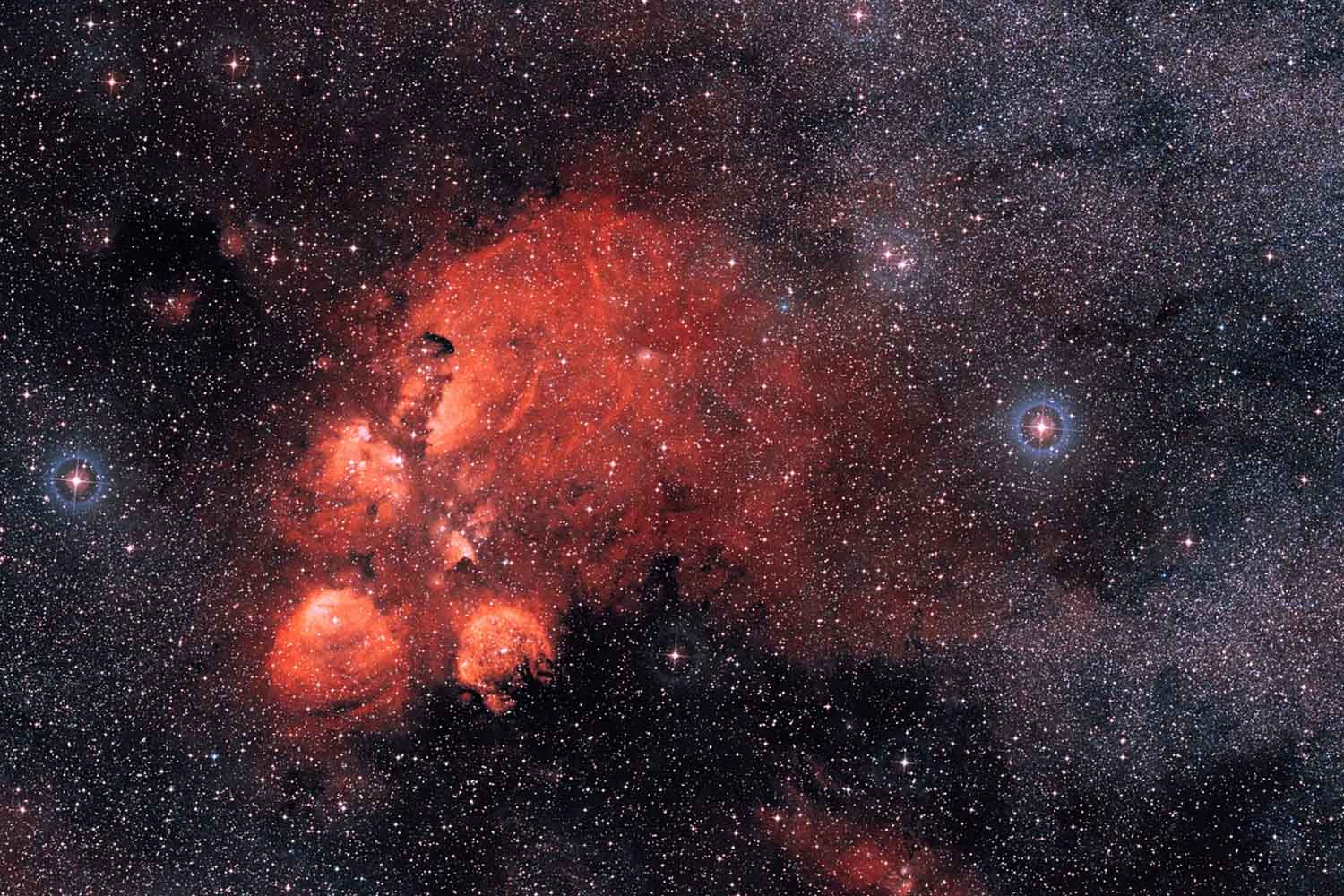
Three bright pads and a larger spot at the base, arranged just like a cat’s paw pads. Looking at the image it almost seems as if a gigantic feline has left its footprint in space. On the other hand, anyone who lives with a cat knows very well how much these creatures love to put their paws everywhere. Evidently, the Milky Way is no exception.
That figure really exists and even has a rather appropriate name: Cat’s Paw Nebulaknown by astronomers as NGC 6334. The image showing the complete footprint comes from the Digitized Sky Survey 2 and was published by the European Southern Observatory (ESO) in January 2010. In July 2025, however, NASA pointed the James Webb Space Telescope towards a portion of the same nebula, photographing what is hidden inside one of its gigantic fingertips.
The nebula, moreover, had already been observed in 1837 by the British astronomer John Herschel, during his stay in South Africa. At the time he could only identify the brightest part. Subsequent observations would have been needed to recognize the entire paw.
A 50 light-year-old cat’s paw
The Cat’s Paw Nebula is located in our galaxy, in the direction of the constellation Scorpius. According to ESO estimates, it is approximately 5,500 light years from Earthwhile NASA reports a distance of about 4,000 light years. The two institutions therefore use different estimates, but agree on its nature as a huge star-forming region.
The gas cloud extends for about 50 light years. To get an idea of size, a single light year corresponds to approximately 9,460 billion kilometers. Nothing but footprints on the freshly washed floor. The pads that appear to make up the paw are enormous regions of interstellar gas and dust. Their characteristic reddish color is mainly due to hydrogen, which emits light when excited by the intense radiation of young, hot stars present in the nebula.
As ESO explains, NGC 6334 is one of the most active massive star-forming regions in the Milky Way. Some have a mass almost ten times greater than that of the Sun and were born in the last million years.
Many others are still hidden by dust, which absorbs and scatters part of the light. According to the observatory, the entire region could contain several tens of thousands of stars. In short, what seems to us to be a tender feline footprint is also an enormous stellar nursery. A decidedly challenging litter, even for the most patient of cats.
The James Webb telescope looked inside your fingertips
On July 10, 2025, to celebrate the third anniversary of its scientific observations, the James Webb Space Telescope turned its instruments toward a portion of the Cat’s Paw Nebula. The new image published by NASA shows details that previous observations could not distinguish: cavities, dust filaments and young stars that are modifying the surrounding environment.
Thanks to his near-infrared camera, NIRCam, Webb was able to observe through some of the dust that hides the forming stars. Small bright cavities appear in the images, some of which resemble other tiny fingertips within the larger footprint.
Basically, a paw inside another paw. A rather efficient solution to take up as much space as possible, as any cat who has conquered a double bed teaches. One of these structures was nicknamed the “Opera House” by astronomers due to its particular circular and stratified shape.
The cavities are shaped by the radiation of the most massive stars, which progressively pushes away the surrounding material. The darker areas, however, can hide accumulations of dust dense enough to host stars still in formation. The same stars that illuminate this gigantic footprint are therefore helping to transform it. Over time, their radiation will disperse the material necessary for the birth of new stars, until the process is interrupted in the affected regions.
The paw will therefore continue to change shape as a result of the physical processes that take place inside it. The cosmic cat, of course, exists only in our imagination. But leaving a giant footprint and disappearing without explanation would be perfectly in his style.
