
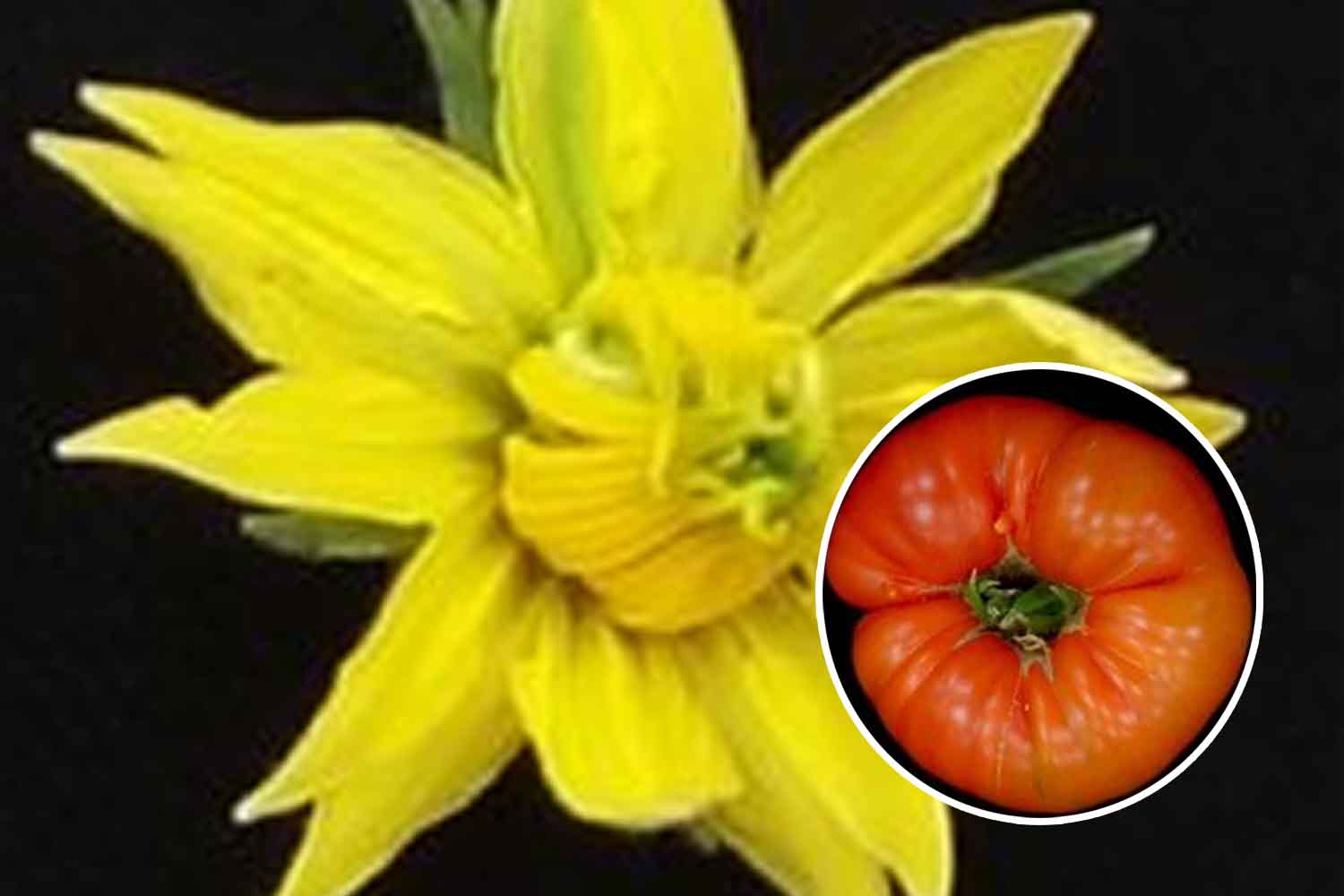
On the first bunch there is a flower that seems to have taken up a lot of space compared to its brothers. It is wide, flattened, has too many petals and in the centre, instead of the usual thin pistil, it shows a flattened and disordered structure. Leave it there and you might find yourself a few weeks later with one of those huge, ribbed, wrinkled tomatoes that demands a photo next to the scale before it even ends up in the salad.
Among enthusiasts they are called megabloom. The name makes a lot of American competitive gardening, but the phenomenon is botanical: behind those exaggerated flowers there are anomalies in the development of the floral meristem, genetic predisposition and, in some cases, low temperatures during the formation of the buds.
In short, the giant tomato begins to become strange when it is still a flower. Miracle fertilizers and secrets kept by grandfather can settle down for a moment.
The giant tomato is born with too many “rooms”
By cutting a tomato you can see the lodges, the internal cavities that contain seeds and jelly. How many there will be is decided very early, when the flower is still forming. And this is where some varieties have an advantage. A study published in Plant Direct reconstructed the role of genetic loci lc And fasselected during tomato domestication and associated with a greater number of lodges and larger fruits. Another work, published on PNAShe identified in the gene ENO a further regulator of the size of the floral meristem. The larger this little factory of plant organs is, the more complex the architecture of the flower and fruit can become.
This is why the phenomenon is more easily observed in varieties that already produce large, fleshy and very ribbed tomatoes. A cherry tree starts from another construction project. This does not mean that every Oxheart is destined to produce a megabloom, nor that every misshapen flower will automatically produce a one-kilo tomato. Genetics prepares the ground. Then the environment intervenes.
Cold nights can make the flower even stranger
In 2019, some researchers cultivated a tomato line predisposed to producing many niches by subjecting the plants, during different stages of bud formation, to night temperatures of 10, 15 or 20 °C.
After twenty days, the plants exposed to 10°C nights developed on average more buds and showed more anomalies in the flowers and fruits. The authors linked the effect to the accumulation of gibberellins, plant hormones involved in the growth and development of floral organs. The study was published inInternational Journal of Molecular Sciences.
Here it is best to keep the thermometer away from easy recipes. The experiment involved a specific multilocular line and controlled conditions. It doesn’t mean that simply placing the seedlings in the cold is enough to order the tomato to exceed one kilo.
The relationship between low temperatures and deformations of the first fruits is however well known. The University of Maryland Extension reports, for example, that the catfacing – the deformation with deep grooves and scars in the flower area – appears especially in large-fruited cultivars and is favored by exposure to temperatures below about 10 °C after transplanting. It is therefore not so strange to find the family champion right among the first bunches. That tomato carries with it the cold nights experienced when it was little more than a sketch.
How to recognize a megabloom
You have to look at the buds even before the tomatoes. A possible megabloom tends to be much larger than other flowers in the same cluster, broad and flattened. When it opens it can show a large number of petals, irregularly arranged sepals and deformed or partially fused floral organs. The center of the flower may also appear much wider than normal.
Describing it simply as “four or five flowers glued together”, however, risks being too convenient. The appearance may indeed resemble a fusion of multiple flowers and there may be fused organs, but studies indicate more profound alterations in the development of the meristem and the formation of floral structures. If pollination succeeds, an equally irregular fruit can develop from that somewhat drunken geometry: large, flattened, ribbed, with many lodges and several scars. The result can be enormous. The “can” remains fundamental.
Is it worth letting it grow?
Here the owner of the garden decides. Those looking for regular production can eliminate very deformed fruit. The University of Maryland reports that those heavily affected by the catfacing they can ripen poorly and continue to use plant resources in the meantime. Those who want to see what happens can easily let it grow. When the weight increases it may be useful to support the fruit and especially the peduncle, preventing it from breaking.
It also takes a little discipline with the water. Large, bumpy tomatoes can be especially troublesome when cracks arrive: two weeks of dry soil, then a good watering or a rainstorm, and that already tight skin gets a nasty refresher.
The University of Minnesota Extension indicates the rapid availability of water after dry periods among the conditions that favor the cracking. More regular watering and mulching help limit changes in humidity.
Deformations alone do not make the tomato dangerous to eat. A fruit with catfacing mild can be consumed by eliminating the damaged areas, as long as no rot or secondary infections have appeared. The face can be questionable. The sauce rarely notices.
Will the seeds retain superpower?
Only partially. If the tomato belongs to a stable variety, saving the seeds of a large fruit may make sense because some characteristics related to the size and number of buds have a strong genetic component. The works on lc, fas and ENO they show it quite clearly.
The single megabloom, however, also depends on the conditions in which that specific flower was formed. Saving seeds does not guarantee that you will find the same giant flower the following year. And if the tomato came from a hybrid variety, the offspring can have very different characteristics from the parent plant.
What remains is that disproportionate bud that appears among perfectly normal flowers. You can cut it and continue to grow neater tomatoes. Or leave it there. We’ll find out weeks later if he becomes a one-kilo monster. He, however, had started preparing much earlier.
