
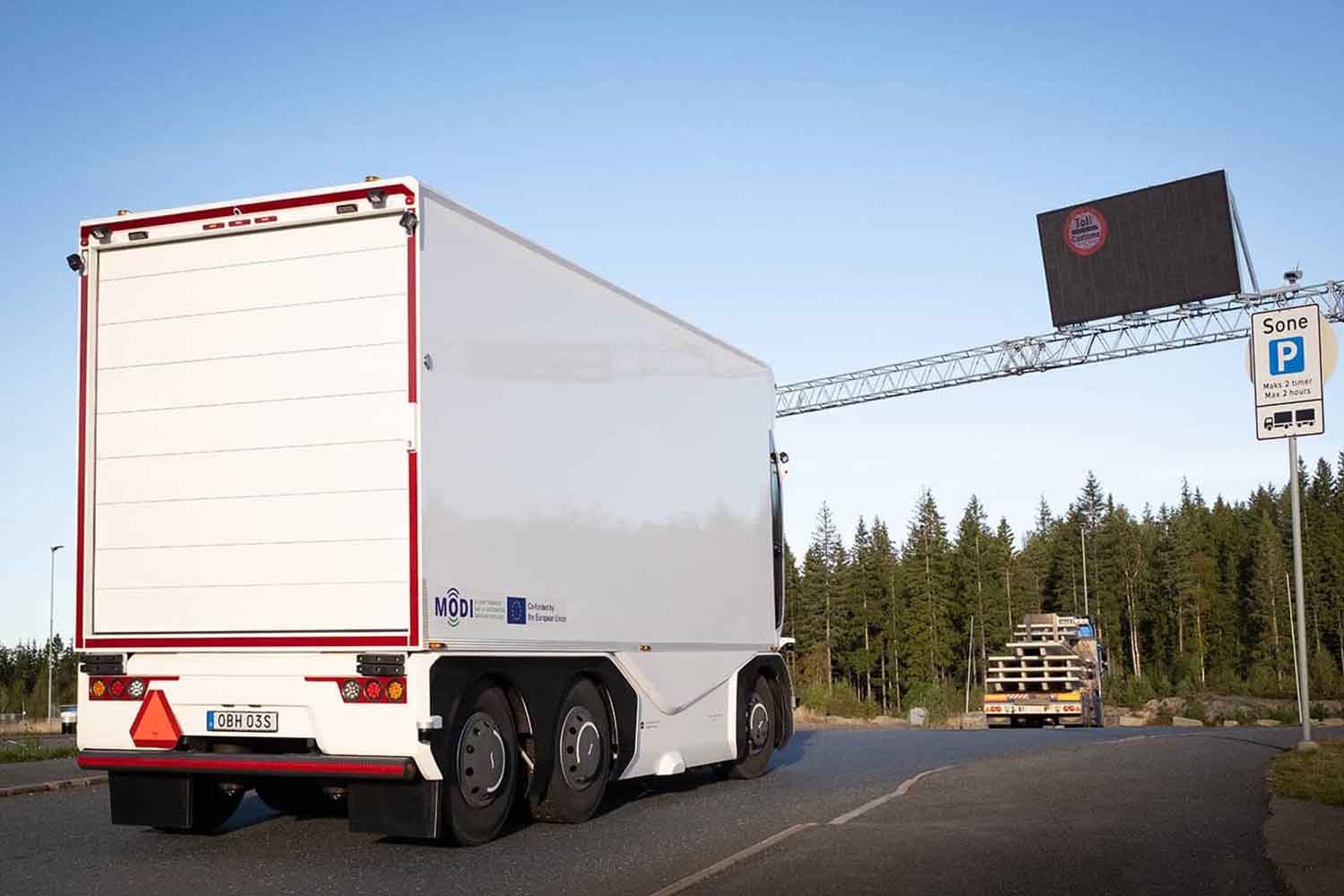
On September 25, 2025, an electric truck without a driver’s cab crossed the border between Sweden and Norway, transporting goods with no one on board. No steering wheel, pedals or windshield. The vehicle, developed by the Swedish company Einride, passed the Ørje border crossing, where it also had to face a rather concrete problem: passing through customs without a driver who could show the documents.
According to Einride, this was the first international crossing made by an autonomous electric truck without a cab. The test was conducted for the Nordic postal operator PostNord, as part of the European MODI project. An important result, with one clarification: we are talking about an organized and authorized demonstration, carried out in 2025, and not the start of a regular service between the two countries. The most interesting part, however, comes right at customs.
The truck also had to stop at customs
The Ørje passage was repeated twice, with two different procedures. The first provided for an immediate green light: the truck passed through customs control without stopping. The second instead simulated a situation in which the authorities requested an inspection, forcing the vehicle to stop.
This is reported by SINTEF, the Norwegian research institute that coordinated the demonstration. And it is an important detail, because the success of the test is often described as a crossing without any stopping. Stops, when necessary, are still part of customs procedures.
To manage them, Einride connected the vehicle system to Digitoll, the digital platform of Norwegian Customs, with the support of the technology company Q-Free. The goods had been declared in advance by PostNord. Upon arrival at the border, the truck’s license plate was automatically recognized and the customs system instructed the vehicle to continue or stop.
Both procedures worked, according to the researchers. The truck therefore demonstrated that it can receive and comply with customs instructions without a person physically present on board. A capability that could prove particularly useful for international transport, where rules, IT systems and responsibilities change.
How a truck without a cab works
The Einride Pod was born with a feature that distinguishes it from traditional electric trucks: it is designed from the beginning to operate without a driver. In place of the cabin there are electronic systems, cameras, radar and LiDAR sensors, which use laser pulses to reconstruct the surrounding environment. The data is processed by autonomous driving software, which recognizes obstacles and other vehicles and decides how to move.
The technology is classified at automation level 4, according to the SAE standard. It means that the vehicle can manage driving autonomously, without continuous intervention by a person, within pre-established operating conditions. It doesn’t mean it can cross any road, in any weather or traffic situation.
Human supervision also remains. As Einride explains in the presentation of its technology, operators remotely monitor the activities of the trucks, following their position, condition and operation. They can intervene when a situation requires assistance. The system allows you to supervise multiple vehicles, even if there is no verifiable data demonstrating that a single operator can stably manage ten trucks at the same time, as is sometimes reported.
Then there is an obvious design advantage: by eliminating the cab, the manufacturer can redistribute the spaces of the vehicle and reduce some components. However, the actual gain in load capacity and consumption depends on the configuration. The 15% additional useful volume attributed to the Pod is not documented for the truck used in the Norwegian test.
How much does a driverless electric truck pollute?
Einride claims that its transport system can reduce CO2 equivalent emissions by up to 90% compared to traditional diesel transport. It is an estimate that the company already presented in 2019, during the launch of the first commercial operations. The electric truck eliminates exhaust emissions and can significantly reduce overall emissions. The percentage, however, varies depending on the origin of the electricity, the production of the batteries, the load transported and the distances travelled. Most importantly, 90% does not represent a result measured when crossing the border between Sweden and Norway.
The environmental issue remains relevant. According to the European Commission, heavy-duty vehicles produce more than a quarter of road transport greenhouse gas emissions in the European Union. Electrifying freight transport can therefore contribute to decarbonisation even independently of the introduction of autonomous driving.
From the first tests to daily deliveries
The European MODI project, funded through Horizon Europe, examined the obstacles to the movement of autonomous heavy vehicles along the logistics corridor connecting Rotterdam to Oslo. The tests also involved ports, cargo terminals and distribution centers, where vehicles must coordinate with loading, unloading and recharging operations.
Meanwhile, Einride has taken other steps. On 15 September 2026, together with Lidl, it announced the launch of a daily service on public roads in Germany with an autonomous truck without a cab. The vehicle connects logistics and commercial facilities under a specific authorization from the German Federal Transport Authority.
It is a different step from the customs test: it demonstrates that the technology can also be used in repeated operations, along authorized routes. The possibility of extending it to more complex road networks, costs, safety conditions and large-scale economic sustainability remain to be assessed.
Consequences at work also require attention. Remote supervision introduces new tasks, but reduces the need to have a driver physically present on each truck. From these experiments we cannot yet derive a reliable balance of the jobs that will be created or replaced.
In Ørje the truck crossed the border twice, even respecting customs instructions. To achieve a European driverless freight transport network, shared authorizations, infrastructures and rules will still be needed. Technology has already learned to stop when asked to. Now it’s up to European countries to decide where it can circulate.
