
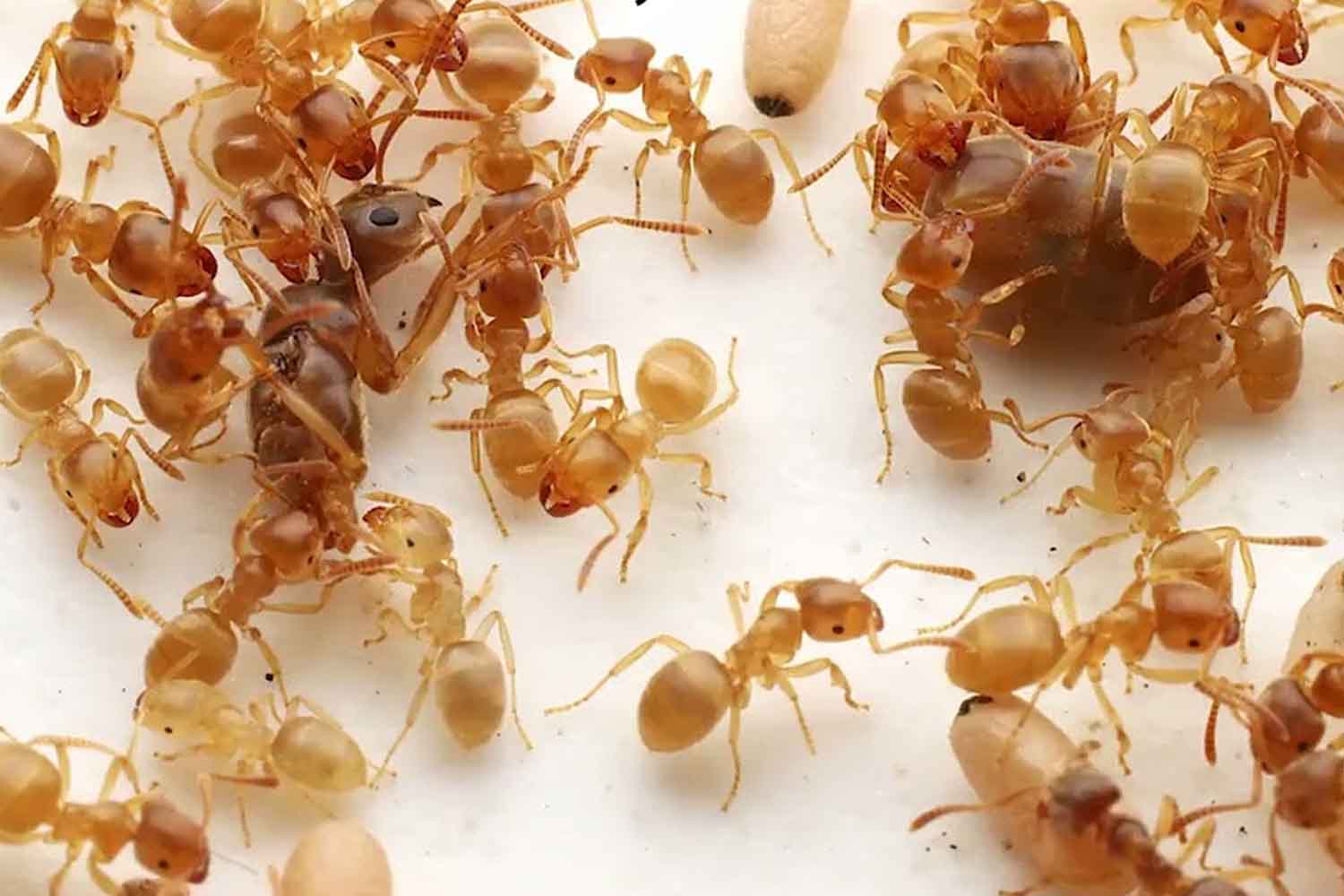
Looking at it from the outside, an anthill seems like a small example of order, a microsystem in which everyone knows what to do and no one disturbs the balance. But the story that comes from the pages of Current Biology reminds us that a detail is enough – an out of place smell, an unexpected entrance, an imperceptible gesture – to transform that same anthill into a place of profound manipulation. The new study, titled “Socially parasitic ant queens chemically induce queen-matricide in host workers”has highlighted a behavior that overturns what we thought we knew about the sociality of insects: a parasitic ant enters a nest that does not belong to it and convinces the workers to commit matricide. It does not do so with violence, nor with brute force, but through a chemical strategy as simple in appearance as it is devastating in its effects.
It all started in 2021, when Taku Shimada, myrmecology enthusiast and author of the Japanese blog AntRoomobserves a scene that leaves him perplexed. He publishes the video, which remains online for years until it reaches the eyes of Keizo Takasuka, a researcher at Kyushu University. His reaction is immediate:
He couldn’t stay on a blog.
He was right. From that moment an investigation takes shape that will lead to the discovery of an evolutionary mechanism as disturbing as it is ingenious.
Two parasitic ants
The protagonists of the story all belong to the genre Lasiusvery widespread in the northern hemisphere. On the one hand there are the victim colonies, mostly Lasius flavus And Lasius japonicus. On the other there are the two parasitic ants, Lasius orientalis And Lasius umbratusknown not only for their infiltration ability but also for their strong odor, a characteristic that will come in handy in their plan.
The first phase of the coup d’état takes place far from the eyes of the workers. Before attempting to enter, the parasitic ant spends an entire night in contact with some pupae and some workers of the colony it wants to invade. It is a defined process host-odor pre-acquisition and serves a single purpose: to impregnate the intruder’s body with the smell of the future victim. In ants, identity is not a visual fact but an olfactory one. Without this chemical disguise, the parasite would be detected and killed immediately. With that new scent, however, she crosses the entrance to the anthill as if she were one of them, indistinguishable from the residents.
It is only after being accepted that the parasite takes action. It approaches the queen of the nest and covers her with a strong-smelling liquid, which researchers most likely identify as formic acid. In many species this compound is an alarm signal: it communicates danger, aggression, something that threatens the entire colony.
And this is where the plan takes shape. The workers, who live in a world built entirely around smells, no longer recognize their queen. The smell they perceive on her has nothing to do with the identity of the mother they nurtured and protected every day of their lives. From one moment to the next, the queen smells like an enemy. And for an ant, a wrong smell is worth more than any memory.
Two different styles
The way in which the attack occurs varies depending on the parasite species. Lasius orientalis adopts a slow and steady strategy: spray the host queen up to fifteen times over the course of about twenty hours. The effect is not immediate, but grows like a tension that the colony can no longer contain. The workers begin to appear nervous, then become aggressive, and only after several days do they fatally strike their sovereign. Lasius umbratushowever, seems to have been created for lightning operations: two precise sprays and in a few minutes the entire colony turns against the queen, who is killed and literally torn to pieces without hesitation.
In all cases, the parasite does not stand idly by. She runs away immediately after spraying the acid, knowing full well that that olfactory chaos could turn against her too. He returns only when the queen has been eliminated and the tension has dissolved. The workers, now orphans, welcome her without suspicion, feed her and treat her like the new mother of the colony. Within a short time, the intruder begins to lay her eggs and establishes herself as queen in her own right. She got everything she needed: a colony already built, workers already trained, an empire already functioning. The dirty work was done by the daughters of the previous queen, manipulated through a simple smell.
A behavior with no advantages for the workers
What makes this behavior even more interesting (and more disturbing) is that it brings no benefit to the workers who kill their queen. No genetic benefit, no new chance to reproduce, no improvement in colony conditions. The workers lose their mothers without earning anything. It is an induced matricide for the exclusive benefit of the parasitic ant. Scientists consider this a new type of social manipulation, never before observed in insects. It is also a brilliant example of convergent evolution: Lasius orientalis And Lasius umbratuswhile not closely related, have independently developed the same deception mechanism.
The discovery raises many open questions. We don’t know if this type of manipulation is limited to these species or if, underground, there are many other forms of chemical coups that we haven’t yet noticed. We do not know whether species that do not use formic acid exploit other substances with the same effect. And we don’t know if something similar also happens in social wasps, close relatives of ants that may have evolved similar tactics.
Takasuka himself said that he asked an artificial intelligence if a story had ever been imagined in fiction in which a daughter is tricked into killing her mother. The answer was no. Nature, once again, is more creative than any screenwriter. And that’s why it’s worth looking at it closely, even when it seems calm. Especially when she seems calm.
You might also be interested in:
