
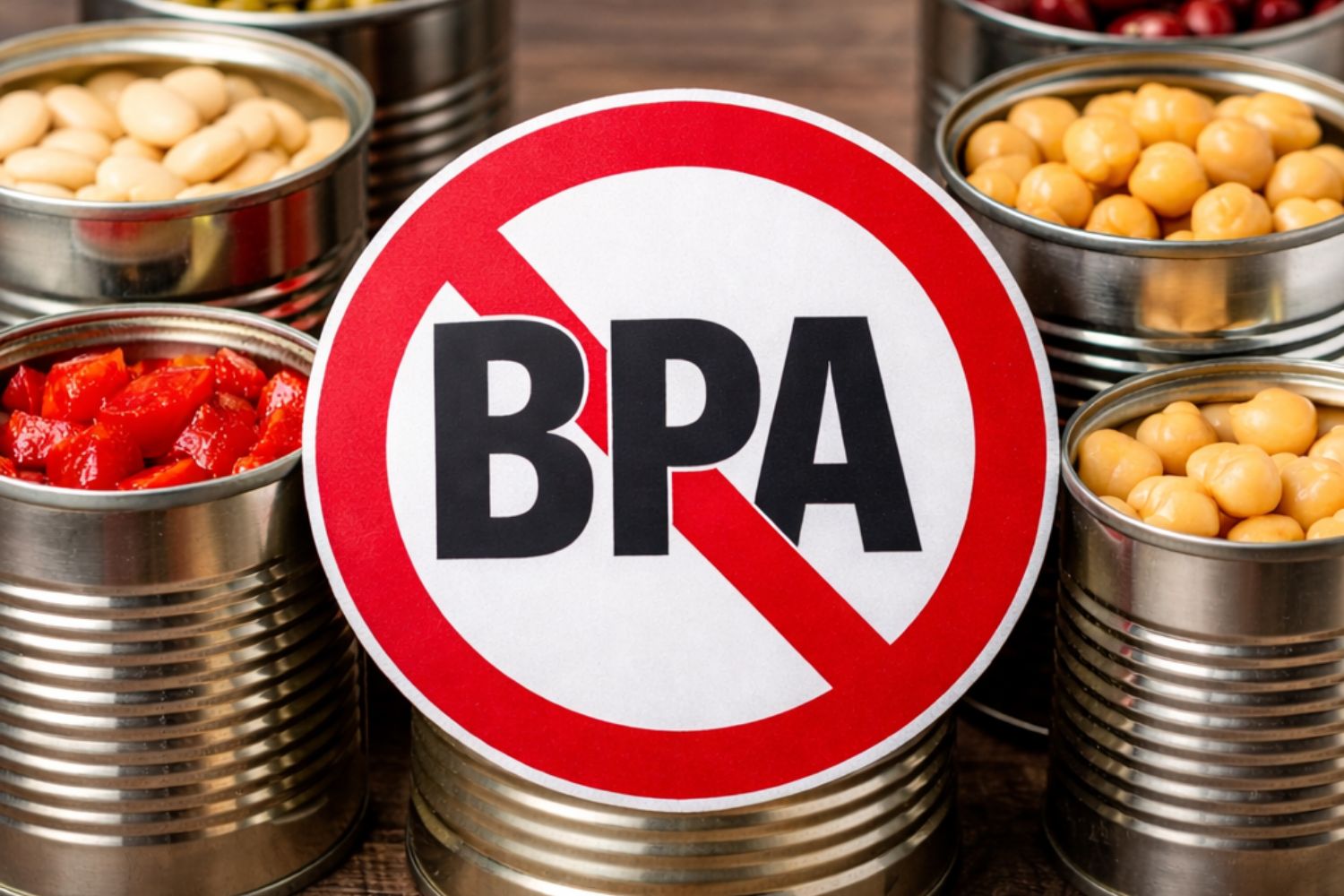
From Monday 20 July 2026, disposable containers coated with bisphenol A can no longer be placed on the European market. This marks the end of the eighteen-month transitional period provided for by Regulation (EU) 2024/3190, which officially entered into force on 20 January 2025, as also confirmed by the European Commission page dedicated to the provision.
The ban directly concerns beer cans, carbonated drinks, energy drinks and ready-to-drink drinks, as well as who fills those containers. Anyone expecting shelves to be cleaned overnight, however, will be disappointed: the regulatory transition works differently, and the “old generation” cans will continue to appear in supermarkets for months, in some cases for years.
What is BPA and why is it a concern
Bisphenol A, or 4,4′-isopropylidenediphenol (CAS number 80-05-7), is a compound used for decades in the production of epoxy resins and polycarbonates. In the food sector it is found above all in the paints that cover the inside of cans and metal capsules, where it acts as a barrier against corrosion and alterations of the product. The crux is migration, given that small quantities of the substance can pass from the coating to the food, and this is what the European Food Safety Authority’s assessment focused on. In April 2023, EFSA drastically revised the tolerable daily dose downwards, bringing it from 4 micrograms to 0.2 nanograms per kilo of body weight, a factor of approximately twenty thousand times, after detecting possible effects on the immune system which, according to estimates, would concern all age groups of the population. This is attested by the simplified summary published by EFSA itself.
The deadlines, in no particular order
The regulation does not provide a single date for all products, and here lies the most misunderstood part of the story. For common disposable items, namely beverage cans, the deadline was last Monday. For packaging intended for fruit, vegetables and fishery products, as well as those coated in BPA only on the external surface, the transitional period extends until 20 January 2028: the replacement of the internal coating, in these cases, requires longer leak tests. Professional food production equipment also enjoys a 36-month transition period, with an additional year allowed for sale.
The logic of stocks intervenes to further complicate the picture, because empty packaging legally placed on the market before 20 July can be refilled for another twelve months, and already packaged drinks remain on the market until stocks run out. In short, anyone who has cans in their warehouse will not find themselves with material blocked from one day to the next: in fact the counting starts from the date of entry of the packaging, not from that of filling. This is why, as reported in a previous article, old generation cans will realistically be able to appear on shelves for years to come, especially on the canning front.
The exemption for large tanks
The regulation also leaves a window for epoxy coatings applied to containers with a capacity exceeding 1,000 litres: here BPA remains permitted, albeit with a restriction on migration. The technical reason lies in the ratio between surface area and volume, judged too low to generate significant exposure for the consumer. Tanks and process vessels therefore remain outside the general ban.
Not just BPA: the lot of other bisphenols
The provision not only affects BPA, but also other bisphenols and derivatives with harmonized classification as carcinogenic, mutagenic, toxic for reproduction or endocrine disruptors of category 1A and 1B, including bisphenol S, bisphenol AF and tetrabromobisphenol A. The declared objective is to avoid the so-called regrettable substitution, i.e. the transition to structurally similar and equally problematic substances. It is not a far-fetched fear: the European Chemicals Agency (ECHA) has already evaluated 148 bisphenols as a group, going so far as to recommend restrictions for over thirty of them due to possible hormonal or reproductive effects, precisely to prevent one dangerous bisphenol from replacing another equally harmful one.
On a documentary level, all materials subject to the regulation must travel with a specific declaration of conformity, valid even when BPA has not been intentionally used. The Commission’s guidance notes C/2025/6721, published on 17 December 2025, clarify how to demonstrate this compliance: the technical documentation will be sufficient, making Good Manufacturing Practices the central tool along the entire supply chain.
