
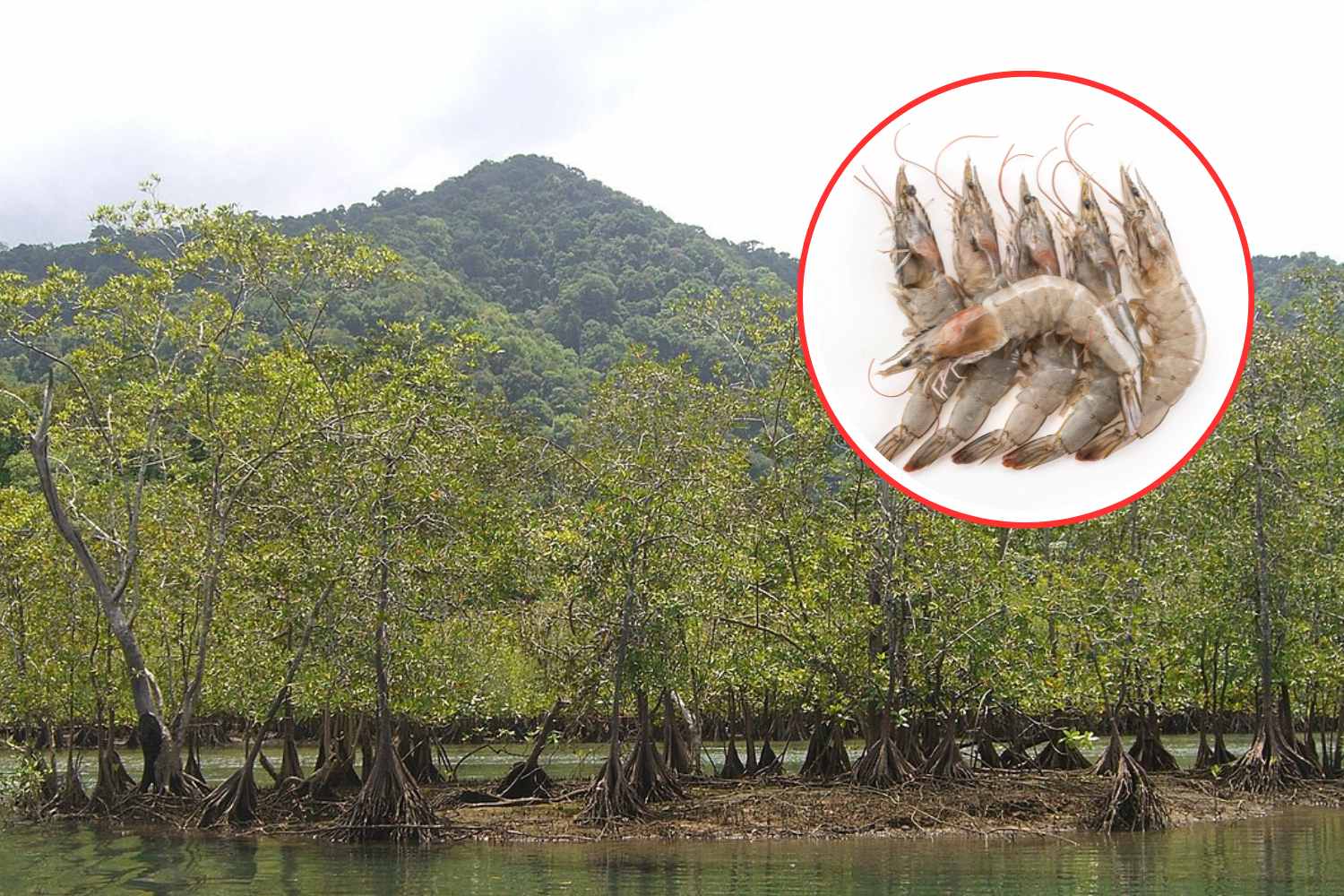
On the coasts of Ecuador the global shrimp market has found one of its great production capitals. In just a few years, the country has transformed aquaculture into a strategic sector of the national economy, to the point of overtaking oil as the main export product. This growth has given rise to an environmental crisis affecting one of the most important ecosystems on the planet: mangroves.
A report published by Guardian talks about the conflict that runs through the Ecuadorian coastal areas, where the expansion of shrimp farms is putting pressure on marine forests, biodiversity and traditional activities such as the harvesting of the concha negra, the black mollusk that lives among the roots of the mangroves and represents an essential source of income for many communities.
@Wikimedia/Canva
Production grows, forests retreat
Ecuador has seen its shrimp production almost quadruple in the last ten years. Most of the product is exported to China, the United States and Europe, also supported by the growth in international sales after the reduction of trade duties.
However, this expansion coincided with a long transformation of the coastal territory. Between 1969 and 1999 the country lost up to 43% of its mangroves, while today the surfaces occupied by shrimp farms are approximately one and a half times larger than the remaining forests.
Direct destruction of mangroves is prohibited by law and the sector claims that illegal conversion of ecosystems is now almost eliminated. However, several researchers and inhabitants of the affected areas contest this reconstruction, arguing that the degradation continues through interventions that are more difficult to monitor: expansion of the embankments, excavation of canals, modifications to the water systems of the ponds.
“Many people think that the destruction of mangroves is a phenomenon of the past. That’s not true,” he said Guardian Eduardo Rebolledo Monsalve, researcher at the Catholic University of Esmeraldas.
When the water cycle changes
Mangroves are complex systems, regulated by the movement of the tides, capable of filtering water, protecting coasts from erosion and offering refuge to numerous species. According to the experts quoted by the British newspaper, the embankments and canals built for livestock farming can alter the natural exchange of water, modifying the salinity and oxygenation of the land. Under these conditions the mud can dry out and remaining trees can slowly die.
Water quality is also at the center of criticism. A 2023 study found concentrations of ammonium and phosphorus about two and a half times higher in mangroves near Esmeraldas farms than in areas not affected by production. According to an assessment by Seafood Watch, more than half of farm waste ends up in the surrounding environment.
Industry operators deny the accusations. José Antonio Camposano, president of the National Chamber of Aquaculture of Ecuador, argued that farms would have no interest in operating in degraded waters because negative environmental conditions would damage the health of the shrimp themselves.
The burden of insufficient controls
One of the most critical elements concerns the State’s ability to control a rapidly growing sector. In Esmeraldas, a province where there are over 200 shrimp farms, the Guardian reports the presence of only one aquaculture inspector, without adequate means of transport. Local communities can lodge complaints through mangrove stewardship agreements introduced since 2000, but many residents say complaints rarely lead to concrete interventions.
In El Oro, an association that manages over 3,300 hectares of mangroves has filed 17 complaints since 2019. “Unfortunately, we know that these practices reach the legal office of the ministry, and everything ends there,” said Luis Ángel Flores Ramírez, a crab fisherman and former president of the association.
Restoring is not enough without changing the model
In recent years, reforestation projects have been created, also financed by companies in the sector. Some initiatives aim to recover degraded areas and involve local communities in the reconstruction of ecosystems. According to several researchers, however, environmental restoration risks becoming merely a compensatory intervention if it is not accompanied by more effective controls on existing production.
The mangroves of Ecuador thus illustrate a tension that affects many global food chains: the distance between the product consumed on the tables of international markets and the environmental effects left in the territories where it is produced. In the case of shrimp, that distance passes through murky waters, coastal forests, and communities that have lived for generations among tree roots on the fragile boundary between land and sea.
