
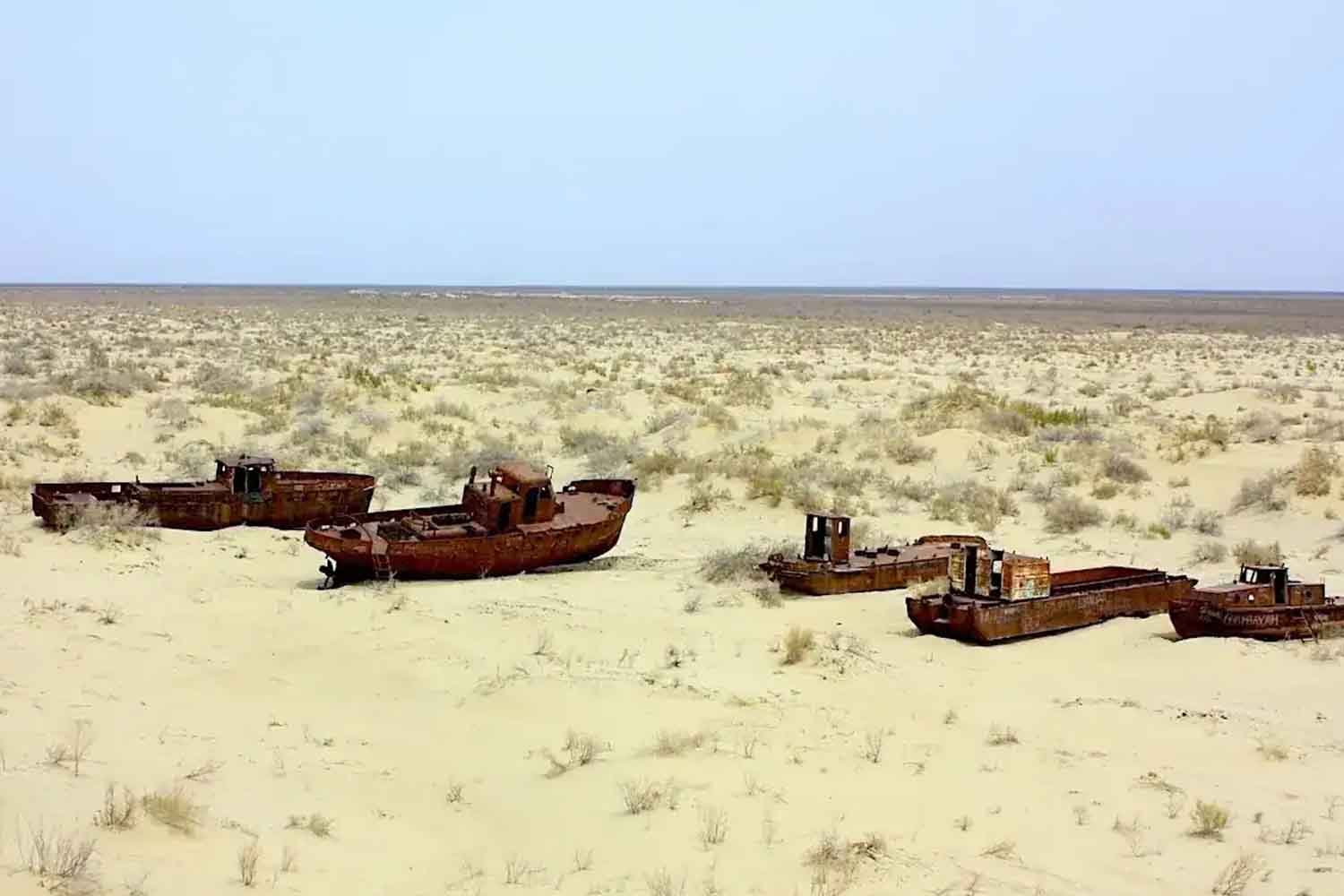
The Aral Sea has left rusty ships on the sand, salt-filled dust and a seabed almost as vast as Ireland. From 1960 to 2022, that dry expanse released approximately 748 million tons of CO₂ into the atmosphere. Carbon was missing from the account of one of the largest man-made environmental disasters. Now there’s that too.
The estimate comes from a study published in Science and coordinated by the Blanes Center for Advanced Studies of the Spanish Higher Scientific Research Council, the CEAB-CSIC. The work mainly concerns the immense dry seabed left by the basin. The tepid recovery observed in recent years remains good news, however concentrated in the Small Aral Sea, the northern section in Kazakh territory. Further south, water survives mostly on old maps.
The emptied lake began to return carbon
@NASA
When a lake is full, algae, plants and other organisms deposit organic matter at the bottom. Water slows decomposition and some carbon can remain trapped in sediments for centuries. Draining removes that cover: oxygen enters, microbial activity resumes and CO₂ returns to the atmosphere.
In the case of the Aral, the central estimate is 204 million tons of carbon released since 1960, with a margin of uncertainty of 53 million. Converted into carbon dioxide, they correspond to approximately 748 million tonnes. The vegetation grown on the new seabed made up for less than 1% of the losses. Too little to even pretend a draw.
The calculation comes from an expedition conducted in 2022. The group collected sediments in areas that remained without water in different periods: some exposed for a few years, others dry for decades. He then combined the samples with direct measurements of CO₂ exchanges, satellite images and drone surveys. The seabed thus offered a natural chronology of drying, useful for reconstructing over sixty years of losses.
However, the core samples reached a maximum depth of 50 centimetres. The lower layers still remain to be studied and the total could be higher if carbon degradation extends further down.
The effect is already large enough to rewrite the area’s carbon budget. By including emissions from the old seabed into land use calculations, the region goes from a presumed net absorber to a source of carbon. The lake had disappeared from the water maps. Its emissions had also disappeared from climate accounts.
The rebirth of the Aral mainly concerns the North
In the 1960s the Soviet Union diverted much of the waters of the Amu Darya and Syr Darya towards irrigated crops, especially cotton. The Aral Sea, then the fourth largest lake basin in the world, began to retreat, increased its salinity and ended up separating into multiple bodies of water.
In 2005, Kazakhstan completed the Kok-Aral Dam, retaining the waters of the Syr Darya in the northern section. The level of the Little Aral has risen, salinity has decreased and fishing has shown signs of recovery. It is a concrete rebirth, with very precise boundaries.
Satellite images tell a very different trajectory further south. The Great Aral broke into two lobes and its eastern section disappeared completely in 2014, except to partially fill during some more favorable years.
The same name now brings together different realities. The recovered surface in the Little Aral coexists with a huge salt plain between Kazakhstan and Uzbekistan. Talking about the lake as a single body of water now serves above all for grammar.
The exposed seabed continues to generate dust transported by the wind onto agricultural land and towards residential areas. The disappearance of water has affected fishing, altered the local climate and left substances accumulated during decades of intensive agriculture exposed. The study adds a less visible consequence: the loss of carbon stored in sediments.
Another 605 million tonnes of CO₂ remain in the seabed
The carbon already released is enormous. The one still buried offers a margin for intervention. According to the authors, bringing water back to a substantial part of the old seabed could avoid the emission of another 605 million tons of CO₂, an amount comparable to almost three years of Spain’s current anthropogenic greenhouse gas emissions.
Covering the sediments again would reduce contact with oxygen and slow the degradation of organic matter. The authors also tried to estimate the economic value of this carbon: using 2024 prices in voluntary markets as a reference, avoidable emissions could correspond to credits of between $3.6 and $18 billion.
The range depends on prices, certification rules, storage duration and the ability to demonstrate that emissions would have occurred without the project. Carbon credits represent a possible source of financing. The water really has to arrive anyway.
The study incorporates scenarios developed by researchers in Central Asia. Less dispersive channels, more efficient irrigation systems and coordinated management between the countries crossed by the rivers could increase the flow to the lake. An investment estimated at around 9.7 billion dollars would allow, according to one of the scenarios, to recover approximately half of the surface occupied by the Aral in 1960 and generate credits estimated at 323 million tonnes of CO₂ equivalent. They are projections linked to water works, financing and political agreements yet to be built.
The problem also affects other retreating basins, from the Great Salt Lake in the United States to Lake Urmia in Iran, up to Lake Chad and the Caspian Sea. When the water disappears, the seabed enters the carbon cycle with a different role than it has had for centuries. A passage that has remained on the margins of many climate inventories. The water diverted to irrigate the desert ended up creating a new one. We now know that that desert also emits CO₂. The 605 million tons remaining in the sediments depend on how much water we manage to return to the Aral Sea, and how much we continue to take.
